


.webp)


In the fast-paced development of optical communication, Passive Optical Networks (PONs) stand as the backbone of high-speed data transmission, linking homes, businesses, and data centers with exceptional efficiency. At the core of these networks is the PLC Splitter, short for Planar Lightwave Circuit Splitter. This device plays a vital role in precisely dividing optical signals, enabling smooth signal distribution to multiple endpoints.
What Is a PLC Splitter and How Does It Work?
A PLC Splitter is a passive optical component built to split a single input optical signal into multiple output signals (or combine multiple inputs into one output) while keeping a specific power distribution ratio. Unlike active components that need external power, PLC Splitters operate passively, using advanced planar lightwave circuit technology to control light signals.
The main part of a PLC Splitter is a microfabricated chip made from silica-based materials. This chip has a network of waveguides—tiny channels that guide light signals with very little loss. When an optical signal enters the input waveguide, it is evenly spread across the chip’s waveguide network, which then sends the signal to multiple output waveguides. The precision of this microfabricated structure guarantees that the signal is split uniformly, with consistent power levels across all outputs. This uniformity is a major advantage over traditional splitting technologies, as it gets rid of signal imbalances that can harm network performance.
Another key feature of PLC Splitters is their ability to handle a wide range of wavelengths. This makes them compatible with different PON standards like EPON (Ethernet Passive Optical Network) and GPON (Gigabit Passive Optical Network). This versatility lets network operators use PLC Splitters in various environments, from residential fiber-to-the-home (FTTH) networks to enterprise data centers.

Key Types of PLC Splitters
PLC Splitters come in different configurations, each made to meet specific network needs. They are mainly classified based on port count, packaging type, and polarization-maintaining capabilities—all of which affect how the splitter fits into a network and performs under different conditions.
Port Count Configurations: 1xN and 2xN
The port count of a PLC Splitter refers to the number of input and output ports, and it is a crucial factor when choosing the right device. The two main configurations are:
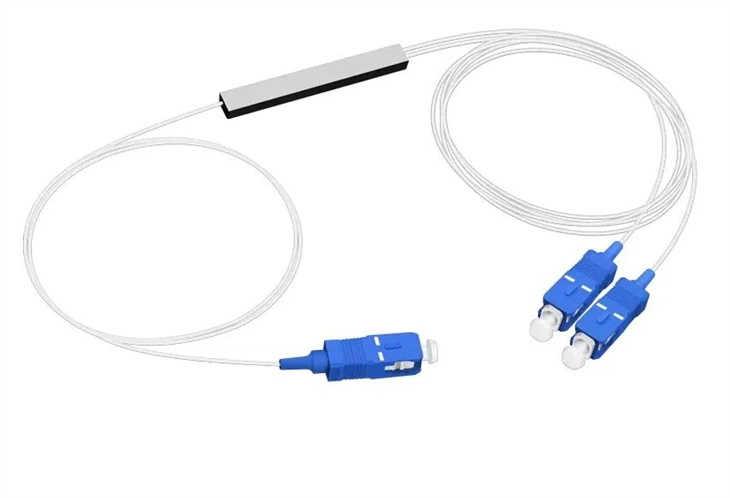
1xN Splitters: These have 1 input port and N output ports (where N usually ranges from 2 to 64). They are perfect for point-to-multipoint networks, such as residential FTTH setups. For example, a 1x32 PLC Splitter can send a signal from one optical line terminal (OLT) to 32 optical network units (ONUs) in homes, reducing the need for extra fiber cables and cutting deployment costs.

2xN Splitters: With 2 input ports and N output ports, these splitters are designed for networks that need redundancy or dual-signal distribution. They are commonly used in enterprise or industrial settings where network downtime is not allowed. A 2x32 PLC Splitter, for instance, can take signals from two different OL Ts and send them to 32 ONUs. If one input signal fails, the other can take over seamlessly, minimizing service interruptions.
Packaging Types
The packaging of a PLC Splitter protects the internal chip and waveguides and makes installation and integration easier. The three most common packaging options are:
ABS Box Packaging: Splitters in ABS (Acrylonitrile Butadiene Styrene) boxes offer strong protection against physical damage, dust, and moisture. These boxes are lightweight but durable, making them suitable for both indoor and outdoor use, like in utility closets or outdoor fiber cabinets. A 1x4 PLC Splitter with an ABS box is a common choice for small residential networks, balancing protection and compactness.
Blockless Packaging: Blockless PLC Splitters don’t have an outer box, instead having a slim, compact design that saves space. They are ideal for high-density environments like data center racks, where space is limited. A 1x16 Blockless PLC Splitter can be easily mounted with other components in a rack, making the most of available space without affecting performance.

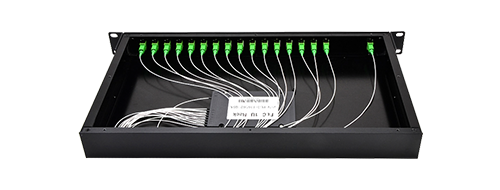
1U 19” Rack-Mount Packaging: For large-scale networks that need centralized management, rack-mount PLC Splitters are the top choice. These are housed in 1U (1.75 inches) tall enclosures that fit standard 19-inch server racks. A 1x64 PLC Splitter with a 1U 19” rack-mount box is widely used in data centers, where it can efficiently send signals to hundreds of endpoints.
Polarization-Maintaining (PM) PLC Splitters
In applications where signal polarization stability is important—such as coherent optical communication, fiber optic sensing, or high-speed data transmission—PM PLC Splitters are necessary. These splitters keep the polarization state of the input signal, ensuring output signals have the same polarization as the input. They use specialized waveguides to reduce polarization mode dispersion (PMD), which can distort signals in high-speed networks. PM PLC Splitters are often used in advanced PON systems, research labs, and industrial sensing applications where signal integrity is a must.
Applications of PLC Splitters
Residential Fiber-to-the-Home (FTTH) Networks
FTTH networks are changing residential internet access, providing gigabit speeds to homes and apartments. PLC Splitters are essential here, letting a single OLT at the service provider’s central office connect to many ONUs in residential buildings. A 1x32 PLC Splitter, for example, can serve an entire apartment complex, splitting the OLT’s signal into 32 separate lines—one for each unit. This reduces the need for expensive fiber runs from the central office to each home, lowering deployment costs while ensuring fast, reliable internet for residents.

Enterprise and Data Center Networks
In enterprise settings, PLC Splitters connect multiple employees, servers, and devices to a single optical network. A 2x32 PLC Splitter can provide redundant connectivity to a large office. If one input signal fails, the other takes over, preventing downtime that could disrupt business operations. In data centers, blockless PLC Splitters like 1x16 or 1x32 models are used in high-density racks to distribute signals between servers, storage systems, and network switches. Their compact design saves valuable rack space, and their uniform signal distribution ensures fast, error-free data transmission.
Telecommunication and 5G Infrastructure
As 5G networks roll out globally, the need for high-capacity backhaul and fronthaul links grows rapidly. PLC Splitters play a key role in 5G infrastructure, connecting base stations to core networks and sending signals to multiple antennas. A 1x64 PLC Splitter, for instance, can be used in a 5G fronthaul network to split a signal from a baseband unit (BBU) to 64 remote radio units (RRUs), covering a large area with minimal fiber usage. This scalability helps telecom operators expand their 5G networks quickly and affordably.
Industrial and Sensing Applications
In industrial settings, PLC Splitters are used in fiber optic sensing systems to monitor temperature, pressure, and vibration in critical equipment like pipelines, turbines, and power grids. PM PLC Splitters are particularly useful here, as they keep the polarization state of the sensing signal, ensuring accurate, reliable measurements even in harsh industrial environments. A PM PLC Splitter can be part of a pipeline monitoring system, splitting a sensing signal into multiple channels to monitor different sections of the pipeline. This real-time monitoring helps prevent equipment failure and ensures industrial safety.
Choosing the Right PLC Splitter
Selecting the right PLC Splitter for a network requires considering several factors, including network size, environmental conditions, and future scalability. Here are the key points to keep in mind:
Port Count
The port count should match the number of endpoints in the network. For small residential networks, like an apartment building with 8 units, a 1x8 PLC Splitter is enough. For larger networks, such as a data center with 64 servers, a 1x64 or 2x32 splitter may be needed. It’s also important to plan for future growth—choosing a splitter with more ports than currently required can avoid costly upgrades later.
Packaging Type
The packaging type should be based on the deployment environment. For outdoor or harsh indoor environments, like utility closets with high humidity, an ABS box splitter offers the best protection. For high-density settings like data center racks, a blockless or rack-mount splitter is ideal. Rack-mount splitters are also preferred for centralized management, as they are easy to access and maintain in one location.
Polarization Requirements
If the network needs stable polarization, like in coherent optical communication or fiber sensing, a PM PLC Splitter is essential. For standard PON applications like FTTH, a non-PM splitter is sufficient and more cost-effective.
Vendor Reliability
Finally, it’s important to choose a reputable vendor that offers high-quality PLC Splitters. Vendors like Fibermart provide a wide range of PLC Splitters—from 1x2 blockless models to 1x64 rack-mount units—with strict quality control to ensure performance and durability. Working with a trusted vendor also gives access to technical support and warranty coverage, which are important for minimizing network downtime.
Conclusion
In the dynamic landscape of optical communication, where the demand for high-bandwidth, low-latency connectivity continues to surge—driven by trends like 5G expansion, smart city development, and the exponential growth of data centers—PLC Splitters have solidified their position as an irreplaceable foundational component. Their unique combination of passive operation, uniform signal distribution, and adaptability across diverse environments addresses the core challenges of modern network design: scalability, reliability, and cost-efficiency.
Unlike traditional splitting technologies that struggle to keep pace with evolving network needs, PLC Splitters not only meet today’s requirements for dense signal distribution in FTTH, enterprise, and industrial settings but also provide a forward-compatible solution for future innovations.


 network.jpg "Fiber Optic Technology: The Light Bridge Connecting the Future")





No comments have been posted yet.