


.webp)


In the relentless pursuit of higher speeds, greater distances, and unprecedented precision within optical communication and sensing systems, a fundamental challenge emerged: conventional amplifiers failed to preserve the critical polarization state of light signals. This limitation became a significant barrier as applications reliant on polarization information—from next-generation coherent communications to advanced LiDAR and quantum experiments—demanded amplification without compromise. Enter the Polarization-Maintaining Erbium-Doped Fiber Amplifier (PM-EDFA). This specialized technology doesn't merely amplify light; it meticulously maintains the polarization integrity of the signal throughout the process. By combining high gain, impressive output power, and exceptionally low noise with the unique ability to preserve polarization states (exceeding 20 dB PER), PM-EDFAs have become the indispensable engine powering breakthroughs. They enable transoceanic cables to carry coherent signals across thousands of kilometers, allow satellites to receive faint interstellar communications, empower distributed sensors to monitor submarine cable stress with unparalleled accuracy, and provide the stable, polarized light essential for cutting-edge research and atmospheric monitoring. As the backbone of modern high-performance optical systems, the PM-EDFA is not just an amplifier; it's the key enabler unlocking the full potential of polarization-sensitive technologies across the globe.
Throughout the evolution of fiber optic communication and sensing systems, the Erbium-Doped Fiber Amplifier (EDFA) revolutionized optical signal transmission. However, as we entered the era of coherent communications and polarization-sensitive applications, conventional EDFAs revealed their limitation: the inability to maintain the polarization state of optical signals. Consequently, the Polarization-Maintaining EDFA (PM-EDFA) emerged as a core technology in high-speed communications, precision sensing, and advanced laser systems. This specialized optical amplifier not only amplifies optical signals but also maintains the consistency of their polarization state, solving critical challenges in numerous high-tech applications. From transoceanic submarine cables to meteorological satellites, and from LiDAR systems to quantum communication experiments, PM-EDFAs are pushing the boundaries of global optical communication and sensing technologies.
Working Principle and Features of Polarization Maintaining Fiber Amplifier
The core value of a PM-EDFA lies in its ability to amplify optical signals while preserving their polarization state unchanged. This characteristic is crucial for many polarization-sensitive applications.
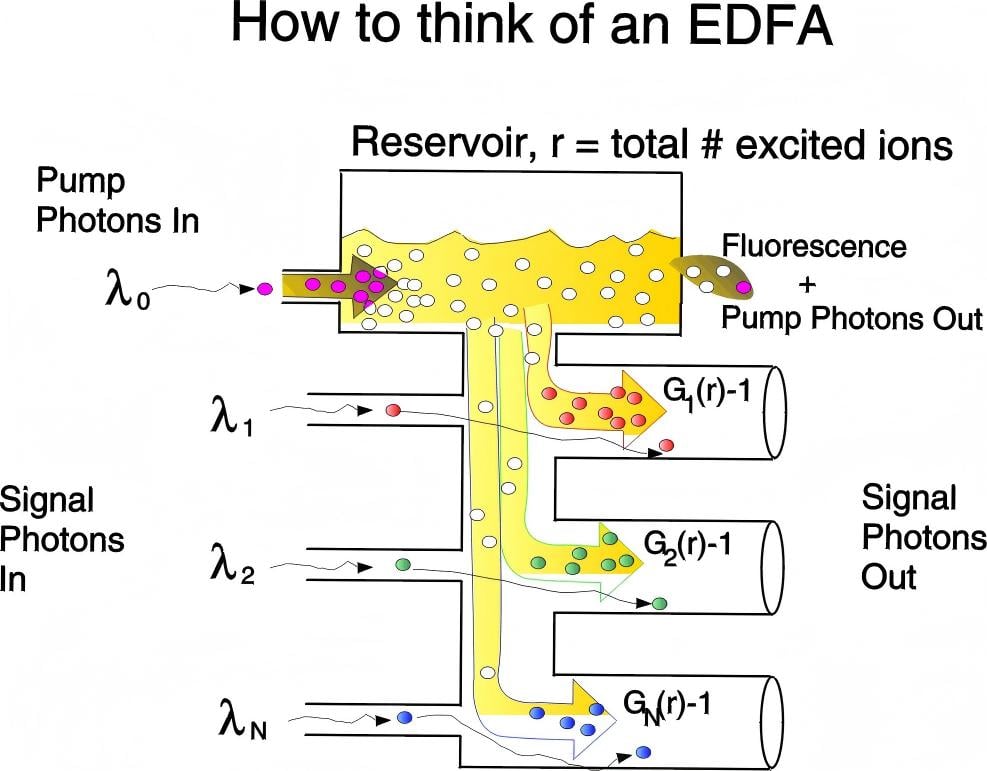
Polarization Maintaining Optical Path Structure
PM-EDFAs employ an all polarization-maintaining optical path design. This includes input/output PM fiber couplers, PM optical isolators, PM wavelength division multiplexers (WDM), and PM erbium-doped fiber. All optical components are optimized for polarization preservation, ensuring polarization state consistency during signal transmission and amplification. Crucially, these components are connected using specialized polarization-maintaining splicing techniques that guarantee precise slow-axis alignment. This design ensures only signals aligned with the slow axis are effectively amplified, while light on the fast axis is blocked or attenuated.
Key Performance Parameters
For example, this 37dBm polarization-maintaining amplifier from Fiber-MART exhibits impressive performance indicators:
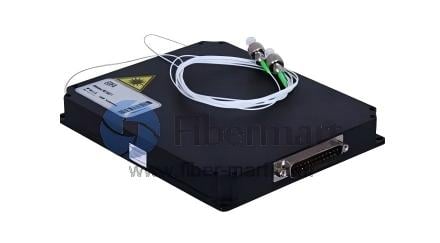

Operating Band: Primarily covers the C-band (1529-1565 nm) and L-band (1570-1625 nm), meeting diverse communication system requirements.
Gain Capability: Gains up to 37dB, enabling amplification of weak signals to usable power levels.
Output Power: Maximum output power reaching 37dBm (~2W), with high-power models achieving up to 40dBm (10W).
Polarization Extinction Ratio (PER): Typically better than 20dB, with high-end models exceeding 23dB, ensuring output light has highly pure linear polarization.
Noise Control: Minimum noise figure as low as 4.5dB, particularly critical when amplifying weak signals.
Innovative Low-Noise Design
Recent technological advancements have led to more sophisticated low-noise architectures. Dual-stage amplification design divides the system into two stages: the first stage offers lower gain (20-25dB) but incorporates specialized tilted fiber Bragg gratings to filter out Amplified Spontaneous Emission (ASE) noise early in the amplification process; the second stage provides higher gain (30-40dB), boosting the pre-amplified signal to the target power level. This design is especially adept at handling scenarios with extremely low input power (e.g., below -65dBm), effectively solving noise issues caused by weak signals in long-haul transmissions like satellite communications.
Applications of PM Fiber EDFA in Communication and Sensing
The unique capabilities of PM-EDFAs make them indispensable key components in several high-tech fields.
1. Long-Haul Coherent Optical Communication Systems
In modern fiber optic communications, PM-EDFAs play a critical role in signal enhancement. They compensate for signal attenuation over long distances while maintaining the signal's polarization state, which is essential for coherent communication systems. In transoceanic submarine cables, the deployment of PM-EDFAs allows signals to travel thousands of kilometers without losing polarization information. In satellite optical communication systems, faced with the challenge of extremely low received signal strength (typically below -65dBm), next-generation low-noise PM-EDFAs effectively suppress ASE noise accumulation and improve system signal-to-noise ratio (SNR) and transmission quality through their innovative dual-stage structure.
2. Fiber Optic Sensing and Monitoring Systems
PM-EDFAs hold unique value in distributed fiber optic sensing systems. B-OTDR (Brillouin Optical Time-Domain Reflectometer) systems utilize the high-power, polarization-preserved light amplified by PM-EDFAs to continuously monitor stress and strain states along the entire length of submarine cables. This technology overcomes the limitations of conventional OTDR, providing crucial fiber stress data throughout the cable lifecycle – manufacturing, handling, installation, deployment, operation, and maintenance. It helps engineers improve manufacturing processes, optimize installation plans, detect potential failure points early, and significantly enhance the reliability of submarine cable systems.
3. LiDAR and Meteorological Monitoring
In LiDAR (Light Detection and Ranging) systems, PM-EDFAs provide high peak power amplification while preserving polarization, making them ideal light sources for atmospheric sensing. Pulsed PM-EDFAs can generate laser pulses with peak power exceeding 100W, pulse widths ranging from 200-400ns, and repetition rates up to 20kHz. These characteristics allow them to meet the stringent demands of 2D/3D wind profilers, weather monitoring, and atmospheric pollution monitoring. By analyzing the polarization state of light scattered back by atmospheric particles, researchers can obtain precise atmospheric parameters and pollutant distribution information.
4. Laser Coherent Beam Combining and Research Applications
In laser coherent combining, multiple laser beams require consistent polarization states to achieve effective interference and beam combination. PM-EDFAs ensure that the output laser from each amplification channel has the same polarization state, providing the technical foundation for high-power, high-beam-quality laser synthesis. In research, PM-EDFAs supply the necessary polarization-stabilized light sources for quantum optics experiments, interferometry, and high-resolution spectroscopy, meeting the strict polarization purity requirements of scientific investigations.
Core Value and Technical Advantages of PM Fiber EDFA
The ability of PM-EDFAs to replace conventional EDFAs in numerous high-end applications stems from their solutions to several key technical challenges:
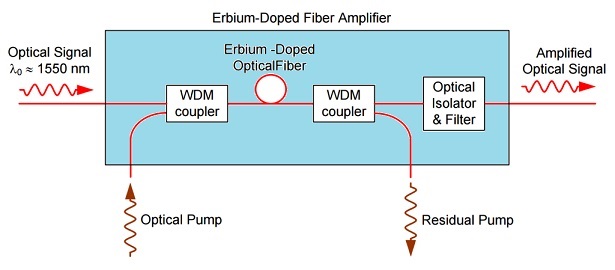
Guaranteeing Polarization Consistency
Conventional EDFAs can disrupt or alter the polarization state during amplification, which is unacceptable for applications requiring polarization information. PM-EDFAs, through all-PM optical path design and precise axis alignment techniques, ensure the output signal's polarization state matches the input, typically with an extinction ratio better than 20dB. This feature is particularly vital for coherent optical communications, as these systems utilize the polarization dimension of light to carry information. PM-EDFAs enable systems to accurately decode polarization-encoded information even after long-distance transmission.
The Art of Balancing High Power and Low Noise
Modern applications demand both high output power and extremely low noise figures – a contradictory requirement for traditional amplifiers. PM-EDFAs successfully balance these demands through innovative multi-stage amplification architectures. Dual- or triple-stage designs coupled with narrowband ASE filters can deliver output power up to 33dBm (2W) while achieving noise figures as low as 3.6dB. This high-power, low-noise characteristic enables systems to probe longer distances and transmit more data.
Flexibility for Diverse Applications
Polarization-maintaining EDFA provides multiple operating modes to suit different application requirements, such as 30dBm high-power polarization-maintaining optical amplifier:
Continuous Wave (CW) Mode: For amplifying continuous optical signals.
Pulsed Mode: Generates high peak power pulsed light, suitable for LiDAR and sensing systems.
Automatic Gain Control (AGC) Mode: Maintains constant gain, unaffected by input power fluctuations.
Automatic Power Control (APC) Mode: Maintains stable output power levels.
This flexibility allows the same technological platform to serve a broad spectrum from high-speed communications to precision sensing, significantly expanding its application scope.
FAQ Frequently Asked Questions
Q: What is the requirement for the input and output power for AGC or APC mode?
A: Basically the input range from -10~+10dBm, the output power can reach 37dBm. Fibermart can customize the input or output power according to your requirement.
Q: What kind of EDFA mostly used in the signal amplifying or optical transmission application?
A: We have Pre-Amplifier, In-line Amplifier and Booster-Amplifier.
Q: What is the maximum optical power that can be amplified by the high power polarization maintaining EDFA?
A: The high power polarization maintaining EDFA can amplify optical signal up to 5 Watt optical power(37dBm).
Q: What are the applications of the high power PM Fiber EDFAs?
A: The applications of the high power polarization maintaining EDFAs include fiber optic sensing, free space optical sensing, and experiments in nonlinear fiber optic.
Q: What is the noise figure of the high power polarization maintaining EDFA?
A: The noise figure of the high power polarization maintaining EDFA is under 4.5dB.
Q: What is the warranty and ISO certification that Fibermart PM fiber amplifiers have?
A: The Fibermart EDFA amplifier provides 12 month free warranty for any quality problem. And our EDFA is manufactured under a ISO 9001 certified quality management system. The ISO 9001:2015 certification applies to Fibermart Hong Kong production factory only.
Conclusion
PM EDFAs play a pivotal role in high-speed coherent optical communication systems, ensuring the integrity of signal polarization states after long-distance transmission. In the realm of distributed fiber optic sensing, they provide high-power, polarization-maintaining light sources, enabling stress and strain monitoring with unprecedented precision. For LiDAR and meteorological detection, they deliver high peak-power pulsed output, helping scientists decipher the secrets of the atmosphere.
With the accelerated deployment of 5G/6G networks, the expansion of the Internet of Things (IoT), and global digitalization, the demand for high-speed, high-capacity, long-distance optical communication will continue to surge. As a key component underpinning these technologies, the importance of the PM-EDFA will only grow.
Fiber mart's team will provide you with professional solutions






No comments have been posted yet.