


.webp)


In the intricate world of fiber optic communication, optical attenuators play a pivotal role in maintaining the balance and integrity of signal transmissions. At Fibermart, we understand how essential these tiny devices are in ensuring that the data we send and receive through vast networks arrives clearly and accurately. But what exactly are optical attenuators, and why are they so crucial in fiber optic systems? That's what we're here to explain! This blog post is designed to demystify these crucial components, showing you how they work, the different types available, and why they're so important for your fiber optic network.
The Role of Optical Attenuators in Fiber Optic Communication Systems

Ⅰ. What is an Optical Attenuator?
An optical attenuator is a device designed to reduce the power level of an optical signal. In simpler terms, it dims the light traveling through the fiber optic cable. This might seem counterintuitive—after all, why would you want to weaken the signal? The answer lies in the need to maintain optimal signal strength. Too strong a signal can overwhelm receivers, causing distortion and data loss. By carefully controlling the signal strength, optical attenuator ensure that the system operates within its ideal parameters.
Optical attenuators are used primarily in fiber optic communication systems to manage the power level of signals. This management is crucial because it prevents the overloading of optical receivers, which can lead to errors and degradation in communication quality. Attenuators can be used in various scenarios, such as testing and measuring equipment, balancing signal power in multi-channel systems, and adjusting power levels in long-distance fiber optic links.
Ⅱ. Basic Working Principle of Optical Attenuators
Optical attenuators work by introducing a controlled loss into the fiber optic link. They achieve this through various mechanisms:
1.Absorption:
The attenuator material absorbs some of the optical power, converting it into heat. This process involves materials that have specific absorption characteristics suited to the wavelength of the light passing through the fiber.
2.Reflection:
Part of the light is reflected back towards the source, reducing the amount of light that continues through the fiber. This method typically involves introducing a slight mismatch in the optical medium.
3.Scattering:
The light is scattered in different directions, which effectively reduces the power of the transmitted signal. This can be achieved through various techniques, such as using a roughened surface or introducing microscopic particles into the optical path.
These processes can be finely tuned to provide a specific level of attenuation, allowing precise control over the signal strength. Different types of attenuators utilize these mechanisms in various combinations to achieve the desired level of attenuation.
Ⅲ. Types of Optical Attenuators
Optical attenuators come in various forms, each suited to different applications and requirements. Here’s an overview of the most common types:
1.Fixed Attenuators
Fixed attenuators provide a set level of attenuation that cannot be adjusted. They are typically used in situations where the signal power needs to be permanently reduced by a known amount. These are straightforward and reliable for applications with consistent requirements.

Applications:
Network Design: Used during the initial setup of fiber optic networks to set the appropriate power levels.
Permanent Installations: Ideal for environments where the power levels do not need to be adjusted frequently.
Benefits and Limitations:
Benefits: Simple to use, reliable, and no need for adjustments once installed.
Limitations: Lack of flexibility in environments where power levels might need to change.
2.Variable Attenuators
Variable attenuators allow the attenuation level to be adjusted. This flexibility makes them ideal for testing and maintenance tasks, where signal levels may need to be changed frequently. They can be manually adjusted or electronically controlled, providing versatility in various scenarios.

Applications:
Testing and Measurement: Essential for lab environments where different attenuation levels are needed.
Dynamic Networks: Useful in environments where signal conditions may change and require adjustment.
Benefits and Limitations:
Benefits: High flexibility, can be adjusted to suit changing needs, suitable for various testing scenarios.
Limitations: More complex than fixed attenuators, potentially higher cost and maintenance.
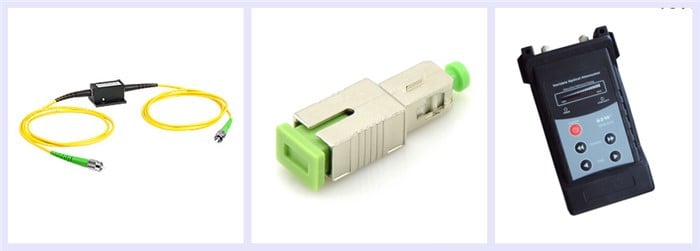
3.Step Attenuators
Step attenuators offer discrete levels of attenuation, which can be changed in fixed steps. This design combines elements of both fixed and variable attenuators, allowing for easy adjustments without the need for continuous tuning.
Applications:
Incremental Testing: Useful in scenarios where specific attenuation steps are required.
Maintenance: Convenient for technicians to set and reset attenuation levels without continuous adjustments.
Benefits and Limitations:
Benefits: Simple adjustment between predefined steps, reliable performance.
Limitations: Limited to the predefined steps, less flexibility compared to continuously variable attenuators.
4.In-Line Attenuators
In-line attenuators are integrated directly into the fiber optic link. They are designed to be inserted into the fiber path and provide a fixed level of attenuation. These are useful for long-term installations where space and simplicity are critical.
Applications:
Long-Distance Links: Used in long-haul fiber optic cables to maintain appropriate signal levels.
Space-Constrained Installations: Ideal for setups where adding additional equipment is impractical.
Benefits and Limitations:
Benefits: Space-efficient, simple installation, reliable fixed attenuation.
Limitations: Lack of adjustability, once installed, the attenuation level cannot be changed without replacing the attenuator.

5.Build-Out Attenuators
Build-out attenuators, also known as bulkhead attenuators, are used at the connection points of fiber optic cables. They are ideal for applications where attenuation is needed at the interface, providing a straightforward solution for managing signal strength at critical junctures.
Applications:
Interface Management: Used where fiber optic cables connect to other devices or networks.
Signal Conditioning: Helps to balance signal strength at the connection points to prevent overloading.
Benefits and Limitations:
Benefits: Easy to install at connection points, useful for managing interface signal levels.
Limitations: Limited to specific points in the network, not suitable for in-line attenuation.
Ⅳ. The Importance of Optical Attenuators in Fiber Optic Communication
1.Signal Optimization
In any fiber optic communication system, maintaining the right signal strength is essential. Optical attenuators play a crucial role in ensuring that signals are neither too weak nor too strong. If a signal is too weak, it can lead to data loss and communication errors. Conversely, if a signal is too strong, it can cause distortion and overload the receiver. By optimizing the signal strength, optical attenuators help to ensure reliable and efficient communication.
2.Protection of Optical Components
Fiber optic components, especially receivers, are sensitive to the power levels of incoming signals. Excessive signal strength can damage these components, leading to costly repairs and downtime. Optical attenuators protect these sensitive components by controlling the power level, thus enhancing the longevity and reliability of the entire communication system.
3.Network Flexibility
Modern fiber optic networks are highly dynamic, with constantly changing requirements. Optical attenuators provide the flexibility needed to adapt to these changes. Whether it's adjusting the signal strength during network upgrades, managing different signal levels in complex installations, or testing new configurations, attenuators are essential tools that enable the network to meet diverse and evolving demands.
Ⅴ. Conclusion
Optical Attenuators are indispensable components in the realm of fiber optic communication. They ensure that signals are transmitted at the optimal power level, protecting sensitive components and maintaining the integrity of the communication system. With various types of attenuators available, each suited to different needs, these devices offer the flexibility and reliability required in modern network infrastructures.

As Fibermart continue to rely on fast and efficient communication networks, the role of optical attenuators will only become more significant. Choosing high-quality attenuators from reputable Optical Attenuator Manufacturers is crucial to maintaining system performance. One excellent option to consider is the 0-30dB 1064nm Multimode Min MEMS Variable Optical Attenuator. This high-quality attenuator provides precise control over your signal strength, ensuring optimal performance and protection for your fiber optic systems.
Ready to enhance your network with top-tier optical components? Visit our Fibermart website to learn more about our products and how we can help you achieve superior communication efficiency. Explore Fiber-Mart's wide range of fiber optic solutions, and let us support you in maintaining a robust, adaptable, and high-performing network.





No comments have been posted yet.