


.webp)


Planar Lightwave Circuit PLC splitters are fundamental passive optical components that evenly distribute optical power across multiple output ports, supporting full-spectrum operation from 1260 nm to 1650 nm. As core equipment in Fiber-to-the-Home (FTTH), 5G fronthaul, and passive optical network (PON) systems, their installation location directly determines network topology, transmission performance, construction cost, and operational reliability.
In optical distribution network (ODN) design, two mainstream deployment schemes are widely adopted: centralized splitter architecture and distributed splitter architecture. These two models differ significantly in splitter placement, splitting ratio configuration, cable routing, and application scenarios.
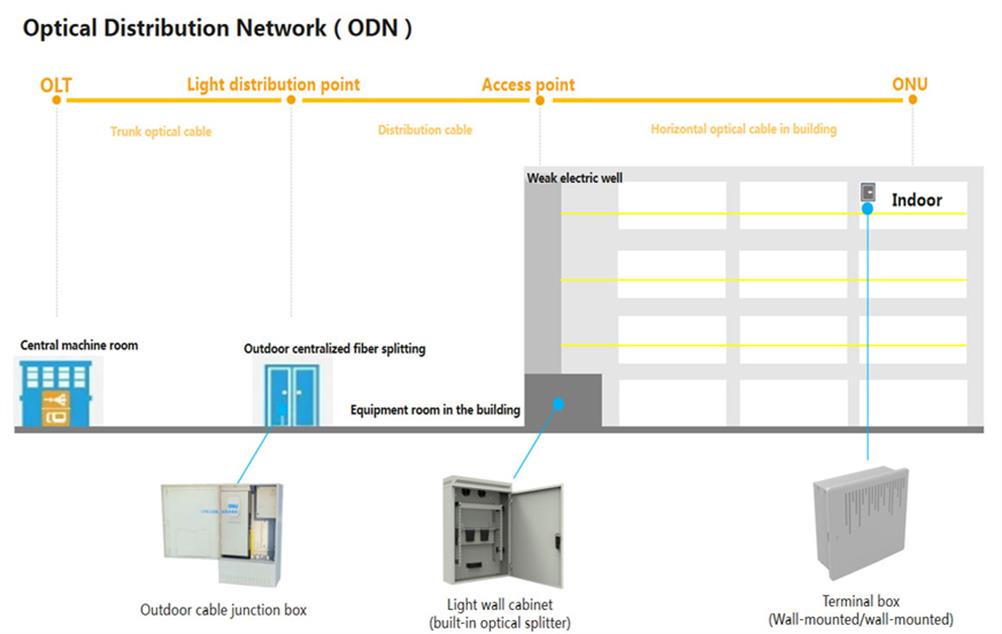
Core Concepts and Structural Principles
Definition of Centralized PLC Splitter Architecture
Centralized architecture concentrates all splitting functions at a single physical node, typically deployed in central offices, optical line terminal (OLT) cabinets, or optical distribution frames (ODFs) near the central office. The entire splitting process is completed in one stage, such as 1×32 or 1×64, without cascading multiple splitters.
Definition of Distributed PLC Splitter Architecture
Distributed architecture disperses splitting across two or more stages, with primary splitters placed near the central office and secondary splitters deployed closer to end-users, such as in optical cross-connect cabinets, building distribution boxes, or wall-mounted terminals. Splitting ratios are allocated hierarchically, for example, 1×4 at the first stage and 1×8 at the second stage to achieve equivalent 1×32 splitting.
Basic Structural Differences
The key structural differences between the two architectures lie in splitting stages, splitter location, cable type, and management mode. Centralized architecture adopts single-stage splitting, with all splitters located in central offices or near-central cabinets, and uses main optical cables paired with home-run drop cables for a unified, centralized management mode. In contrast, distributed architecture relies on multi-stage cascading splitting, with splitters placed both in the central office and remote distribution points, and uses a combination of main cables, branch cables, and drop cables, requiring a hierarchical, distributed management approach.
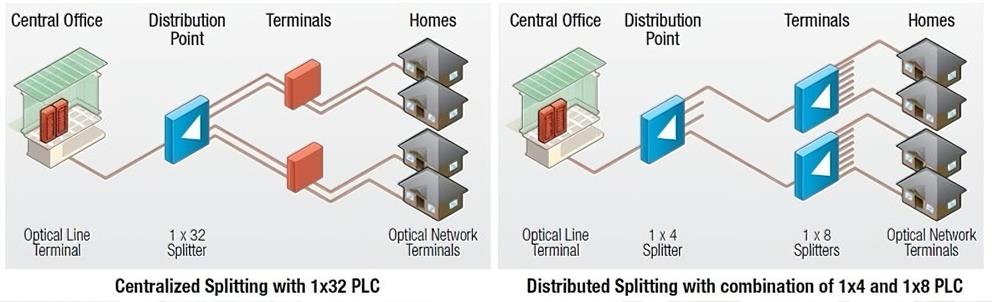
Centralized PLC Splitter Architecture: Features and Application Notes
Technical Characteristics
● Concentrated deployment: All splitters are installed in standard racks, trays, or boxes in equipment rooms, facilitating unified management and maintenance.
● Single-stage splitting: Adopts high-port-count splitters (1×16, 1×32, 1×64) to complete power distribution in one step, reducing insertion loss and simplifying link budgeting.
● Home-run cabling: Each user is connected via an independent drop cable from the central splitting point to the user terminal, with no shared branch cables.
Core Advantages
● Simplified ODN structure: Fewer connection points and splitting stages lower total insertion loss and improve link stability.
● Convenient operation and maintenance: Centralized placement simplifies fault location, replacement, and service provisioning, reducing on-site troubleshooting workload.
● High compatibility: Suitable for standardized, large-scale deployment with consistent equipment and configurations, lowering procurement and management costs.
● Reliable performance: Reduced optical loss and fewer failure points enhance overall network stability and signal quality.
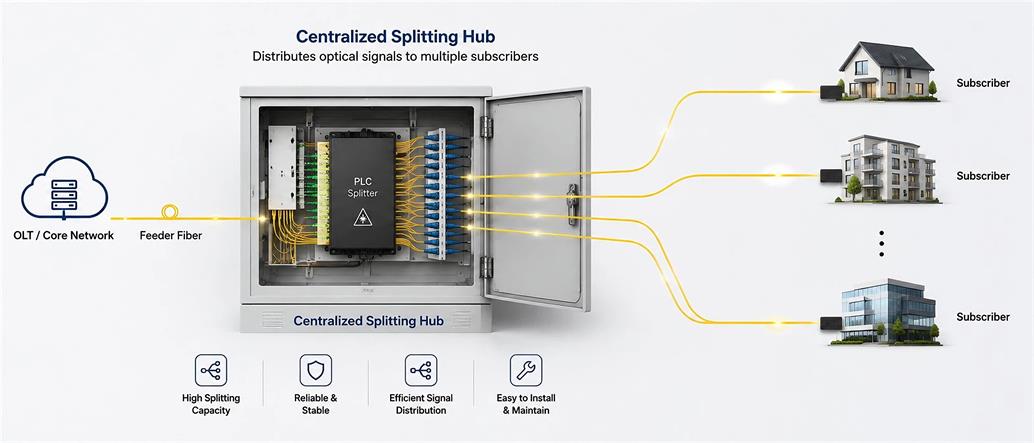
Limitations and Constraints
● High cable consumption: Home-run cabling requires extensive optical cables, increasing material costs in large-scale or geographically dispersed projects.
● Poor flexibility for sparse users: Less economical for low-user-density areas due to high upfront cable investment.
● Limited scalability: Expanding ports may require replacing entire high-split-ratio splitters rather than incremental upgrades.
Recommended Installation Scenarios
● Dense residential communities, high-rise buildings, and urban commercial zones with concentrated user distribution.
● Projects prioritizing low loss, high reliability, and simplified maintenance.
● Newly planned networks with standardized cabling and unified equipment room resources.
Distributed PLC Splitter Architecture: Features and Application Notes
Technical Characteristics
● Hierarchical splitting: Splits power across two or more stages, balancing central and remote deployment to optimize cable usage.
● Dispersed deployment: Secondary splitters are installed near users, shortening drop cable lengths and reducing total cable consumption.
● Flexible configuration: Supports mixed splitting ratios and modular deployment, adapting to irregular user distribution.
Core Advantages
● Cost-effective cabling: Reduces main cable usage by branching near users, lowering material and construction costs.
● Strong scalability: Supports incremental deployment by adding secondary splitters as users increase, matching investment with demand.
● Wide adaptability: Ideal for scattered users, suburban areas, and irregular layouts, avoiding over-investment in cabling.
● Flexible engineering: Accommodates existing pipeline resources and complex terrain, reducing construction difficulty.
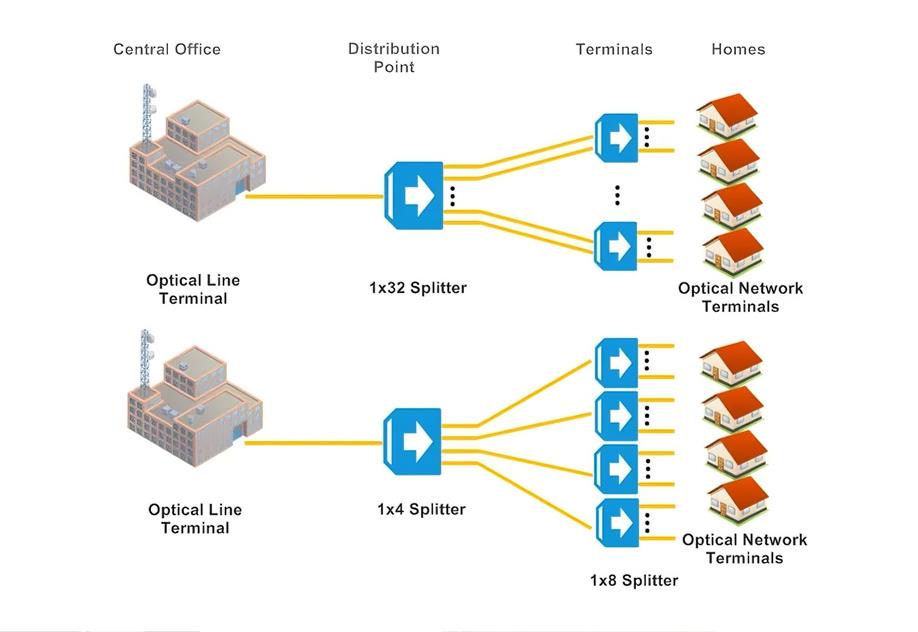
Limitations and Constraints
● Higher insertion loss: Multi-stage cascading increases total loss, requiring stricter link budget planning.
● Complex management: Dispersed splitters increase maintenance points and complicate fault location.
● Higher construction requirements: On-site installation of secondary splitters demands higher technical standards for splicing and protection.
Recommended Installation Scenarios
● Suburban areas, villages, and urban–fringe zones with scattered user distribution.
● Renovation projects using existing pipelines and ducts to minimize reconstruction.
● Phased deployment projects requiring gradual capacity expansion.

Comparative Analysis of Centralized and Distributed Architectures
Performance Comparison
● Insertion loss: Centralized architecture has lower loss due to single-stage splitting; distributed architecture has higher loss from cascading.
● Reliability: Centralized architecture has fewer fault points; distributed architecture has more connection points that may reduce stability.
● Signal quality: Centralized architecture provides more uniform power distribution; distributed architecture may have uneven power across stages.
Cost Comparison
● Equipment cost: Centralized uses fewer high-port splitters; distributed uses more low-port modules, with similar total equipment cost.
● Cabling cost: Centralized has higher cable expenses; distributed significantly reduces cable usage and construction costs.
● Maintenance cost: Centralized lowers long-term OPEX; distributed has higher maintenance costs due to dispersed nodes.
Flexibility and Scalability
Centralized architecture offers stable performance but limited expansion flexibility. Distributed architecture supports on-demand expansion and adapts to dynamic user growth.
Construction and Maintenance
Centralized deployment features simple construction, centralized management, and easy troubleshooting. Distributed deployment has more complex construction and higher on-site maintenance requirements.
Selection Principles and Deployment Recommendations
Basic Selection Principles
● User density: Choose centralized for dense areas; distributed for sparse areas.
● Cost structure: Prioritize cabling cost → distributed; prioritize maintenance → centralized.
● Performance requirements: High reliability/low loss → centralized; flexible expansion → distributed.
● Project stage: New unified networks → centralized; phased reconstruction → distributed.

Practical Engineering Guidelines
● Urban dense residential/commercial zones: Use centralized 1×32 or 1×64 splitters in ODF/rack cabinets for low loss and easy maintenance.
● Scattered suburban/rural areas: Adopt two-stage distributed splitting (e.g., 1×4 + 1×8) to reduce cable usage.
● High-standard projects: Prioritize centralized architecture to ensure stability and reduce failure risks.
● Pipeline-constrained sites: Use distributed architecture to leverage existing routes and minimize construction.
Summary
The choice between centralized and distributed PLC splitter installation depends on user distribution, cost targets, performance needs, and construction conditions. Centralized architecture delivers low loss, high reliability, and easy maintenance, ideal for dense, high-standard networks. Distributed architecture offers cost efficiency, flexibility, and scalability, suitable for scattered, phased deployments.In practical ODN design, engineers should conduct detailed surveys, link budget calculations, and cost analyses to select the optimal architecture.





No comments have been posted yet.