


.webp)


The exponential growth of artificial intelligence (AI) and machine learning workloads is driving a paradigm shift in data center infrastructure worldwide. As traditional copper-based interconnects struggle to keep up with the demands of massive GPU clusters, Co-Packaged Optics (CPO) has emerged as a transformative technology, offering unprecedented bandwidth, reduced latency, and significant power savings. Recent breakthroughs in CPO design, manufacturing, and commercialization are poised to redefine the future of high-performance computing and AI-driven data centers across the globe.
The Rise of CPO Technology
CPO represents an advanced packaging technology that integrates optical engines directly with switch or compute chips (ASICs) within the same package, eliminating the need for traditional pluggable optical modules. By reducing the distance between electrical and optical components, CPO minimizes signal loss, cuts power consumption by 30–50%, and enables higher data rates of 1.6 Tbps to 3.2 Tbps per port. This innovation is critical for AI clusters, where thousands of GPUs require low-latency, high-bandwidth communication, reducing latency by up to 60% due to shortened electrical pathways.
Recent Technological Breakthroughs
The field of silicon photonics lies at the heart of recent CPO advancements. Global industry leaders such as Broadcom, NVIDIA, and TSMC have made significant strides in integrating silicon-based optical engines with compute chips using 2.5D and 3D packaging techniques. For instance, Broadcom’s third-generation CPO platform achieves 200 Gbps per channel speeds using silicon photonics and 2.5D integration, doubling the previous generation’s performance while cutting power consumption by half. NVIDIA’s Quantum-X InfiniBand switch, leveraging TSMC’s COUPE technology, supports 144 ports at 800 Gbps each, delivering an aggregate bandwidth of 115 Tbps. This switch also incorporates liquid cooling to manage thermal loads exceeding 1 kW/cm².
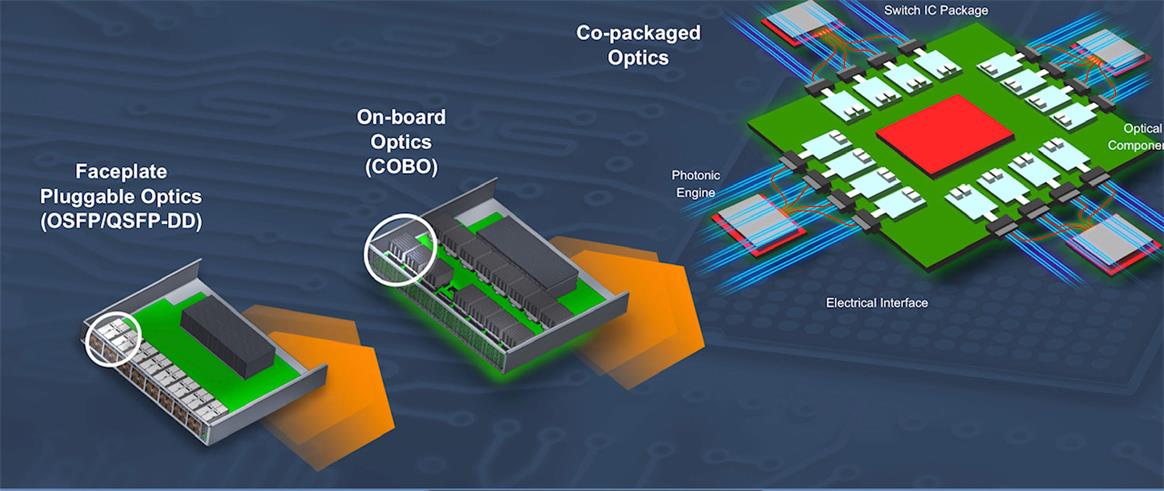
Innovations in laser sourcing and fiber connectivity are also driving progress. CPO systems rely on external laser sources to ensure stability and simplify maintenance. Polarization-Maintaining Fiber plays a critical role here, preserving signal integrity by maintaining laser polarization states over long distances. Companies like Sterlite Technologies Inc. (STI) have developed specialized fiber variants tailored for CPO, including bend-resistant fibers for dense, complex routing within switches.
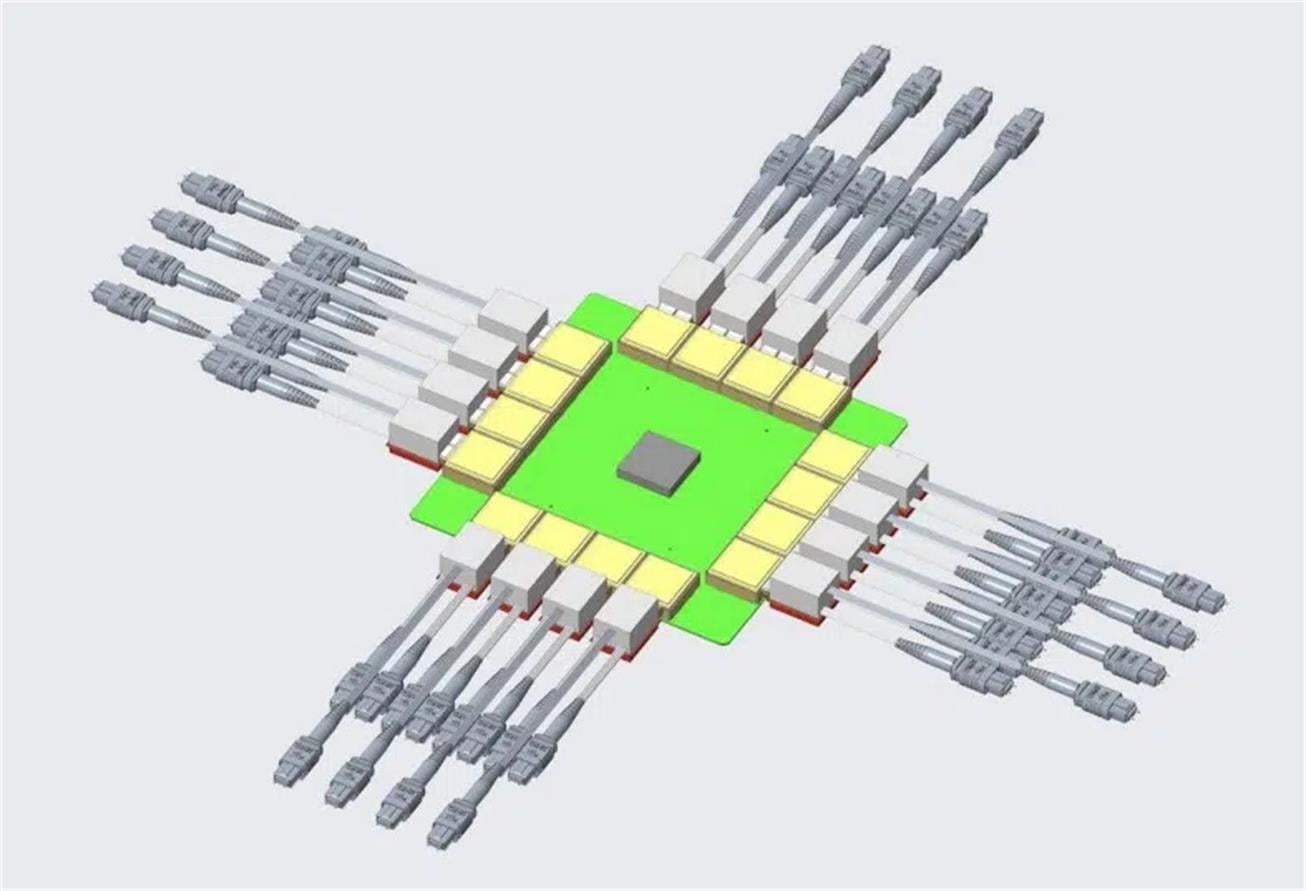
High-density fiber management solutions are essential for CPO switches to manage thousands of connections. Fiber shuffle boxes and MPO/MTP connectors are now being used to organize fiber arrays efficiently. For example, a single 51.2 T CPO switch may require over 1,152 fibers, managed using 72-fiber MPO connectors to reduce front-panel clutter. Flexible Optical Backplanes enable customizable fiber routing, increasing port density by 20 times compared to traditional patch panels.
Industry Adoption and Commercialization
The CPO market is transitioning from lab research to large-scale deployment, driven by tech giants and cloud providers. NVIDIA plans to launch its CPO-based Quantum-X InfiniBand and Spectrum-X Ethernet switches in 2026, targeting AI data centers. Broadcom has partnered with Delta Electronics and Foxconn to develop compact, liquid-cooled CPO switches, reducing system-level power consumption by 40%. Other key players like MACOM are advancing CPO optical engines for 1.6T/3.2T applications, with commercial samples expected by 2026.
Market Outlook and Projections
According to industry analyses, CPO shipments are projected to grow exponentially, with 3.2T ports exceeding 10 million units by 2029. This growth is fueled by AI expansion as hyperscale data centers require CPO to support million-GPU clusters. Energy efficiency mandates are also driving adoption, as CPO’s power savings align with global sustainability goals, potentially reducing data center PUE below 1.1. Cost reductions are another factor, with improved manufacturing yields making CPO more affordable.
Challenges and Future Directions
Despite its promise, CPO faces hurdles such as thermal management for high-power ASICs and optical components, which require advanced cooling solutions like liquid cooling. Standardization efforts by industry consortia like OIF and CCITA are working to establish CPO standards for interoperability. Maintenance is another challenge, as CPO’s integrated design complicates component replacement, necessitating innovations like detachable optical engines. Future developments will focus on achieving 400 Gbps per channel speeds by 2026, co-packaged lasers for greater integration, and optical I/O for chip-to-chip communication.
Why This Matters for the Global Industry
CPO is not just an incremental upgrade but a fundamental architectural shift for data centers. It enables sustainable AI growth by reducing power consumption, supports economic efficiency through lower operational costs, and positions companies investing in CPO today to lead the next wave of computing innovation. This technology is pivotal for maintaining competitive advantage in the rapidly evolving digital landscape.
The CPO-Powered Future
CPO technology is set to become the backbone of AI-driven data centers, offering unmatched performance and efficiency. With industry leaders accelerating commercialization and regional players advancing material and packaging innovations, CPO is poised to redefine the boundaries of high-speed connectivity. As we approach 2026–2027, the era of widespread CPO adoption will usher in a new age of computational power and sustainability. For businesses and investors, understanding CPO’s trajectory is essential for leveraging opportunities in AI infrastructure, cloud services, and semiconductor ecosystems.
.jpg "Optical Communication Revolution: Permanently Programmable Fiber Splitters Break Through Network Upgrade Bottlenecks")





No comments have been posted yet.