


.webp)


In the rapidly evolving landscape of optical communication and photonics, fiber waveguide coupling stands as a critical technology that bridges optical fibers with advanced photonic components. This process, which enables the precise transfer of light signals between fibers and waveguides (such as those on photonic integrated circuits, or PICs), is foundational to the performance of devices ranging from data center transceivers to medical imaging tools.
What Is Fiber Waveguide Coupling?
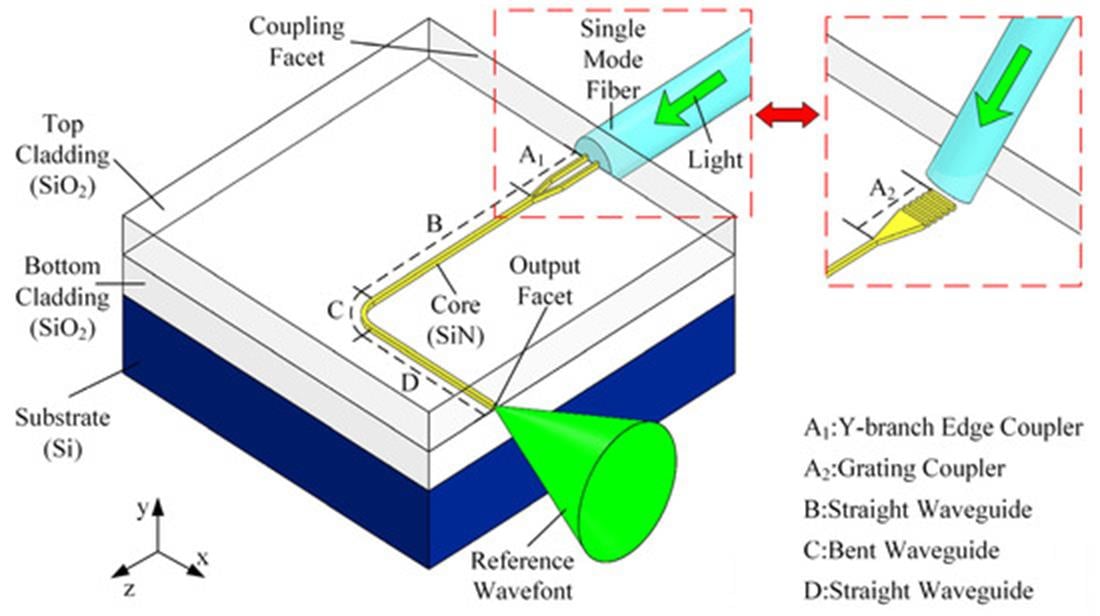
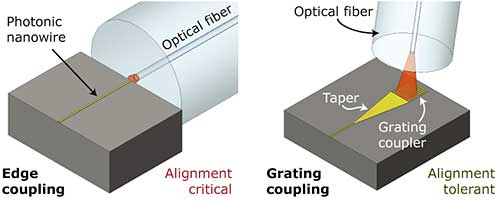
At its core, fiber waveguide coupling is the mechanical and optical process of aligning optical fibers—thin, flexible strands of glass or plastic that transmit light—with waveguides, which are structured channels (often on chips or substrates) designed to guide light along a specific path. The goal is to minimize light loss during transmission, as even small misalignments can lead to significant signal degradation.
Light travels through optical fibers via total internal reflection, while waveguides rely on similar principles but are constrained by their physical structure (e.g., silicon-based waveguides on PICs). For efficient coupling, the core of the fiber (where light is concentrated) must align with the waveguide’s core with extreme precision—often at the micron or sub-micron level. This alignment ensures that most of the light from the fiber enters the waveguide without being scattered or absorbed, preserving signal integrity.
Common coupling scenarios include fiber-to-chip coupling (connecting a single fiber to a PIC), fiber array-to-chip coupling (using a fiber array unit, or FAU, to link multiple fibers to a chip simultaneously), and fiber array-to-waveguide coupling (aligning FAUs with standalone waveguides). Each scenario requires tailored alignment strategies to address unique mechanical and optical challenges.
Key Challenges in Fiber Waveguide Coupling
Sub-Micron Alignment Tolerance
The core diameter of a single-mode optical fiber—widely used in long-distance communication—is typically around 8-10 microns, while waveguides on PICs can be even smaller (2-5 microns). A misalignment of just a few microns can reduce coupling efficiency by 50% or more. This means alignment systems must operate with resolution down to the nanometer scale to meet performance requirements.
Environmental Instability
Vibrations, temperature fluctuations, and mechanical drift can disrupt alignment over time. For example, a slight vibration from nearby equipment or thermal expansion of the coupling system’s components can shift the fiber or waveguide out of alignment, leading to signal loss. Long-term stability is therefore essential, especially for industrial systems that operate continuously.
Scalability for High-Volume Applications
In manufacturing settings (e.g., producing PLC fiber splitters or PIC-based transceivers), coupling must be fast, consistent, and repeatable. Manual alignment, while precise for research, is too slow and prone to human error for mass production. Scaling coupling processes to meet industrial demands requires automated systems that can handle multiple fibers or components simultaneously.
Compatibility Across Components
Optical fibers, FAUs, PICs, and waveguides come in diverse sizes and configurations. A coupling system must be adaptable to different component types—for instance, aligning a 12-fiber FAU with a silicon PIC versus a single-mode fiber with a Y-waveguide. This compatibility requires flexible fixtures, adjustable alignment stages, and customizable software.
Solutions: Fiber Waveguide Alignment Systems
To overcome these challenges, specialized fiber waveguide alignment systems have been developed, combining precision mechanics, advanced optics, and intelligent software. Leading providers like Fibermart offer a range of systems tailored to different use cases—from research labs to industrial production lines—each designed to optimize coupling efficiency, stability, and speed.
System Components: The Building Blocks of Precision
A high-performance alignment system integrates multiple components to address every stage of the coupling process:
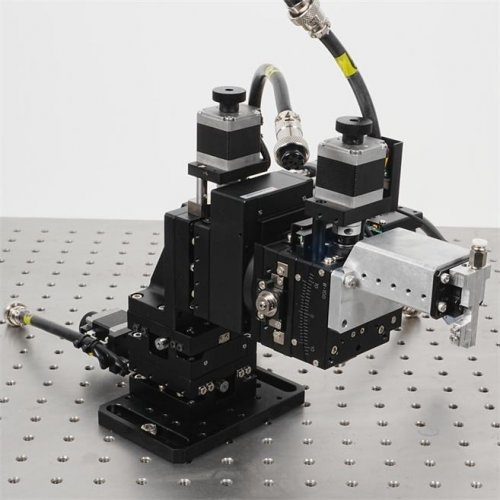
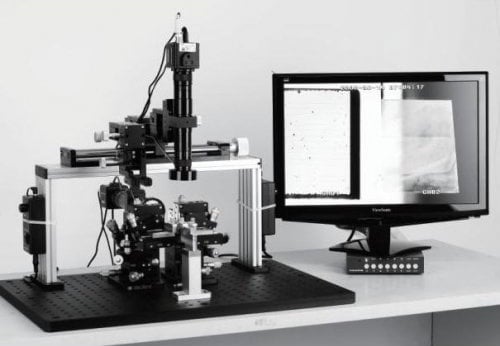
Alignment Stages: Dual 6-axis motorized stages (or manual stages for research) provide movement along X, Y, Z, pitch, yaw, and roll axes, enabling sub-micron positioning. Full-auto stages use differential micrometers or stepper motor actuators for nanometer-level control.
Fixtures: Custom FAU fixtures and PIC fixtures with touch sensors secure components in place, ensuring stability during alignment.
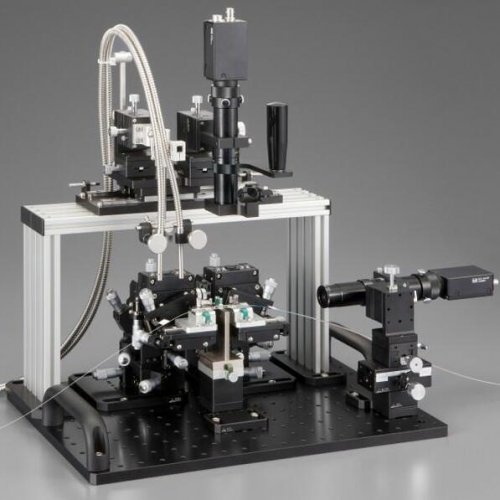
Vision Systems: CCD cameras, high-resolution lenses, and LED lighting provide real-time visual feedback, allowing operators or software to adjust alignment with precision.
Optical Testing Tools: Light sources and power meters measure coupling efficiency, ensuring the system meets performance targets before finalizing the connection.
UV Curing & Epoxy Dispensers: After alignment, these tools permanently bond fibers to waveguides, locking in position for long-term stability.
Anti-Vibration Tables: Isolate the system from external vibrations, preventing alignment drift and maintaining signal integrity.
Motion Controllers: 12-axis 5-phase motor controllers coordinate stage movement, enabling synchronized alignment of multiple components (critical for FAU-to-chip coupling).
System Types: From Manual to Full Automation
Alignment systems are categorized by their level of automation, matching the needs of different applications:
Manual Align Systems: Ideal for research labs or low-volume testing. These systems use thumbscrews for manual positioning, with micron resolution. They are cost-effective and flexible for prototyping but lack the speed of automated systems.
Semi-Automated Systems: Combine manual oversight with software control. Workflow software guides operators through alignment steps, uses vision systems for feedback, and automates basic adjustments. They balance precision and flexibility, making them suitable for small-batch production (e.g., custom PIC testing).
Full-Automated 12-Axis Systems: Designed for industrial production lines (e.g., PLC fiber splitter manufacturing). These systems use closed-loop feedback (or open-closed loopback coupling) to auto-adjust alignment, eliminating human error. They handle high-volume tasks quickly—aligning multiple fibers or FAUs simultaneously—while maintaining sub-micron precision.
Applications of Fiber Waveguide Coupling
Data Centers & Telecommunications
In data centers, where high-speed data transmission is critical, fiber-to-PIC coupling is used in transceivers and optical switches. PICs integrate multiple photonic functions (e.g., lasers, modulators, detectors) on a single chip, and efficient coupling with fibers ensures that data is transmitted between chips and fiber networks with minimal loss. Similarly, in long-distance telecommunications, fiber array-to-waveguide coupling is used in dense wavelength division multiplexing (DWDM) systems, which increase the bandwidth of fiber optic cables.
Photonic Integrated Circuits (PICs)
PICs are the “microchips of photonics,” and their performance depends entirely on effective fiber coupling. Applications include quantum computing (where PICs manipulate quantum bits via light), lidar systems (for autonomous vehicles), and optical sensors (for environmental monitoring). Full-automated alignment systems are key to scaling PIC production, as they ensure consistent coupling across hundreds or thousands of chips.
PLC Fiber Splitters
Planar Lightwave Circuit (PLC) fiber splitters are used to split a single optical signal into multiple signals (or combine multiple signals into one). Manual or semi-automated alignment systems are used in their manufacturing, aligning fiber arrays with PLC waveguides to ensure equal signal distribution across all output fibers.
Medical & Industrial Sensing
In medical imaging (e.g., endoscopes) and industrial sensing (e.g., temperature or pressure sensors), fiber waveguide coupling enables the transfer of light signals between fibers and miniaturized sensors. The precision of alignment systems ensures that these sensors deliver accurate, reliable data—critical for applications like minimally invasive surgery or pipeline monitoring.
Conclusion
For businesses and researchers alike, investing in high-quality alignment systems—such as those offered by Fibermart—is essential to unlocking the full potential of fiber waveguide coupling. Whether for prototyping a new PIC design or scaling production of fiber optic components, these systems provide the precision, stability, and flexibility needed to stay at the forefront of photonics innovation.





No comments have been posted yet.