


.webp)


For many young people today, serial communication might seem like an outdated term. However, some of the most common standards, like RS-232, RS-422, and RS-485, are still widely used in industrial communications. Therefore, we have written this article to help beginners understand these standards and recognize the differences between them through a detailed comparison.

Now, let's get started.
What is RS-232?
The RS-232 interface complies with the serial data communication interface standard established by the Electronic Industries Alliance (EIA). Its original designation was EIA-RS-232 (often abbreviated as 232 or RS232). It is widely used for connecting computer serial interface peripheral devices, connecting cables, and in mechanical, electrical, signaling, and transmission processes.
The RS-232 standard specifies data transmission rates of 50, 75, 100, 150, 300, 600, 1200, 2400, 4800, 9600, and 19200 bits per second (baud).
What are the characteristics of RS-232?
RS-232 is one of the mainstream serial communication interfaces. Because the RS-232 interface standard emerged earlier, it inevitably has some shortcomings, mainly the following four points:
#1: High Interface Signal Level
The interface's signal level is high, which can easily damage the interface circuit chips. The voltage on any signal line of the RS-232 interface uses a negative logic relationship.
Logic "1" is -3V to -15V; Logic "0" is +3V to +15V, with a noise margin of 2V. The receiver must recognize signals above +3V as logic "0" and signals below -3V as logic "1". TTL level, in contrast, uses +5V for logic high and 0V for logic low. Because it is not compatible with TTL levels, a level conversion circuit is required to connect to TTL circuits.
#2: Low Transmission Rate
The transmission rate is low. In asynchronous transmission, the bit rate is 20Kbps; hence, the integrated program baud rate on a 51 CPLD development board can only reach 19200, which is also the reason for this limitation.
#3: Weak Noise Immunity
The RS-232 interface uses one signal line and one signal return line (common ground) to form a common-ground transmission scheme. This common-ground transmission is susceptible to common-mode interference, resulting in weak noise immunity.
#4: Short Transmission Distance
The transmission distance is limited. The maximum distance is 50 feet (about 15 meters), only reaching about 15 meters.
What is RS-485?
When the communication distance needs to reach from tens of meters to several kilometers, the RS-485 serial bus is widely used. RS-485 uses balanced transmission and differential reception, therefore it has the ability to reject common-mode interference.
Besides the bus transceiver having high sensitivity (able to detect voltages as low as 200mV), it can also recover transmission signals from over a kilometer away.
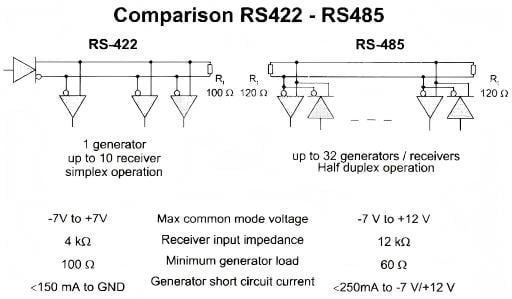
RS-485 operates in half-duplex mode, meaning only one point can be in the transmission state at any time. Therefore, the transmission circuit must be controlled by an enable signal.
What are the characteristics of RS-485?
RS-485 facilitates multi-point interconnection, which can save many signal lines. RS-485 can form a network to create a distributed system, allowing parallel connection of up to 32 drivers and 32 receivers. Addressing the shortcomings of RS-232, the new RS-485 standard has the following characteristics:
-
Electrical Characteristics: Logic "1" is represented by a voltage difference between the two wires of +2V to +6V; logic "0" is represented by a voltage difference of -6V to -2V. The interface signal level is lower than RS-232-C, making it less likely to damage interface circuit chips. This level is compatible with TTL levels and can be easily connected to TTL circuits.
-
Maximum Data Transmission Rate: 10 Mbps
-
Noise Immunity: The RS-485 interface combines a balanced driver and a differential receiver, providing strong common-mode interference rejection and good noise immunity.
-
Maximum Transmission Distance: The maximum transmission distance for the RS-485 interface is 4000 feet (about 1219 meters), and it can reach up to 3000 meters.
-
Multi-Drop Capability: The RS-232-C interface only allows one transceiver on the bus (single-drop capability). In contrast, the RS-485 interface allows up to 128 transceivers on the bus (multi-drop capability). Using a single RS-485 interface allows for quick establishment of a network of user devices.
What is RS-422?
The full name of the RS-422 standard is "Electrical Characteristics of Balanced Voltage Digital Interface Circuits," which defines the characteristics of the interface circuit. This standard includes a signal ground, making a total of 5 wires.
Because the receiver uses high input impedance and the transmitting driver has stronger driving capability than RS232, it allows multiple receiving nodes to be connected to the same transmission line, up to 10 nodes.
There is one master device (Master), and the rest are slave devices (Slave). Slave devices cannot communicate with each other, so RS-422 supports point-to-multipoint bidirectional communication. The receiver input impedance is 4kΩ, so the maximum load capacity at the transmitter end is 10×4kΩ + 100Ω (termination resistor).

What are the characteristics of RS-422?
Since the RS-422 four-wire interface uses separate send and receive channels, there is no need to control data direction. Any necessary handshaking between devices can be implemented in software (XON/XOFF handshaking) or hardware (using a pair of separate twisted pairs).
-
The maximum transmission distance for RS-422 is 4000 feet (about 1219 meters), and the maximum transmission rate is 10 Mb/s.
-
The length of the balanced twisted pair is inversely proportional to the transmission rate; the maximum transmission distance is only possible at rates below 100 kb/s. The highest transmission rate can only be achieved over very short distances. Typically, the maximum transmission rate achievable on a 100-meter long twisted pair is only 1 Mb/s.
-
RS-422 requires a termination resistor, whose resistance should be approximately equal to the characteristic impedance of the transmission cable. Termination is not needed for short-distance transmission (usually below 300 meters). The termination resistor is connected at the far end of the transmission cable.
RS-422 vs RS-485, What's the Difference?
RS-422 and RS-485 circuits work on the same principle. They both send and receive differentially and do not require a digital ground. Differential operation is the fundamental reason for achieving long transmission distances at the same data rate.
This is the real difference between RS-422/RS-485 and RS232. Because RS232 is single-ended input and output, it requires at least three lines for duplex operation (digital ground, transmit line, and receive line for asynchronous transmission), and other control lines can be added for functions like synchronization.
-
RS-422 can operate in full-duplex (simultaneous send and receive) using two pairs of twisted wires.
-
RS-485 can only operate in half-duplex (cannot send and receive simultaneously), but it only requires one pair of twisted wires.
-
Both RS-422 and RS-485 can transmit 1200 meters at 19 kbps. New transceivers allow devices to connect to the line.
The electrical performance of RS-422 is the same as RS-485. The main difference is:
-
RS-422 has four signal lines: two for transmitting (Y, Z) and two for receiving (A, B). Because receiving and transmitting are separate in RS-422, it can receive and send simultaneously (full-duplex).
-
RS-485 has two signal lines: transmission and reception are shared.
What is RS-423?
RS-423, or RS/EIA/TIA-423, is a serial communication standard with characteristics superior to RS-232. It defines an unbalanced (single-ended) interface, similar to RS-232, with a unidirectional transmitting driver allowing connection of up to 10 receivers. It is typically implemented using integrated circuit technology for serial binary signal exchange between DTE and DCE.
-
RS-422 supports multi-drop connections, while RS-423 only supports point-to-point links.
-
RS-422 is designed for direct connection of intelligent devices.
-
RS-423 is intended to enhance RS-232 and act as an intermediary between RS-422 and RS-232.
Both RS-423 and RS-232 share the disadvantage of using common-ground devices, which can degrade communication quality and potentially cause communication failures whose root cause is often difficult to determine.
In this regard, RS-422, RS-485, and Ethernet based on twisted-pair connections are superior. RS-423 is not popular in industry due to its drawbacks.
What is the Difference Between RS-232, RS-422, and RS-485?
-
RS232 is full-duplex, RS485 is half-duplex, and RS422 is full-duplex.
-
RS485 and RS232 are only physical communication protocols (interface standards); RS485 is differential transmission mode, RS232 is single-ended transmission mode, but the communication software does not differ significantly.
-
PCs are already equipped with RS232 and can be used directly. If RS485 communication is needed, simply connect an RS232 to RS485 converter to the RS232 port; no software modification is required.

Do RS232/RS422/RS485 Interfaces Look Different?
-
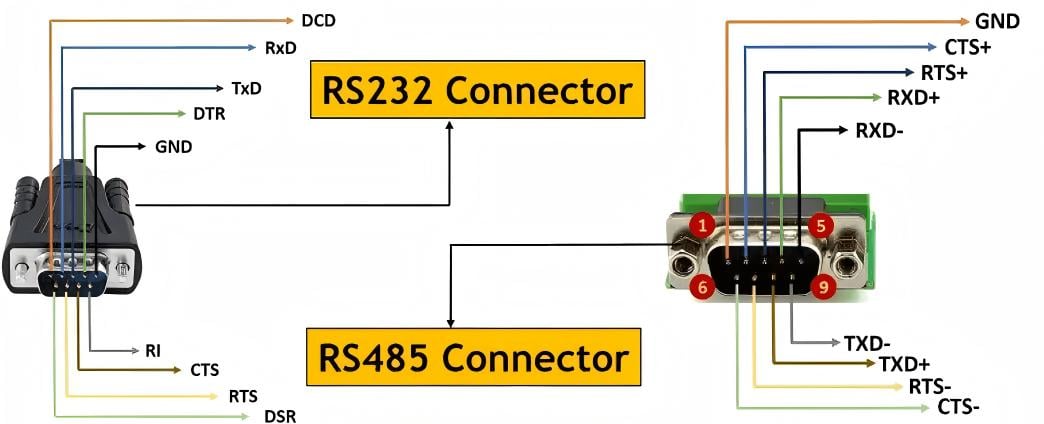
They are usually DB9 interfaces; there are also other types, or you might need to check the internal wiring to know whether it's RS232, RS422, or RS485.
-
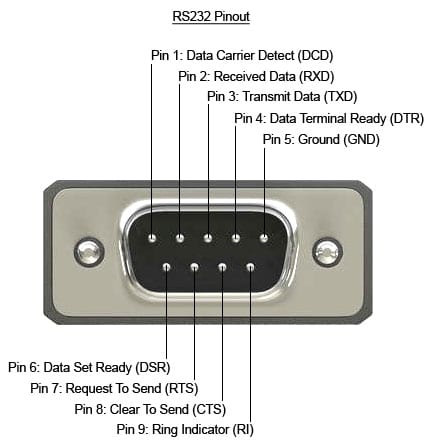
RS232 is a standard interface, a D-subminiature 9-pin (DB9) interface. The interface signal definitions for connected devices are unified. The signal definitions are as follows:
(Note: The original text likely expected a pinout definition diagram, which was not included in the document, so the specific pin definitions are omitted in the translation.)
Since PCs typically only have an RS232 interface by default, there are two ways to obtain an RS485 circuit for a PC host computer:
-
Use an RS232/RS485 conversion circuit to convert the RS232 signal from the PC's serial port to an RS485 signal. For complex industrial environments, it is best to use isolated products with surge protection.
-
Use a PCI multi-serial port card, where you can directly select an expansion card that outputs RS485 signals.
The computer connects to multiple 485 devices (access controllers) via an RS232-to-RS485 converter and polls the devices on the bus.
The wiring labels are 485+ and 485-, corresponding to the 485+ and 485- connections on the device (controller).
-
Communication Distance
The theoretical maximum distance between the farthest device (controller) and the computer is 1200 meters. We recommend customers keep it within 800 meters, and optimally within 300 meters.
If the distance is too long, you can purchase a 485 repeater (extender) (please buy from a professional converter manufacturer; the repeater is placed in the middle or at the start of the bus - refer to the manufacturer's manual). Theoretically, a repeater can extend the distance to 3000 meters.
-
Load Capacity
How many devices (controllers) can one 485 bus carry? This depends on the communication chip selected for the controller and the communication chip in the 485 converter.
Common specifications are 32, 64, 128, and 256 units. This is a theoretical number. In practical applications, depending on the field environment, communication distance, and other factors, the actual number of loads may not reach this figure. Weigeng company controllers and converters are designed for 256 units, but we recommend customers limit each bus to 80 units or fewer.
Use a 485 communication bus (must use twisted pair or one pair from a network cable). If using ordinary wire (not twisted pair), interference will be significant, communication will be unstable, and it might even fail completely.
Each controller device must be daisy-chained in series; star connections or branches are not allowed. If there are star connections or branches, interference will be very high, communication quality will be poor, and transmission might fail.
Controller Area Network (CAN)
CAN is an in-vehicle network communication protocol introduced by Bosch in the 1980s, widely used in automotive and industrial control fields. The main features of this protocol include:
-
Electrical Characteristics: CAN also uses differential signals. A voltage difference of about 2V between the two wires (CAN_H and CAN_L) represents the logic "recessive" (logic "1") state, while the logic "dominant" (logic "0") state has a voltage difference close to 0V.
-
Communication Mode: It supports multi-point communication with a multi-master structure, uses an arbitration mechanism to handle bus conflicts, and supports both high-speed (CAN High Speed) and low-speed (CAN Low Speed) modes.
-
Transmission Distance: Under correct wiring conditions, the transmission distance of a CAN bus can reach 10 km (high-speed CAN) or several kilometers (low-speed CAN).
-
Application: Primarily used in vehicle electronic systems and industrial automation control systems.
Transistor-Transistor Logic (TTL)
TTL refers to a type of logic level standard, commonly used for communication within or between integrated circuits over short distances, rather than being a communication standard itself. The main characteristics of this standard include:
-
Electrical Characteristics: TTL level signals are typically defined as logic "1" being approximately +5V (typical) and logic "0" being close to 0V. The signal amplitude is relatively small.
-
Communication Mode: TTL levels are primarily used for chip-level interfaces, such as UART, SPI, I²C signal transmission interfaces.
-
Transmission Distance: Because TTL level signals attenuate quickly, they are not suitable for long-distance transmission and are usually limited to within a few centimeters to a few meters.
-
Application: TTL levels are widely used for internal communication in embedded systems and between integrated circuits on computer motherboards.
Frequently Asked Questions (FAQs)
What is UART?
UART stands for Universal Asynchronous Receiver-Transmitter. It is a serial port technology used for implementing serial data transmission. It is a circuit responsible for converting parallel data into serial data for communication and converting serial data back into parallel data for the receiving end to use.
How to eliminate common-mode interference on the RS-485?
Common-mode interference is typically eliminated by the following methods:
-
Use shielded twisted pair cable and ensure good grounding.
-
Consider using galvanized conduit for shielding in areas with strong electric fields.
-
Route wiring away from high-voltage lines, and never bundle high-voltage power lines and signal lines together.
-
Do not share the same power supply with devices like electric control locks.
-
(Use a linear regulated power supply or a high-quality switching power supply (ripple interference less than 50mV)).
Conclusion
RS232, RS422, RS423, and RS485 are all essentially physical layer protocols. They are all serial communication protocols and are ubiquitous device interfaces. Serial interfaces are widely used in electronics and embedded systems, often for remote data acquisition from devices or remote control.
They change the way signals are transmitted, whether to a PC, a microcontroller, or using a serial communication protocol or TTL level for serial communication. A communication conversion chip is required to convert them to RS232, RS422, RS423, or RS485 signals.
Learn more about TTL 1x9 Optical Modules suitable for RS232, RS422, and RS485 industrial Ethernet.





No comments have been posted yet.