


.webp)


To provide customers with high-quality fiber optic patch cables , manufacturers perform a series of tests during the design and manufacturing process. These fiber optic patch cable tests are crucial for any type of fiber optic network. End users, not just suppliers, need to understand these fiber optic patch cable tests to better judge their quality and ensure their viability. This article will introduce four tests: 3D testing, insertion loss (IL) testing, return loss (RL) testing, and end-face testing. Fiber optic patch cables that have passed these four tests are generally of high quality, providing end users with peace of mind.
3D Testing: Guarantee of High-Quality Connector End Faces
3D testing is a critical test for ensuring fiber optic connector performance. When manufacturing fiber optic patch cord assemblies, suppliers use a 3D interferometer (an optical interferometer) to inspect the fiber optic connector endfaces and strictly control their dimensions. 3D testing primarily measures curvature radius, vertex offset, and fiber height. Details are as follows:
Radius of Curvature
The radius of curvature is the radius from the ferrule axis to the end face, as shown in the figure below. This is also the curve radius of the ferrule end face. High-quality fiber optic patch cord connectors require a curvature radius within a certain range. A curvature radius that is too small will exert excessive pressure on the fiber, while a curvature radius that is too large will not exert pressure on the fiber, resulting in an air gap (i.e., an air gap) between the connector and the fiber end face. Both too large and too small curvature radii can lead to light scattering or insufficient physical contact, thus failing to ensure optimal transmission performance. Only an appropriate curvature radius ensures proper pressure and excellent transmission performance.

Figure 1: Curvature radius of 3D test
Vertex Offset
Apex offset refers to the distance between the highest point of the ferrule end face curve after grinding and polishing and the axis of the fiber core. This is a critical factor in the polishing process, and inaccurate polishing can lead to apex offset.

Figure 2: 3D test vertex offset
Technical standards generally require that the apex offset of fiber optic patch cables be ≤50μm. A larger apex offset creates an air gap, resulting in higher insertion loss (IL) and return loss (RL) in the fiber optic patch cable. Ideally, PC and UPC fiber optic connectors have nearly zero apex offset because the ferrule endface is polished perpendicular to the polished surface during polishing, with the apex aligning with the fiber core axis. However, for APC fiber optic connectors, the endface is at an 8-degree angle to the fiber axis, not completely perpendicular. For more information on PC/UPC/APC, visit "Which Connector to Choose: PC vs. UPC vs. APC?"
Fiber Height
Fiber height is the distance from the fiber end face to the ferrule cross section, or the height from the fiber core to the ferrule end face. Similarly, the fiber height should not be too low or too high. If the fiber height is too high, the pressure inside the fiber increases when connecting two fiber connectors, potentially damaging the fibers. If the fiber height is too low, a gap will form when connecting the two fiber connectors, increasing insertion loss. This is essential for transmission systems with strict insertion loss requirements.

Figure 3: Fiber height in 3D testing
The values tested using a 3D interferometer for fiber optic patch cables with different polishing methods and types will vary, but all tested fiber optic patch cables should meet or exceed industry-recognized end-face geometry standards. The following table shows the geometric dimension requirements for MTP single-mode fiber optic connector end faces based on IEC/PAS 61755-3-31 and IEC/PAS 61755-3-32.
|
Item Name
|
Require
|
|
Ferrule X angle (SX)
|
-0.2~0.2° (PC sum APC)
|
|
Ferrule Y angle (SY)
|
±0.2°
|
|
Ferrule X radius (RX)
|
≥2000mm
|
|
Ferrule Y radius (RY)
|
≥5mm
|
|
Fiber curvature radius (RF)
|
≥1mm
|
|
Fiber height (H)
|
1000~3000nm
|
|
Maximum fiber height difference (HA)
|
500nm
|
|
Maximum adjacent height difference (HB)
|
300nm
|
|
Coplanarity
|
≤2000nm
|
|
Core inclination
|
-100nm~+ 200nm
|
IL and RL Testing: Key Tests for Optical Deployments
Insertion loss (IL) refers to the loss of signal power caused by the insertion of a device at a certain point in the transmission system. Return loss (RL) is the power loss caused by partial signal reflection back to the source during transmission due to discontinuities in the transmission link. For more information on the definitions of insertion loss and return loss, please visit "A Brief Analysis of Insertion Loss and Return Loss in Fiber Optic Connectors."
Insertion loss and return loss testing are crucial during both the manufacturing and installation processes. Fiber optic cable suppliers must ensure that the insertion loss and return loss of their fiber optic patch cables meet the appropriate standards. For example, the TIA standard specifies a maximum insertion loss of 0.75dB for fiber optic patch cables (the maximum acceptable value). For most fiber optic patch cables on the market, the normal insertion loss range is between 0.3dB and 0.5dB, with some lower insertion loss ranges between 0.15dB and 0.2dB. Fiber optic manufacturers typically use insertion loss and return loss testers to verify that the test results are within the normal range, ensuring that end users receive qualified products.
For end users, in addition to using the insertion loss and return loss values listed in product specifications as a reference when designing fiber links and selecting other equipment or components, they can also perform their own testing if available testing tools are available. This effectively helps installers quickly troubleshoot and identify faulty system components. Optical time domain reflectometers (OTDRs) and optical frequency domain reflectometers (OFDRs) are both commonly used instruments for measuring return loss.
End Face Testing: Ensuring End Face Cleanliness and Smoothness
Fiber optic cleaning refers to the cleaning of fiber optic connector end faces. Whether forty years ago or today, cleaning fiber optic connector end faces is an essential step in fiber optic maintenance. Manufacturers typically use fiber optic end face inspection instruments to confirm whether there are contaminants, scratches, or cracks on the fiber optic connector end faces. Fiber optic engineers often use fiber optic cleaning tools (such as fiber optic cleaning pens and cassette cleaning boxes) to clean fiber end faces during cabling to ensure they are free of contamination.
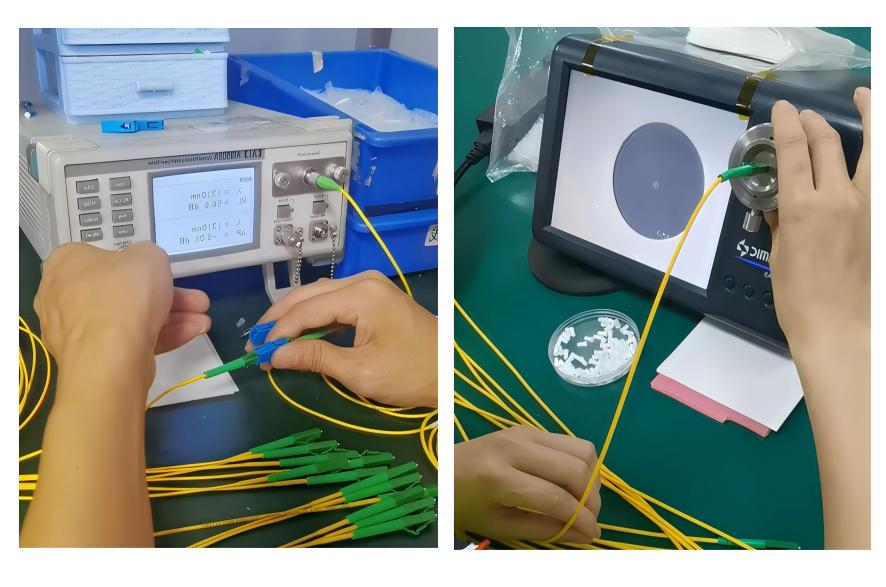
Figure 4: End face test
Why perform end-face testing? A good fiber optic connector end-face is essential for ensuring high-quality fiber optic connections. If the fiber optic connector end-face is contaminated (such as dust), scratched, or even deformed, it will increase return loss and may even permanently damage the fiber optic connector, rendering it unusable. Furthermore, dust between the end-faces can scratch the surface, causing air gaps or misalignment of the fiber cores, thereby reducing the quality of optical signal transmission. Since these contaminants cannot be seen visually, if the end-face is not tested and cleaned, it will contaminate the connected socket. Therefore, even if the supplier has tested and cleaned the fiber optic connector end-face before shipment, it is still necessary to clean the end-face before and after inserting and unplugging the fiber optic connector. Furthermore, if the end-face will not be used again, it should be covered with a dust cap.
Summarize
In summary, the fiber optic industry is improving the quality of fiber optic connectors by exploring key parameters that need to be measured, and industry associations and committees have been committed to determining manufacturing standards for fiber optic quality assurance. If fiber optic patch cords pass the above four tests and the test results meet the standards, they will help achieve high-quality optical signal transmission. For end users, it is necessary to check whether the supplier has performed these tests and whether they can provide relevant test reports to confirm that their parameter values are within the correct range.
See more fiber testing tools and equipment at HERE.





No comments have been posted yet.