


.webp)


In the digital age, where data transmission speed and reliability are paramount, fiber jumper cables stand as the backbone of high-performance optical networks. From bustling data centers to expansive telecommunication systems and enterprise-grade infrastructures, these specialized cables play a critical role in ensuring seamless, low-loss signal transfer. This guide delves into the core of fiber jumper cables, exploring their key features, types, technical specifications, and applications—equipping you with the knowledge to make informed decisions for your network needs.
What Is a Fiber Jumper Cable?
A fiber jumper cable, also known as a fiber optic patchcord, is a short-length optical fiber cable terminated with connectors on both ends. Unlike long-haul fiber optic cables used for intercity or international data transmission, fiber jumpers are designed for "last-mile" connectivity within localized networks. Their primary function is to link critical network components, such as switches, routers, servers, and optical transceivers, enabling the rapid and accurate transfer of light-based signals.

What sets fiber jumpers apart is their precision engineering. Each cable is crafted to minimize signal degradation, support high bandwidth, and withstand the demands of continuous operation—making them indispensable in environments where even minor signal loss can disrupt operations, such as financial data centers or cloud computing facilities.
Key Types of Fiber Jumper Cables: Tailored to Network Needs
Fiber jumper cables are not one-size-fits-all. They are categorized based on two core factors: fiber mode (how light travels through the fiber) and connector type (the interface that links the cable to network devices). Understanding these categories is essential to selecting the right cable for your application.
Fiber Mode: Single-Mode vs. Multimode
The fiber mode determines the cable’s bandwidth, transmission distance, and wavelength compatibility—directly impacting its use case.
Single-Mode Fiber (SM) Jumpers: These cables use a narrow core (typically 8-10 microns) that allows only one path for light to travel. They are optimized for long-distance transmission (up to tens of kilometers) and high bandwidth, making them ideal for telecommunication backbones, long-haul data links, and large-scale enterprise networks. The most common single-mode standard is OS2, which supports wavelengths of 1310nm and 1550nm—wavelengths chosen for their low attenuation (signal loss) over long distances.
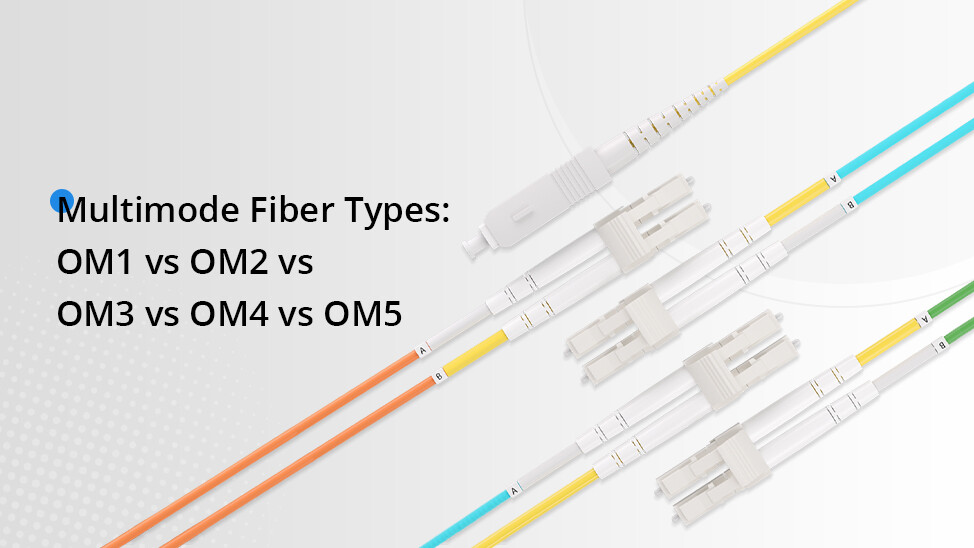
Multimode Fiber (MM) Jumpers: Multimode cables have a larger core (50 or 62.5 microns) that enables multiple light paths. They are designed for short-distance transmission (up to a few hundred meters) and are more cost-effective than single-mode options. Common multimode standards include OM1, OM2, OM3, OM4, and OM5:

OM1: Supports bandwidths up to 600 MHz·km and is suitable for legacy networks using 850nm or 1300nm wavelengths.
OM2: Offers improved bandwidth (up to 500 MHz·km at 850nm) and is ideal for short-range, low-cost applications like office local area networks (LANs).
OM3 & OM4: These are "laser-optimized" multimode cables, supporting bandwidths of 2000 MHz·km (OM3) and 4700 MHz·km (OM4) at 850nm. They are widely used in data centers for high-speed links (e.g., 10G, 40G, 100G Ethernet) due to their ability to handle high data rates over short distances.
OM5: The latest multimode standard, OM5 supports multiple wavelengths (850nm, 910nm, 940nm) and is designed for future-proofing networks with emerging high-speed protocols.
Connector Types: Ensuring Secure, Low-Loss Connections
Fiber jumpers are terminated with connectors that ensure a tight, aligned fit with network devices—critical for minimizing insertion loss (signal loss when the cable is connected). The most common connector types include:
LC: A small-form-factor connector (SFF) with a push-pull design. It is compact, lightweight, and ideal for high-density environments like data centers, where space is limited. LC connectors are widely used for 10G, 40G, and 100G Ethernet links.
SC: A square-shaped connector with a snap-in design. It is easy to install and remove, making it popular in enterprise networks and telecommunication systems. SC connectors are often used for single-mode applications.
FC: A threaded connector that provides a secure, stable connection. It is resistant to vibration, making it suitable for industrial environments or outdoor applications where mechanical stability is critical.
ST: A bayonet-style connector with a twist-lock design. It was once common in legacy multimode networks but is now less frequently used in modern high-speed systems.
E2000: A high-performance connector with a dust cap, which protects the ferrule (the part that transmits light) from contamination. It is ideal for harsh environments and is often used in data centers and telecom networks requiring maximum reliability.

Simplex vs. Duplex Configurations
Fiber jumpers also come in two configurations based on the number of fiber strands:
Simplex: Contains a single fiber strand, used for one-way data transmission (e.g., sending signals from a transmitter to a receiver).
Duplex: Contains two fiber strands, used for two-way data transmission (e.g., sending and receiving signals simultaneously). Duplex cables are more common in most network applications, as they support full-duplex communication.

Applications of Fiber Jumper Cables: Powering Diverse Industries
Data Centers
Data centers are the backbone of the digital economy, handling petabytes of data daily for cloud computing, big data analytics, and streaming services. Fiber jumpers are essential here for connecting servers, storage arrays, and network switches, enabling high-speed links (such as 400G Ethernet) that support rapid data transfer. The compact LC connector is preferred in data centers due to its small size, which allows for high-density installations—critical in facilities where space is limited. Additionally, laser-optimized OM3 and OM4 multimode cables are widely used, as they can handle high data rates over the short distances typical of data center environments.
Telecommunication Systems
Telecom providers depend on fiber jumper cables to build and maintain reliable communication networks, including 5G infrastructure, voice call services, and internet connectivity. Single-mode OS2 fiber jumpers are the standard choice here, as they support long-distance transmission (up to 100km) with low attenuation—essential for linking cell towers, base stations, and core network facilities across large geographic areas. The FC connector is often used in outdoor telecom applications due to its threaded design, which provides a secure, vibration-resistant connection that can withstand harsh weather conditions.
Enterprise Networks
Businesses, universities, and government offices rely on fiber jumper cables to build robust local area networks (LANs) and wide area networks (WANs) that connect employees, devices, and systems. Multimode OM2 and OM3 cables are commonly used for LANs, connecting desktop computers, printers, and servers to network switches over short distances. For WANs that link multiple office locations, single-mode cables are preferred for their long-distance capabilities. The SC connector is popular in enterprise settings due to its easy snap-in design, which simplifies installation and maintenance—critical for IT teams managing complex network infrastructures.

Industrial Environments
In industrial settings such as factories, power plants, and oil refineries, fiber jumper cables are used to connect industrial control systems (ICS), sensors, and monitoring equipment. These environments often expose cables to extreme temperatures, dust, moisture, and vibration, so fiber jumpers used here are designed for durability. LSZH jackets are common to ensure fire safety, while FC connectors are favored for their vibration resistance. The cables’ ability to withstand harsh conditions ensures that industrial operations remain connected and efficient, minimizing downtime that could impact productivity or safety.
Choosing the Right Fiber Jumper: A Step-by-Step Guide
With so many options available, selecting the right fiber jumper cable can be overwhelming. Follow these steps to ensure you make the best choice:
Define Your Application: Start by identifying your network’s core needs. If you require short-distance transmission (e.g., within a data center or office), multimode cables (such as OM3 or OM4) are the best fit. For long-distance transmission (e.g., linking telecom towers or multiple office locations), single-mode OS2 cables are ideal.
Select the Connector Type: Match the connector to your existing network devices and environment. Use LC connectors for high-density setups like data centers, SC connectors for easy installation in enterprise networks, FC connectors for vibration-prone industrial or outdoor applications, and E2000 connectors for harsh environments where dust or contamination is a concern.
Choose Simplex or Duplex: Determine whether you need one-way or two-way communication. Duplex cables, which support two-way transmission, are suitable for most applications (e.g., connecting a switch to a server). Simplex cables, which handle one-way transmission, are better for specific use cases like security cameras that only send data to a central recorder.
Check Environmental Requirements: Consider the conditions the cable will be exposed to. For areas where fire safety is critical (e.g., hospitals), choose LSZH-rated cables. For vertical installations (e.g., building risers), opt for OFNR-rated cables. Ensure the cable’s operating temperature range matches your environment—whether it’s a temperature-controlled data center or an outdoor telecom site.
Prioritize Quality: Select cables made with high-grade fiber, such as CORNING Fiber, to ensure consistent performance. High-quality cables will have low insertion loss, high return loss, and durable connectors that support multiple mating cycles. Reputable suppliers like Fibermart offer cables that meet industry standards (such as TIA/EIA and IEC), ensuring reliability and compatibility with your network.
Summary
In the data-driven era, fiber jumper cables—though compact—serve as the critical "nerve endings" powering high-performance digital networks. More than just physical links between switches, servers, and transceivers, they directly determine network bandwidth, transmission distance, and stability. Whether enabling 400G Ethernet in data centers, long-haul telecom connections, daily enterprise LAN communications, or rugged industrial links, their performance underpins operational efficiency and user experience.
Choosing the right fiber jumper is a scenario-specific decision, not just a specification pick: prioritizing OM3/OM4 multimode’s cost-effectiveness for short-haul high bandwidth, or OS2 single-mode’s low attenuation for long distances; opting for LC connectors’ high density, or FC’s vibration resistance; selecting duplex for two-way communication, or simplex for one-way transmission. Each choice must align with both current needs and future scalability.





No comments have been posted yet.