


.webp)


Hollow-Core Fiber Shatters Physical Limits, Ushering in a New Era for Optical Communications
Light traveling through air, speed increased by 45%, loss reduced to 0.091 dB/km—a fiber optic technology revolution led by Microsoft is reshaping the global digital infrastructure landscape.
Recently, the Microsoft-supported Lumenisity research team published a groundbreaking study in the journal Nature Photonics: a new hollow-core fiber achieved a signal attenuation of just 0.091 dB/km, breaking the theoretical limit of 0.14 dB/km for traditional silica-based fiber——《Broadband optical fibre with an attenuation lower than 0.1 decibel per kilometre》
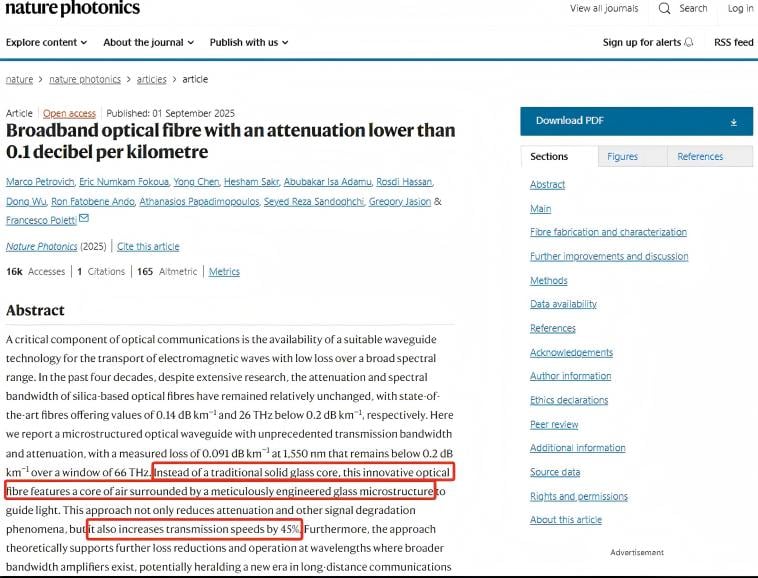
Hailed as "the most notable development in waveguide technology over the past 40 years," this technology marks a monumental breakthrough in optical communications. Hollow-core fiber not only increases transmission speed by 45% but also enables longer-distance data transmission without sacrificing bandwidth.
01 Technological Leap: A Communications Revolution from Glass to Air
Traditional fiber relies on high-purity silica glass to transmit light signals, where light travels at approximately 200 million meters per second. In contrast, hollow-core fiber allows light to travel through air, reaching speeds of 300 million meters per second—45% faster than in glass.
Hollow-core fiber utilizes a unique "Double Nested Anti-Resonant Nodeless Fiber" (DNANF) structure, consisting of multiple concentric glass tubes with micron-level thickness. These tube walls act like microscopic mirrors, continuously reflecting light back into the central air channel while suppressing higher-order modes.
The photonic bandgap effect is the core principle of this technology. Precisely engineered arrays of silica microstructured rings effectively confine light within the air core, significantly reducing the interaction between light and material, thereby dramatically lowering signal attenuation.
02 Performance Breakthrough: Key Metrics Shattering a 40-Year Record
The research team achieved an attenuation level of 0.091 dB/km at the 1550 nm communications wavelength, surpassing the theoretical limit of traditional silica fiber for the first time.
Even more impressive is that this hollow-core fiber maintains a loss below 0.2 dB/km over a broad spectrum of 66 THz, far exceeding the performance of traditional silica fiber, which only achieves such performance in narrow communication bands.
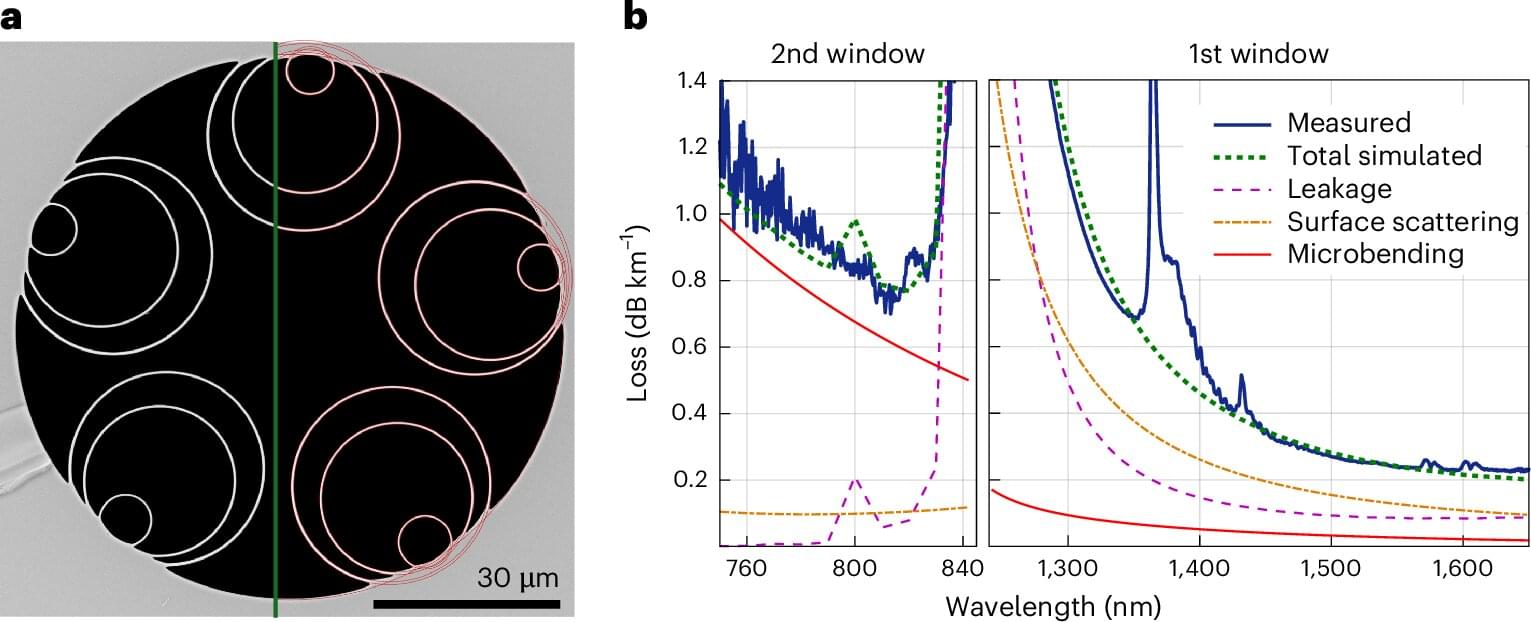
Traditional fiber loses about half its signal strength every ~20 kilometers, requiring repeater amplifiers. Hollow-core fiber extends this distance to approximately 33 kilometers, reducing repeater requirements by 46% and significantly cutting energy consumption and equipment costs for long-distance communications.
03 Microsoft's Strategy: From Lab to Global Network Deployment
Microsoft's investment in hollow-core fiber technology is strategic. In 2022, Microsoft acquired Lumenisity, a company with advanced hollow-core fiber technology, and has since been driving the technology from lab to industrialization.
Currently, Microsoft has approximately 1,200 kilometers of the new fiber operational in live networks, carrying real traffic. At the Ignite 2024 conference, Microsoft announced plans to deploy 15,000 kilometers of hollow-core fiber across its Azure global network within the next 24 months.
This deployment will specifically support the low-latency, high-bandwidth demands of AI and high-performance computing scenarios, indicating Microsoft's preparation for the large-scale commercial use of hollow-core fiber technology.
04 Application Prospects: Unlimited Potential Beyond Traditional Communications
The applications of hollow-core fiber will extend far beyond traditional communications. In artificial intelligence, it will meet the demand for rapid data transfer essential for AI tools.
Quantum communications represent another critical application area. Hollow-core fiber can carry over 1000 times more power than traditional versions and transmit single-photon pulses of visible light.
In latency-sensitive scenarios such as intra-data center connectivity, high-frequency financial trading, and distributed intelligent computing centers, the low-latency of hollow-core fiber will play a vital role.
05 Industrialization Challenges: The Hurdles of Cost and Standardization
Despite its promising, the large-scale commercial adoption of hollow-core fiber still faces challenges. Manufacturing cost is the primary obstacle.
Traditional fiber is made by melting and stretching solid glass into thin strands, whereas hollow-core fiber starts with a glass preform about 20 cm wide, which already has a hollow channel built-in.
When the fiber is stretched to a diameter of about 100 microns, the hollow space requires pressurization to maintain its structure. This process is more complex and precise than traditional manufacturing.
Global standardization is another challenge. The industry needs to develop new standards to ensure the compatibility of hollow-core fiber with existing networks.
Furthermore, solid-core fiber remains the market mainstream, and interfacing hollow-core fiber with it in practical applications is a significant issue.
06 International R&D: Global Giants Racing to Develop
Besides Microsoft, other international tech giants are actively pursuing hollow-core fiber technology. Nokia Bell Labs, in collaboration with Yangtze Optical Fibre and Cable (YOFC), has addressed the challenge of weak backscattering in hollow-core fiber using a 20 km ultra-low loss tube-based structure.
BT (British Telecom) previously partnered with Lumenisity on hollow-core fiber trials. As the technology matures, more telecom operators are expected to join testing and deployment efforts.
The academic community is also deeply involved. Research teams at the University of Southampton have been refining this technology for over a decade, laying a solid foundation for its industrialization.
Microsoft announced plans to deploy 15,000 kilometers of hollow-core fiber across its Azure global network within the next two years, focusing on supporting AI and high-performance computing demands.
Traditional fiber requires signal repeaters approximately every 20 kilometers; hollow-core fiber extends this to 33 kilometers. This means transoceanic submarine cables could use nearly half the number of repeaters.
Hollow-core fiber isn't just for current communication needs; it is foundational infrastructure for future quantum communication networks. It can transmit fragile quantum signals, paving the way for the birth of a quantum internet.





No comments have been posted yet.