


.webp)


In the era of cloud computing, big data analytics, and 5G deployment, data centers face unprecedented demands for faster data transmission, higher port density, and more reliable connectivity. Among the various cabling solutions available, MTP LC cable has emerged as a cornerstone technology, addressing the critical needs of modern data center infrastructure. This article delves into the core attributes, applications, and advantages of MTP LC cable, highlighting why it has become the preferred choice for data center operators worldwide.

Understanding MTP LC Cable: Core Definitions and Technical Fundamentals
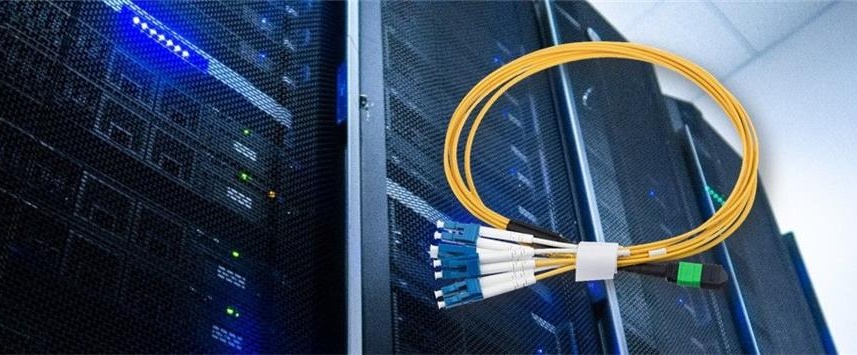
Before exploring its role in data centers, it is essential to clarify what MTP LC cable is and how it differs from traditional fiber optic cables. An MTP LC cable is a pre-terminated fiber optic assembly that features an MTP (Mechanical Transfer Push-On) connector on one end and LC (Lucent Connector) connectors on the other. The MTP connector—often considered a high-performance variant of the MPO (Multi-Fiber Push-On) connector—is designed to handle multiple fiber strands (typically 8, 12, 24, or even 144 fibers) in a single compact interface. In contrast, the LC connector is a small-form-factor (SFF) connector widely used for single or duplex fiber connections, known for its low insertion loss and high return loss.
Key Technical Specifications of MTP LC Cable
The performance of MTP LC cable is defined by rigorous technical standards, ensuring it meets the demands of high-density data center environments. Critical specifications include:
Fiber Mode Compatibility: Supports both single-mode (SM) and multimode (MM) fibers, with multimode options including OM1, OM2, OM3, OM4, and OM5—catering to diverse bandwidth and distance requirements.
Insertion and Return Loss: Typical insertion loss is as low as 0.15dB (maximum 0.35dB), minimizing signal attenuation, while return loss exceeds 20dB, reducing signal reflection and interference.
Transmission Distance: For 400G Ethernet, it supports distances of 50–100m at 850nm (multimode), and for 800G Ethernet, it reaches 50m at 850nm—ideal for short-reach data center links.
Mechanical Durability: Features a minimum bend radius of 7.5mm, a cable outer diameter of 3.0mm, and a breakout diameter of 2.0mm (with a standard breakout length of 0.5m). It also withstands long-term tensile strength of 60N and short-term strength of 120N, ensuring resilience during installation and operation.
Environmental Adaptability: Operates in temperatures ranging from -10°C to 60°C (14°F to 140°F) and stores safely at -10°C to 70°C (14°F to 158°F), making it suitable for controlled data center environments.

Why MTP LC Cable Is Indispensable for Modern Data Centers
Data centers are evolving rapidly, with trends like virtualization, edge computing, and AI driving the need for more efficient connectivity. MTP LC cable addresses three critical challenges: high density, rapid deployment, and future scalability.
Enabling High-Density Cabling
Traditional fiber optic cables with individual connectors (such as SC or ST) require significant rack space, limiting the number of ports per unit area. MTP LC cable solves this by consolidating multiple fibers into a single MTP connector. For example, a 12-fiber MTP LC cable replaces 12 separate LC duplex cables, reducing rack space usage by up to 70%. This is particularly valuable in hyperscale data centers, where every inch of rack space directly impacts operational efficiency and cost.
Accelerating Installation and Maintenance
Data center downtime is costly—often exceeding $5,600 per minute, according to industry reports. MTP LC cable is pre-terminated and factory-tested, eliminating the need for on-site fiber splicing or termination. This reduces installation time by 50–70% compared to field-terminated cables. Additionally, the standardized design of MTP LC cable simplifies maintenance: when a connection issue arises, technicians can quickly replace the pre-assembled cable instead of troubleshooting individual splices, minimizing downtime.
Supporting Future-Proof Scalability
As data center bandwidth requirements grow (e.g., from 100G to 400G to 800G), MTP LC cable provides a scalable solution. Its compatibility with high-fiber-count configurations (up to 144 fibers) and support for next-generation Ethernet standards (400G/800G) means data centers can upgrade their networks without overhauling the entire cabling infrastructure. For instance, a data center initially using 12-fiber MTP LC cable for 100G links can easily transition to 24-fiber or 32-fiber variants to support 400G/800G connections, extending the lifespan of their cabling investment.
Practical Applications of MTP LC Cable in Data Center Architecture
MTP LC cable is versatile and integrates seamlessly into various layers of data center cabling architecture, from backbone trunks to equipment-level connections.
Backbone Cabling (Campus to Data Center)
In data center backbone systems, MTP LC cable serves as the primary link between campus buildings, data center pods, or core switches. Its high fiber count (e.g., 24, 32, or 144 fibers) enables large-volume data transmission between key infrastructure points. For example, a 144-fiber MTP LC cable can connect a core switch to a distribution switch, supporting thousands of end-device connections through downstream splitting.
Distribution Layer (Rack-to-Rack Connections)
At the distribution layer, MTP LC cable facilitates connections between top-of-rack (ToR) switches and end-of-row (EoR) switches. Its compact design allows for easy routing through cable managers, while the LC connectors on one end ensure a secure, low-loss connection to switch ports. A common deployment here is using 12-fiber or 24-fiber MTP LC cable to link ToR switches in adjacent racks, streamlining the distribution of network traffic.
Equipment-Level Connections (Server to Switch)
For direct server-to-switch connections, duplex MTP LC cable (with LC simplex/duplex connectors) is ideal. It provides a reliable link between servers, storage devices, and ToR switches, supporting high-speed data transfer for applications like virtual machine migration and big data processing. The small form factor of LC connectors also aligns with the space constraints of modern server chassis.

Choosing the Right MTP LC Cable: Key Considerations
Selecting the appropriate MTP LC cable for a data center requires evaluating factors like fiber type, cable jacket material, and customization options.
Fiber Type: Single-Mode vs. Multimode
Single-Mode (SM) MTP LC Cable: Best for long-reach applications (e.g., connecting geographically separated data center buildings) or high-bandwidth needs (e.g., 800G Ethernet). It operates at 1310nm or 1550nm wavelengths and has low attenuation (≤0.6dB/km at 1300nm).
Multimode (MM) MTP LC Cable: Suitable for short-reach, high-density environments (e.g., within a single data center pod). OM3 and OM4 variants are popular for 400G/800G links, with attenuation ≤2.3dB/km at 850nm.
Cable Jacket Material
MTP LC cable is available with LSZH (Low Smoke Zero Halogen) or PVC jackets:
LSZH Jackets: Preferred for data centers due to their fire safety properties—they emit minimal smoke and no toxic halogens when burned, protecting equipment and personnel.
PVC Jackets: A cost-effective option for non-critical areas, but less suitable for data centers due to toxic fume emission during fires.
Customization Options
Reputable suppliers (such as Fibermart) offer customized MTP LC cable solutions, including:
Custom fiber counts (8–144 fibers) to match specific bandwidth needs.
Custom lengths (e.g., 0.5m breakout sections or longer trunk cables) to fit installation layouts.
Alternative connector options (e.g., SC, FC, or ST on the breakout end) for compatibility with legacy equipment.

Conclusion
In summary, MTP LC cable is more than just a cabling solution—it is a catalyst for data center efficiency, scalability, and reliability. Its ability to support high density, reduce installation time, and adapt to future bandwidth demands makes it an indispensable component of modern data center infrastructure. Whether deploying a new data center or upgrading an existing one, choosing the right MTP LC cable is a strategic investment that pays dividends in reduced operational costs, minimized downtime, and long-term network agility. As data centers continue to evolve, MTP LC cable will remain at the forefront, powering the next generation of high-speed, high-performance connectivity.





No comments have been posted yet.