


.webp)


With the age of exponential data growth, there has never been a greater urgency for even quicker and more efficient data transport. With the evolution of 5G networks, cloud computing, and data centers, the interconnect technology also needs to adapt to changing bandwidth and performance requirements. The QSFP28 DD cable, or QSFP-DD cable, is a change that has become a copper and optical high-speed interconnect workhorse. Designed to deliver record-breaking data rates, it bridges the gap between current 100G systems and 400G and more in the future.

What Is a QSFP28 DD Cable?
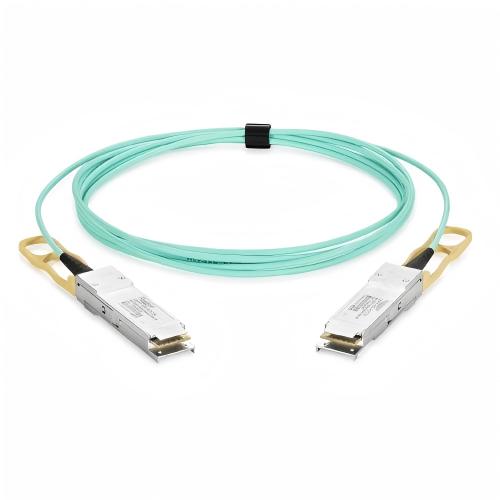
QSFP28 DD cable (Quad Small Form-Factor Pluggable Double Density) is a high-speed interconnect product for next-generation network equipment. "DD" in the product nomenclature stands for "Double Density," i.e., the connector has twice the number of electrical interfaces of a standard QSFP28 module. While a standard QSFP28 connector provides 4 lanes of 25Gbps, the QSFP-DD cable doubles it to 8 lanes up to 200Gbps or even 400Gbps with PAM4 modulation.
The architecture allows network operators to transition smoothly, so that they can take the same form factor to deliver more performance with minimal infrastructure replacement. QSFP-DD QSFP28 cable also allows for higher compatibility, so that interoperability between QSFP-DD ports and installed QSFP28 systems is possible for very flexible deployment.

Key Strengths and Benefits
1. High Bandwidth and Scalability
QSFP-DD cable has the capability to deliver data at 200G or 400G with a huge increase in transmission capacity per port. This is required in today's data centers, where traffic is growing very quickly with the proliferation of cloud computing, AI applications, and video streaming.
2. Backward Compatibility
One of the key advantages of the QSFP-DD QSFP28 cable is backward compatibility. It allows QSFP28-based legacy systems (100G) to be powered using new QSFP-DD ports (400G) through hybrid connections. The ease of upgradeability makes it simple to upgrade the network and lower the capital expenditure.
3. Space-Saving and Cost-Effective Design
Double-density QSFP28 DD cable doubles the number of lanes within the same QSFP28 footprint and delivers dense ports in routers and switches. Its compact size enables data centers to maximize rack space without losing cooling efficiency.
4. Multifaceted Cable Options
QSFP-DD cable has active optical and passive copper forms. Passive DACs are cost-effective to employ in racks' short-reach connections, while AOCs enable longer reach of up to hundreds of meters for inter-rack or inter-data-center uses.
5. Improved Signal Integrity
Designated to high accuracy specifications, the QSFP28 DD cable minimizes crosstalk, insertion loss, and electromagnetic interference (EMI). High-speed and high-density ecosystems are provided with reliable performance by the rugged nature of the cable.

Applications of QSFP-DD and QSFP28 DD Cable
1. Data Centers
Current hyperscale data centers utilize QSFP-DD cables to interconnect top-of-rack (ToR) switches, spine switches, and core routers. Their ability to transfer lots of data among servers makes them appropriate for high-demanding applications such as cloud storage, virtualization, and artificial intelligence-driven analytics.
2. Telecommunication Networks
As the growing 5G networks across the globe keep evolving, backbone structures require secure, fast interconnects. Data gathering and passing between base stations and data core buildings are handled efficiently by the QSFP-DD QSFP28 cable, guaranteeing the best 5G core network performance.
3. High-Performance Computing (HPC)
High-bandwidth, low-latency links rely on HPC clusters for use in scientific simulation and machine learning training applications. The QSFP28 DD cable delivers the bandwidth and reliability required in high-compute setups. Enterprise Networking
A 100G-to-200G or 400G network upgrade can be handled by QSFP-DD cables, so that upgrading won't require an overhaul of the network infrastructure.

Comparison: QSFP28 vs. QSFP-DD
|
Feature |
QSFP28 |
QSFP-DD |
|
Lanes |
4 × 25G |
8 × 25G or 8 × 50G |
|
Data Rate |
100G |
200G / 400G |
|
Compatibility |
100G systems |
Backward compatible with QSFP28 |
|
Form Factor |
Compact |
Same size, double density |
The double-density design of the QSFP-DD cable is the main distinguishing factor, delivering two times the performance within the same physical form factor, with greater scalability and efficiency.
Future Outlook
In the future, cloud computing, artificial intelligence workloads, and IoT equipment will continue to drive network speed and capacity needs. QSFP28 DD cable is a future-oriented cable that runs 400G and creates the door for 800G network devices. In the future, when future generations of next-generation higher-speed Ethernet technology are released, QSFP-DD cables will remain an integral component of high-speed data communication devices.
Data center and manufacturing companies are increasingly popular with QSFP-DD QSFP28 cables due to their greater bandwidth, price-performance, and backward compatibility. This ensures a smooth upgrade path to ultra-high-speed connectivity while simultaneously safeguarding current investments.
Conclusion
The QSFP28 DD cable, or simply QSFP-DD cable, is revolutionizing rapid data transfer with its double-density features, backward compatibility, and scalable performance. Its flexibility in data centers, telecommunication, and HPC usage makes it an exemplary technology in next-generation networking infrastructure. As more bandwidth demands increasingly become an urgent concern, the QSFP-DD QSFP28 cable provides the flexibility, stability, and future-proofing aspect that contemporary networks need.


-Assembly-Applications.jpg "What Is Active Optical Cable?")





No comments have been posted yet.