


.webp)


Let's take a moment to examine a specific AOC product: a 40Gb/s QSFP+ Active Optical Cable Assembly from Fibermart.

A detailed examination reveals that this active optical cable (AOC) assembly is ingeniously constructed from four distinct functional components, each playing a critical role.
( 1 ) The High-density QSFP+ Connector: This is the SFF-8436 compliant electronic interface, the part that is physically plugged into a router or switch port. It serves as the electrical gateway for data signals.
( 2 ) The 4-Channel Full-Duplex Active Optical Cable Transceiver: This is the core intelligence of the assembly. Embedded discreetly within the connector shell and invisible from the outside, this integrated optical transceiver is responsible for the crucial opto-electronic (O-E) and electro-optic (E-O) conversion, translating electrical signals into light and vice versa.
( 3 ) The MPO Optical Connector: The black, robust connector is permanently attached to the shell and the optical fibers within. This permanent factory termination is a key feature, as it effectively shields the delicate optical interface from end-user handling and environmental contaminants like dust, ensuring long-term reliability.
( 4 ) The Ribbon Optical Fiber Cable: This is the physical highway for light signals. The product pictured features a yellow-jacketed single-mode fiber, but it is important to note that multimode fiber variants are also widely available to suit different application needs.
This specific product integrates four independent single-mode fiber optic transceivers at each end. Each transceiver lane operates at data rates ranging from 1 to 10.3125 Gb/s, and the assembly can support impressive link distances of up to 4,000 meters. It is electrically compliant with the SFP+ interface specification and boasts support for a wide array of protocols, including InfiniBand, Ethernet, Fibre Channel, and Myrinet.
The fundamental concept of an AOC, therefore, is to embed the active optical transceiver components directly into the electronic connector, creating a single, integrated unit instead of relying on separate, pluggable optical transceivers and loose fiber patch cables. This is made possible by the cable being permanently attached at the factory.
However, the invention of AOC products was driven by a more fundamental necessity, which is explained in the following section.
The Genesis of AOC: Addressing the Limitations of Copper
Simply put, Active Optical Cable (AOC) assemblies were invented to overcome the growing limitations of copper cable technology in modern data centers and High-Performance Computing (HPC) applications.
The initial driving force came from the evolution of InfiniBand technology. As InfiniBand data rates increased and the physical scale of data center clusters expanded, copper cable technology was pushed to its physical limits. For instance, an InfiniBand Double Data Rate (DDR) of 20 Gigabits per second (Gbps) restricts conventional copper cable to a maximum reach of just 8 to 10 meters.
While this short distance may be acceptable for small clusters, it presents a significant physical layout challenge for larger, scaled-out computing environments. To combat the inherent bandwidth-distance limitations of high-speed electrical signals, designers were often forced to embed complex and costly amplifiers or signal regenerators within the copper cable assemblies themselves.
Furthermore, copper cable is inherently heavy and bulky, creating substantial challenges for cable management and airflow within dense data center racks. The nature of electrical signals also makes copper susceptible to Electromagnetic Interference (EMI), which can limit performance and compromise signal integrity and reliability. In a large, high-performance cluster, these issues compound significantly.
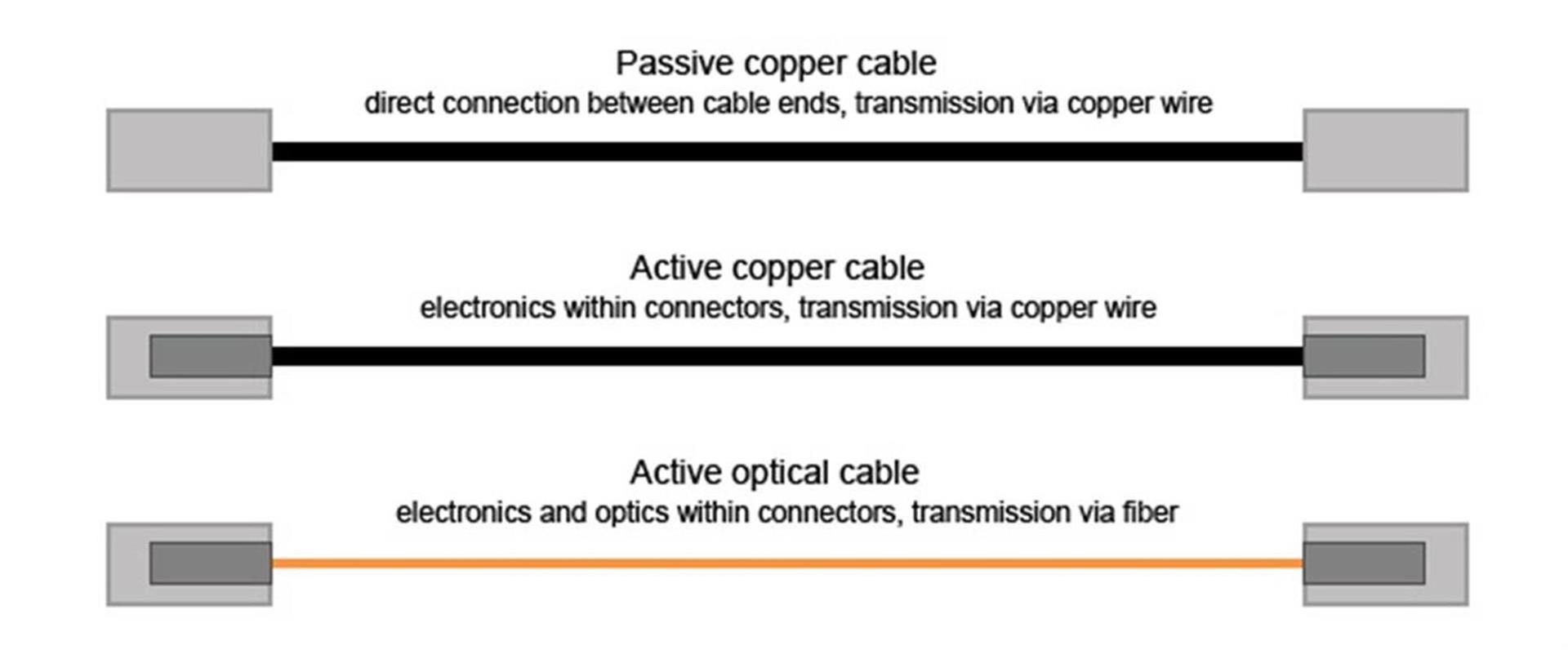
It was to directly address this critical performance gap that companies like Intel and Luxtera pioneered the development of Active Optical Cable assemblies.
The two companies pursued different technological paths. Intel's design utilized Vertical-Cavity Surface-Emitting Lasers (VCSELs) alongside a collection of discrete electronic components. In contrast, Luxtera's "Blazar" AOC products leveraged advanced CMOS photonics technology, which enabled the integration of most transceiver functions directly onto a single silicon chip, with only the laser and photodetectors remaining as separate discrete components.
The Inherent Advantages of Active Optical Cables
The Active Optical Cable assembly offers a multitude of potential advantages. When network equipment is designed with this in mind, it becomes possible to create a common electrical port that can accept either passive copper cable or an active optical cable, granting users the flexibility to select the appropriate technology and cost point for their specific needs with simple reconfiguration.
Permanently attaching the fibers to the optics also eliminates a key cost and reliability concern. The optical connector, especially for parallel optical links, is typically an expensive, precision component due to extremely tight manufacturing tolerances. This element is entirely removed from the end-user's responsibility.
The following list summarizes the major benefits of Active Optical Cable assemblies:
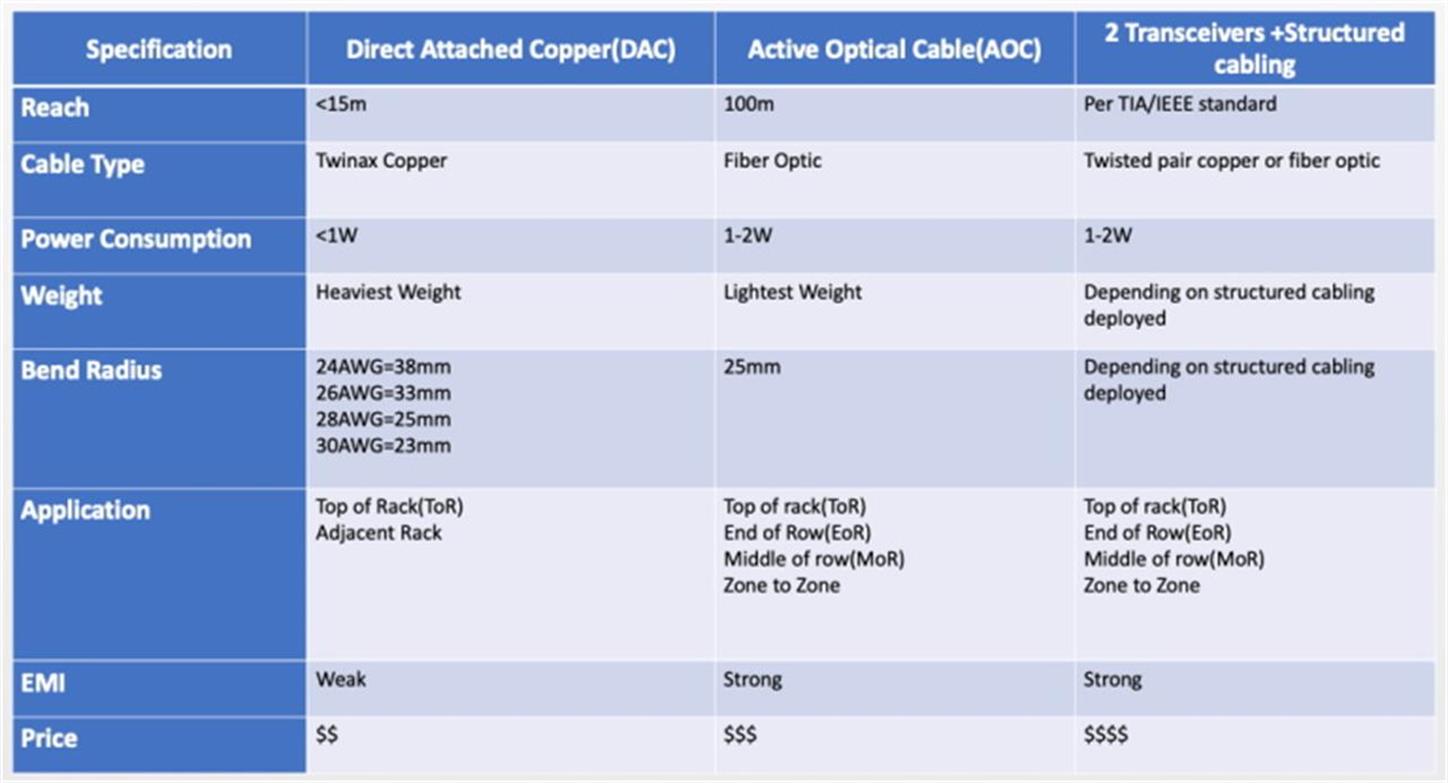
( ! ) Longer Reach and Higher Bandwidth: Capable of supporting much greater distances than copper at equivalent data rates.
( 2 ) Secure, Reliable Transport: Inherently difficult to tap without detection, providing a more secure physical layer.
( 3 ) Limited EMI/RFI Exposure: As optical cables, they are immune to electromagnetic and radio-frequency interference, ensuring signal purity.
( 4 ) Low Bit-Error Rate (BER): Capable of achieving exceptional error rates as low as 10⁻¹⁵.
( 5 ) Smaller Size and Lower Weight: Significantly thinner, lighter, and more flexible than comparable copper cables, easing installation and improving airflow.
Active Optical Cable (AOC) Assembly Applications
Active Optical Cable assemblies have been engineered to support multiple communication protocols simultaneously. Most are designed to be compliant with SFP+ Ethernet and InfiniBand electrical interfaces. A typical 40 Gb/s QSFP+ AOC, for example, supports a broad spectrum of standards:
( 1 ) Multirate Capability: 1.0 Gb/s – 10.3125 Gb/s (per lane)
( 2 ) Architecture: 4-Channel full-duplex active optical cable transceiver
( 3 ) InfiniBand: SDR (2.5Gb/s), DDR (5 Gb/s), QDR (10 Gb/s)
( 4 ) Ethernet: 10G, 40G
( 5 ) Fibre Channel: 8G, 10G
( 6 ) Storage Protocols: SAS, SATA 3G, 6G
( 7 )Storage Area Networks: Fibre Channel SAN 10G, 20G, 40G
( 8 ) High-Performance Networking: Myrinet 40G
The applications for these cables are extensive, including use in optical backplanes, rack-to-rack and shelf-to-shelf interconnects, and connecting storage arrays, hubs, switches, routers, and servers.
( 1 ) Here is a breakdown of the AOC market by key application areas:
( 2 ) Mainframes/Supercomputers (High Performance Computing – HPC)
( 3 ) High Definition TV (HDTV)
( 4 ) Personal Computers
( 5 ) Consumer Electronics (CE)
( 3 ) High Definition TV (HDTV)
( 4 ) Personal Computers
( 5 ) Consumer Electronics (CE)
Here is a breakdown of the AOC market by Bus Interfaces:
( 1 ) InfiniBand: The high-speed interface bus used inside HPC and data centers.
( 2 ) HDMI: The high-definition multimedia interface for audiovisual equipment.
( 3 ) USB: The Universal Serial Bus, ubiquitous in computing and peripherals.
( 4 ) DisplayPort: A digital display interface developed by the Video Electronics Standards Association (VESA).
Active Optical Cable Market Summary
The global active optical cable market size was estimated at USD 3.97 billion in 2023 and is projected to reach USD 9.07 billion by 2030, growing at a CAGR 12.6% from 2024 to 2030. The higher reliability of active optical cables compared to traditional copper cables, along with the widespread adoption of cloud-based services, is driving market growth during the forecast period.
Key Market Trends & Insights
( 1 ) The North America accounted for a significant share of the active optical cable market and accounted for a 37.39% share in 2023.
( 2 ) Based on form factor, the QSFP segment led the market, accounting for 25.45% of the global revenue in 2023.
( 3 ) Based on protocol, the infiniBand segment accounted for the largest market revenue share in 2023.
( 4 ) Based on application, data centers dominated the market, accounting for the highest revenue share in 2023.
Market Size & Forecast
( 1 ) 2023 Market Size: USD 3.97 Billion
( 2 ) 2030 Projected Market Size: USD 9.07 Billion
( 3 ) CAGR (2024 to 2030): 12.6%
( 4 ) North America: Largest market in 2023
In addition, factors such as digitalization and the rollout of 5G networks present significant growth opportunities for the market. The superior reliability of active optical cables over traditional copper cables, combined with the extensive adoption of cloud-based services, is propelling market growth during the forecast period. Furthermore, digitalization and the rollout of 5G networks offer significant growth opportunities for the market. Moreover, the widespread adoption of 4K and 8K Video Technologies is fueling the market growth. 4K and 8K video technologies have become prevalent in industries like medical imaging, gaming, broadcasting, and digital signage, leading to a substantial rise in the demand for high data rates and extended transmission distances.

To meet these needs, Active optical cables have become essential solutions. These progressed optical interconnects offer seamless and reliable transmission of high-resolution video signals over long distances, ensuring the quality and integrity of the video content.
Summary
Active Optical Cables (AOCs) represent a significant advancement in data transmission technology by integrating optical transceivers directly into the cable connectors, creating a single, high-performance solution that overcomes the inherent limitations of traditional copper cables, such as short reach, susceptibility to electromagnetic interference, and physical bulk. This superior design enables longer distances, higher bandwidth, and greater reliability, which has propelled their widespread adoption in data centers, high-performance computing, and consumer electronics, fueling a robust global market that was valued at USD 3.97 billion in 2023 and is projected to grow at a 12.6% CAGR to reach USD 9.07 billion by 2030, driven by key trends including North American market dominance and the leadership of the QSFP form factor.





No comments have been posted yet.