


.webp)


Introduction
People are always questioning the requirement for more bandwidth within the access every so often. With increased interest in bandwidth driven by media consumption (for example file-sharing, high-definition video, gaming etc.) and the explosion of mobile broadband, the question can be rather "What would be the next fiber access technology?".
Two technologies stick out in the industry. They're XG-PON (a.k.a. 10GPON, as a continuation of GPON and/or EPON) and WDM-PON (benefiting from the wavelength domain). This tutorial will compare these technologies based on performance, cost and power consumption. At this time, it is interesting to check the WDM-PON and GPON on one side, where WDM-PON is based on CWDM and GbE channels on each wavelength, and WDM-PON and XG-PON on the other hand, where WDM-PON is based on CWDM again, but each wavelength carries a 10GbE channel, which we'll call XWDM-PON.
In this tutorial, we'll limit our analysis for an architectural and gratifaction comparison since an economic comparison is critically determined by commercial and industrial strategies, and it is quite out of the question if somewhere there is a commercial product and on the other, a method under prototyping. However, even with no explicit calculation, the main point driving the price structure of WDM-PON and GPON/XG-PON will be clear. In order to correctly perform comparison, we have to concentrate our attention on a single WDM-PON architecture; wish to consider consider in both cases the straightforward architecture from the figures below, where ONTs and unidirectional transmission are used.
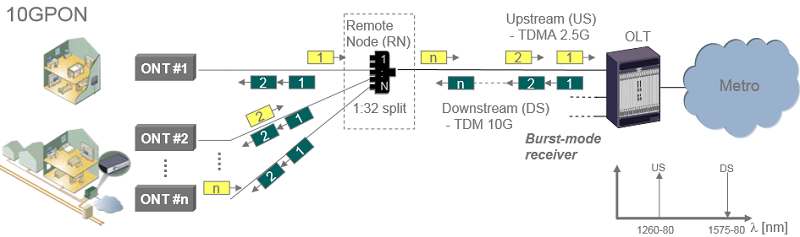

Comparison Based on Performance
Capacity: GPON versus WDM-PON
The capacity per user of a WDM-PON is easily evaluated: just one wavelength is dedicated to each end user. In general, a GbE signal is transmitted on each wavelength, assigning a capacity of just one.25 Gbps to every end user. It's worth nothing the WDM-PON has no particular advantage if area of the signal is constituted by pure broadcast (e.g., conventional IP-TV): the broadcast signal needs to be replicated through the OLT on every wavelength and independently sent to each user. The evaluation of the GPON capacity per user is not so simple once we have seen in the dedicated section.
| Item | 10GPON | WDM-PON |
| DS line rate | 10G | 1G |
| US line rate | 2.5G | 1G |
| Sub/feeder fiber (split) | N=up to 128 | N=up to 64 |
| Reach w/o RE | 20 km | 50 km |
| Reach w RE | 60 km | 100 km |
| GPON co-existence | Maybe | Maybe |
| BW/sub DS | 10G/N | 1G |
| BW/sub US | 2.5G/N | 1G |
System Reach: XG-PON versus WDM-PON
The system reach is in the XG-PON case determined by the split. For instance for a 32 split and a 28 dB link budget, typically equates to about 20 km. For WDM-PON, the AWG has much lower loss than the usual power splitter (50 km looks achievable). Both XG-PON and WDM-PON can be adapted to long-reach scenarios by introducing mid-span reach extenders:
1. For XG-PON either Opto-Electric-Optic (OEO) or SOA extenders can be used to reach up to 60 km (limited by GPON protocol).
2. WDM-PON in C/L-band using Erbium-Doped Fiber Amplifier (EDFA) could reach up to 100 km.
Fiber Utilization: WDM-PON versus GPON
Due that bidirectional transmission can be used in the GPON case, while in our example WDM-PON unidirectional transmission is adopted, the fiber infrastructure is clearly better exploited through the GPON. Unidirectional transmission may be used in WDM-PON, but comes at some cost. Ought to be fact, in order to achieve a sufficient branching ratio, DWDM is needed, for example, 32 channels with a channel spacing of 100 GHz. A possible design can individuate two different bandwidths to be used upstream and downstream. They may be separated by a gap of about 800 GHz to avoid destructive interference from reflections. In this manner, a branching ratio of 16 can be achieved.
However, 100 GHz channel spacing requires cooled DFB lasers to be used both in the ONU as well as in the OLT. This fact, besides the greater cost of the MUX/DeMUX, clearly influences the price of the system. In order to cope with this problem, the use of a WDM comb derived from the filtering of a single broadband noise source has been proposed, but it's not clear yet if real cost advantage is achieved.
Optical Link Budget: WDM-PON versus GPON
The transmission scheme of WDM-PON is very simple: attenuation is given by the loss of the MUX/DeMUX and fiber propagation (taking into account connectors, patch panels, along with other signal losing elements that can be present in the access infrastructure). Focalizing on CWDM-PON, standard CWDM optics can assure a transmitted power 0 dBm, while the receiver sensitivity depends upon the used detector. Utilizing a PIN, the sensitivity at 1.25 Gbps (assuming that a GbE is transmitted) could be about -18 dBm. This number increases to about -28 dBm using an APD. Assuming using 16 wavelengths, the worst channel experiences an attenuation of approximately 0.9 dB/km. Adding another contributions along with a system margin, we are able to assume a loss of 1.3 dB/km. Inserting these numbers in an exceedingly simple link budget evaluation, we obtain 10 km utilizing a PIN in the receiver contributing to 22 km by having an APD.
In the case of GPON, the link budgets are standardized in various GPON classes and therefore are reported within the GPON description section. Regardless, classes B and C power budgets have the same order of magnitude as the budgets evaluated when it comes to the WDM-PON. There is no relevant difference from here of view, because it was intuitive from the fact that fiber propagation and splitting losses are not strongly determined by the signal wavelength in the band relevant for fiber access.
Optical Link Budget: XWDM-PON versus XG-PON1
Standardization prescribes for that XG-PON1, a link budget sufficient to possess a reach suitable for GPON B and GPON C. Taking into account the slightly higher losses experimented by XG-PON1 wavelengths with respect to the GPON wavelength along with a set of other differences in the transmission line between GPON and XG-PON, a budget of 29 and 31 dB, depending on the comparison with GPON B or GPON C, results.
Tips: XG-PON1 functions at 10G DownStream (DS) and a pair of.5G UpStream (US), which is the current focus from the FSAN (Full Service Access Network) operators, with a "GPON like" framing. XG-PON2 functions at 10G symmetrical (longer term).
A similar prescription doesn't exist for XWDM-PON, and a real power budget will be available once that the first industrial product is produced in volumes. Presently, Ethernet components and equipment implementing 10GbE are designed for top class Ethernet applications, if not for the carrier core network as backhauling from the core machines. Thus, these systems can provide good transmission performances. For example, a 10GbE XFP created for the switches placed at the core of the private network of a large corporate or the public Ethernet switches from the core metro network are equipped with APD photodiodes and narrow line width DFB lasers, and usually assures a power budget in between -30 and -34 dBm.
It is to be noted that the XWDM-PON equipped with interfaces that guarantees a power budget of -32 dBm can cover a reach of approximately 25 km. This is not for free naturally, because we have to remember that different from the XG-PON which has a single transmitter into the OLT, an XWDM-PON includes a maximum of 16 transmitters of various colors.
Comparison Based on Technical and Cost
Burst Mode Receiver (BMR)
Dynamic Bandwidth Allocation (DBA)
Colorless ONT
Note: Moreover, WDM-PON needs one Central Office port per subscriber which adds to cost, footprint and power consumptions.
Comparison Based on Power consumption
1. However, as WDM-PON typically has lower power budget (because of much lower loss from the splitter), the power consumption per transmitter may be lower than XG-PON.2. Additional WDM-PON power savings: Integration (Tx, Rx arrays); Unused OLT ports coul d be turned off.
1. It's expected that both a XG-PON ONT and WDM-PON ONTs can be made with a power consumption within the order of 10-15 W.2. A "simple" GPON ONT has today a power consumption of -9 W.
Conclusions
a. Security: WDM-PON using its dedicated wavelength channel per subscriber is often considered to be safer.
b. Management: Point-to-point systems are typically easier to manage than point-to-multipoint systems (e.g. fault handling).4. Thus, the trend is that XG-PON is envisioned for residential applications while WDM-PON is investigated for business or bandwidth intensive backhaul.
Featured Products
Bulk Fiber Optic Cables OM3, OM4 Fiber, Tight Buffer, Indoor & Outdoor, LSZH, Figure8, ADSS Fiber Cables |
Fiber Optic Patch Cables 10G Patch Cable, Single Mode, Multimode, Armored, MPO/MTP Turnk Cables, & Pigtails |
Fiber Optic Transceivers SFP, SFP+, XFP, XENPAK, DWDM, CWDM, 40G QSFP+ & CFP Modules |
-consulting for technical supports or relevant product buying guide
Email for Sales





No comments have been posted yet.