


.webp)


The Rise of LPO, NPO, CPO
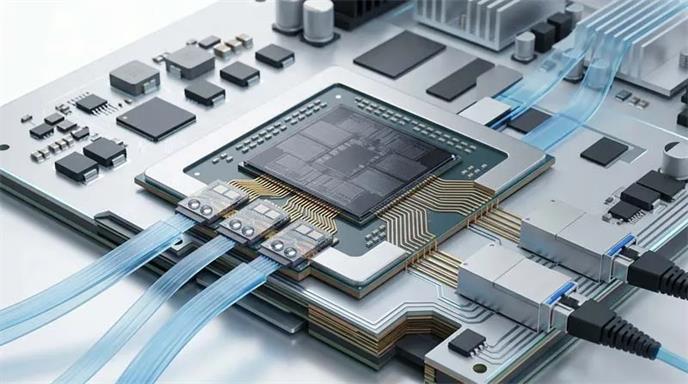
What is LPO? Linear-Drive Pluggable Optics
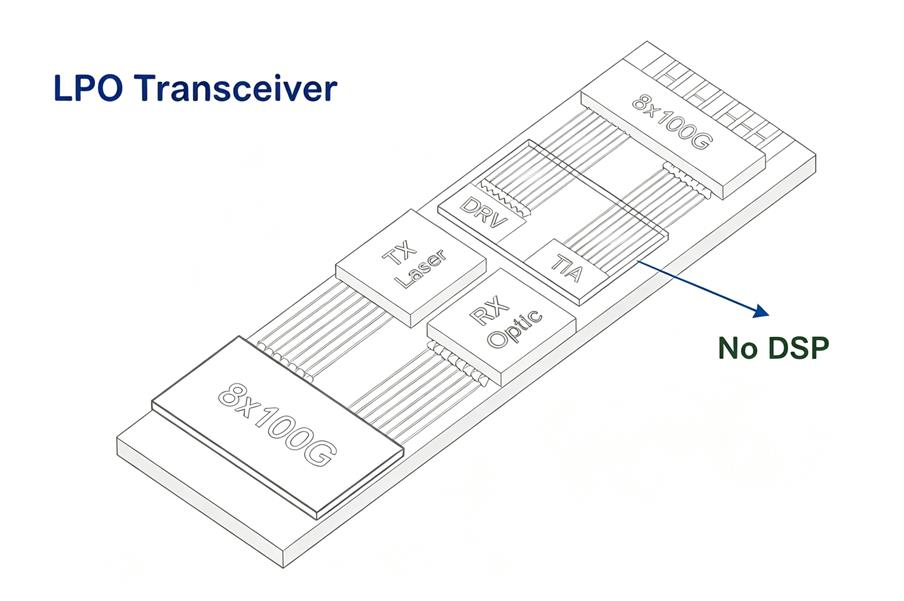
LPO, short for Linear-drive Pluggable Optics, is an innovative optical module packaging technology proposed by Macom and NVIDIA in 2022. Its core idea is to abandon the traditional digital signal processing (DSP) and clock data recovery (CDR) chips in optical modules, building a purely analog "linear direct-drive" optical link. This design directly addresses the high power consumption and high latency caused by DSP chips, making it an ideal choice for short-distance, high-performance scenarios.
Working Principle of LPO
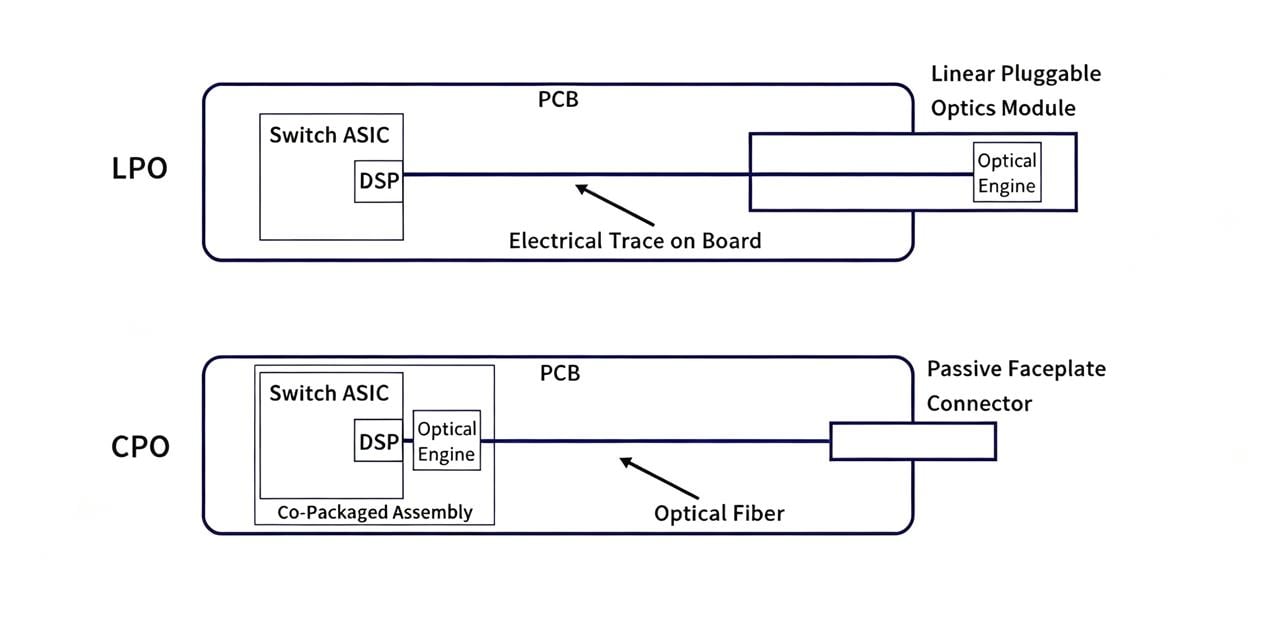
Unlike traditional high-speed interconnect solutions that rely on DSP and CDR for signal equalization, retiming, and compensation, LPO simplifies the signal processing path:
● Transmitter: A high-linearity driver chip directly drives the optical modulator, converting electrical signals into optical signals without digital processing.
● Receiver: A high-linearity transimpedance amplifier (TIA) completes photoelectric conversion and signal amplification, maintaining the analog signal path.
● Signal Compensation: The signal equalization and compensation tasks that were originally handled by the module’s DSP are transferred to the host-side xPU’s SerDes (Serializer/Deserializer), which places higher requirements on the xPU’s analog signal processing capabilities.
Key Advantages of LPO
● Low Power Consumption: Removing the DSP chip reduces module power consumption by 30%–50%, even more than 50% compared to traditional DSP solutions. This is a crucial advantage for data centers aiming to reduce energy costs and optimize PUE.
● Low Cost: DSP chips account for 20%–40% of the BOM cost of traditional optical modules. Eliminating the DSP significantly reduces overall costs, even with the slight cost increase from integrating EQ functionality into drivers and TIAs.
● Low Latency: By removing the DSP processing link, LPO shortens the signal transmission path, reducing latency—a key requirement for HPC inter-GPU communication and other low-latency scenarios.
● Easy Maintenance: LPO retains the traditional modular design of optical components, supporting hot-swapping. Failed modules can be replaced without interrupting system operation, minimizing downtime.
Challenges Faced by LPO
● Limited Transmission Distance: Without DSP’s equalization and error correction capabilities, LPO has a higher bit error rate and shorter transmission distance, usually only a few meters to tens of meters (expected to extend to 500M in the future).
● Immature Standardization: LPO standardization is still in the early stages, with poor compatibility between different vendors. It is currently more suitable for single-vendor closed systems.
● Electrical Channel Design Pressure: LPO relies heavily on the linearity and analog performance of the host-side SerDes. As SerDes speeds transition from 112G to 224G, maintaining link stability becomes a major technical challenge.
What is NPO? Near-Packaged Optics
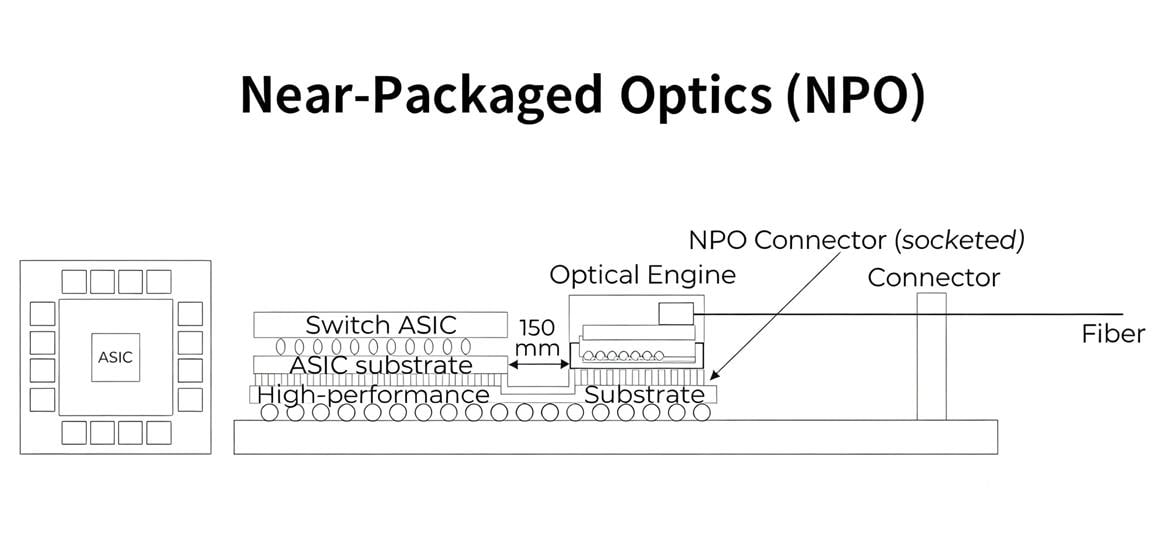
NPO, or Near-Packaged Optics, is a highly integrated optical interconnect solution that sits between traditional pluggable optical modules and CPO. As a "transition springboard" for CPO , its core concept is to place the optical engine and xPU chip (GPU, NPU, switching chip) side by side on the same high-performance PCB or organic substrate, connecting them through extremely short high-speed electrical paths (usually within a few centimeters), with channel loss controlled below 13dB.
Characteristics of NPO
NPO strikes a balance between integration and maintainability. Unlike CPO, which integrates the optical engine and xPU into the same package, NPO keeps them independently packaged, avoiding the high-complexity packaging challenges of CPO while overcoming the performance bottlenecks of traditional pluggable modules. At OFC 2026, major cloud vendors such as Google, collectively announced NPO deployment plans, confirming its status as the preferred solution for intra-cabinet and inter-cabinet interconnects from 2026 to 2027 .
Key Advantages of NPO
● High Bandwidth and Low Loss: The short signal path significantly reduces attenuation and crosstalk, enabling high-bandwidth transmission (800G and above) without relying on complex DSP compensation, ensuring high signal integrity.
● Superior Thermal Management: Independent packaging of the optical engine and xPU prevents optical components from being exposed to the high-heat environment of the GPU core, avoiding wavelength drift and performance fluctuations, and facilitating flexible thermal design.
● Easy Maintenance and High Replaceability: The independently packaged optical engine can be replaced individually when faulty, without replacing the entire xPU chip, reducing maintenance costs and complexity.
● Mature and Low Risk: Compared to CPO, NPO does not require breakthroughs in 3D packaging and other cutting-edge technologies, with lower technical risks and faster mass production. Domestic vendors such as Huagong Technology have launched 3.2T NPO optical engines, which have passed tests by Google and Microsoft and been deployed in key customers .
Challenges Faced by NPO
● Limited Integration: Compared to CPO, NPO still requires substrate wiring for electrical interconnects, resulting in lower integration density and inability to achieve the shortest possible transmission path.
● Performance Bottlenecks at High Speeds: In 1.6T/3.2T high-speed scenarios, electrical connection losses and power consumption will increase, requiring improvements in materials, wiring, and interface standards.
● Latency Synchronization: Although latency is lower than traditional modules, in ultra-large-scale interconnects, balancing latency and uniformity between NPO modules is required to ensure system-level synchronization.
What is CPO? Co-Packaged Optics
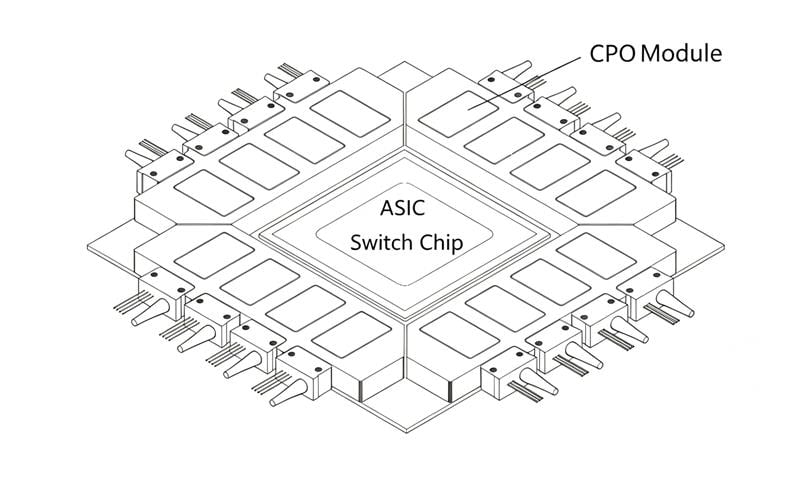
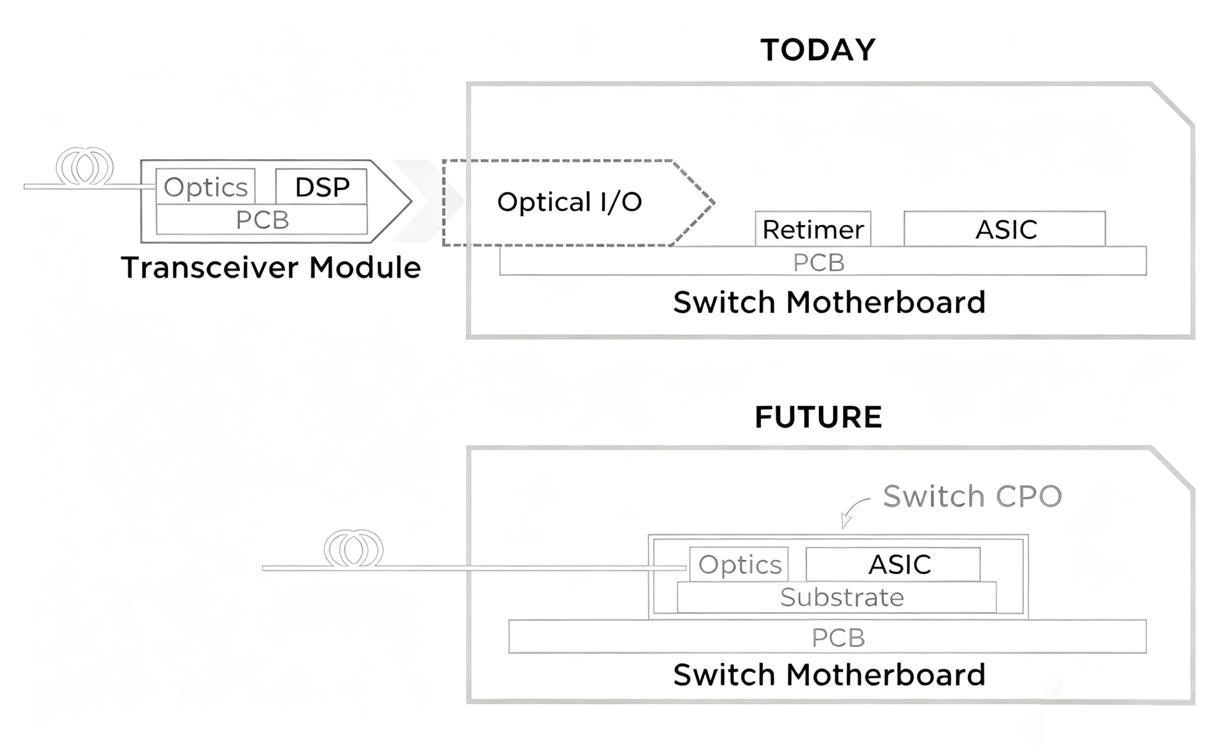
CPO, short for Co-Packaged Optics, is a highly integrated electro-optical interconnect technology evolved from NPO. Its core is to directly integrate the optical engine with the switching chip (ASIC) or computing chip (xPU) into the same package, eliminating the traditional pluggable optical module’s front-panel interface connection to the motherboard. This shortens the electrical signal transmission path from a few centimeters to millimeters, fundamentally optimizing signal integrity, power consumption, and latency.
Notably, the maturity of silicon photonics technology is the key foundation for CPO’s development—it provides CPO with a highly integrated, low-power, low-cost optical engine solution, promoting the rapid advancement of CPO technology.
Structure and Working Principle of CPO
A typical CPO system consists of an electrical chip, optical engine module, silicon interposer, and optical fiber interface, with the following working process:
● Transmission: The SerDes inside the electrical chip outputs high-speed electrical signals, which are transmitted to the optical engine through micro-bump interconnects on the interposer. The driver chip drives the optical modulator to complete electro-optical conversion, and the optical signal is transmitted through optical fiber.
● Reception: The optical signal is converted into an electrical signal by a photodetector, amplified by a TIA, and then transmitted back to the electrical chip through micro-bump interconnects for decoding.
Based on packaging depth, CPO is divided into three types: Type A (2.5D packaging, electrical connection length ≤10cm), Type B (wafer-level 2.5D packaging, higher density), and Type C (3D vertical stacking, millimeters-level interconnects, the highest integration form).
Key Advantages of CPO
● Ultra-High Bandwidth and Low Power Consumption: The millimeters-level signal path supports 1.6T–3.2T+ per-port high-speed interconnects. According to Broadcom, CPO can reduce power consumption by more than 50%, with power consumption per bit dropping from 15–20 pJ/bit (traditional modules) to 5–10 pJ/bit.
● High-Density Interconnection: Integrating the optical engine into the package frees up front-panel space, significantly increasing the I/O density of switches and GPU systems, which is crucial for high-density data centers.
● Ultra-Low Latency and High Reliability: Eliminating intermediate electrical connections and DSP compensation reduces latency, while also reducing sensitivity to electromagnetic interference (EMI), ensuring stable signal transmission.
● Optimized System Energy Efficiency: The highly integrated design reduces conversion losses, lowering the overall PUE of data centers, making it ideal for AI training clusters and ultra-large-scale switching equipment.
Challenges Faced by CPO
● High Packaging Complexity: Optoelectronic co-packaging has extremely high requirements for thermal management, mechanical stability, and packaging yield, resulting in higher manufacturing costs than traditional optical modules.
● Poor Maintainability: The tight integration of the optical engine and electrical chip means that a single optical component failure requires replacing the entire package, increasing maintenance complexity and costs.
● Immature Ecosystem: CPO requires new optoelectronic packaging standards, testing systems, and automated manufacturing processes, and is currently in the early stages of industrialization. Its market adoption is not yet urgent in the 1.6T era, as traditional pluggable modules still meet most industry needs.
LPO vs. NPO vs. CPO: How to Choose the Right Technology?
LPO, NPO, and CPO are not mutually exclusive—they complement each other and target different application scenarios, forming a complete technical system for next-generation optical interconnects:
|
Feature
|
Co-Packaged Optics (CPO)
|
Linear Pluggable Optics (LPO)
|
Near-Packaged Optics (NPO)
|
|---|---|---|---|
|
Architecture
|
Optics integrated with ASIC on package/board
|
DSP-less Pluggable Module
|
Optical engine near xPU on same PCB/substrate (separate packaging)
|
|
Power Consumption
|
Lowest (System level optimization)
|
Lower than DSP-based modules (~50% less)
|
Lower than DSP-based, higher than CPO (optimized short electrical paths)
|
|
Latency
|
Lowest (shortest paths)
|
Lower than DSP-based (No module DSP)
|
Lower than DSP-based/LPO, higher than CPO (cm-level electrical paths)
|
|
Module Cost
|
N/A (Not separate)
|
Lower (No DSP chip)
|
Moderate (independent optical engine, no DSP)
|
|
System Cost
|
Very High (Redesign, complex packaging)
|
Moderate (Leverages pluggable ecosystem)
|
Moderate (lower than CPO, higher than LPO; no complex co-packaging)
|
|
Density
|
Highest Potential
|
Similar to Standard Pluggables
|
Higher than standard pluggables, lower than CPO
|
|
Reach
|
Ultra-Short Reach (cm)
|
Short Reach (SR: ~100m, DR: ~500m-2km)
|
Short Reach (intra/inter-cabinet, ~10m-100m)
|
|
Field Serviceability
|
Very Difficult (Replace entire board)
|
Easy (Hot-swappable modules)
|
Moderate (replaceable optical engine, no xPU swap)
|
|
Vendor Flexibility
|
Lock-in (Single vendor solution)
|
High (Pluggable MSA ecosystem)
|
Moderate (better than CPO, lower than LPO)
|
|
Upgrade Path
|
Difficult (Requires new system)
|
Easy (Swap modules)
|
Moderate (replace optical engine, no full system swap)
|
|
Thermal Challenge
|
High (Integrated ASIC + Optics)
|
Lower (Heat spread across module + switch)
|
Moderate (lower than CPO, independent thermal management)
|
|
Maturity
|
Emerging (Pre-commercial/R&D)
|
Available Now (400G, 800G shipping)
|
Maturing (Deployed in select hyperscalers, 800G/1.6T available)
|
|
Best Suited For
|
Future AI/ML Clusters, Largest Hyperscalers
|
Top-of-Rack, Intra-Rack, Short-Reach Spine-Leaf
|
Intra-Cabinet/Inter-Cabinet, Mid-term transition for hyperscalers
|
● LPO: Focuses on "cost-effectiveness and low latency," suitable for short-distance (intra-cabinet) interconnect scenarios such as HPC inter-GPU communication. It is a practical solution for data centers that need to reduce power consumption and costs in the short term, with broad market prospects for mass production by the end of 2024.
● NPO: Serves as a "transition bridge" between traditional modules and CPO, balancing performance and maintainability. It is suitable for 2026–2027 intra-cabinet/inter-cabinet interconnects, favored by major cloud vendors for its low risk and mature deployment .
● CPO: Represents the "ultimate performance" direction, suitable for future ultra-large-scale AI data centers and 3.2T+ high-speed interconnect scenarios. Although it faces packaging and ecosystem challenges, it is expected to become the mainstream solution in the long term, with the global market expected to reach $5.4 billion by 2027.
Conclusion
As data centers pursue higher bandwidth, lower power consumption, and lower latency, LPO, NPO, and CPO have become the core driving forces of optical interconnect technology evolution. LPO provides a practical low-power, low-cost solution for short-range scenarios; NPO achieves a balance between performance and maintainability, accelerating the transition to high integration; CPO pushes interconnect performance to the limit, laying the foundation for future ultra-large-scale computing platforms. Understanding the characteristics, advantages, and challenges of these three technologies is crucial for data center operators, network engineers, and industry practitioners to make informed technical choices.
In this technological evolution, major vendors at home and abroad are actively deploying related products—from LPO optical transceiver modules to NPO optical engines and CPO co-packaged solutions, all accelerating the pace of commercialization. As technology matures and the ecosystem improves, LPO, NPO, and CPO will jointly reshape the data center interconnect landscape, powering the rapid development of AI and HPC industries.
FAQs
Q1: What is the difference between CPO and LPO?
CPO integrates optical engines directly with the switch ASIC to maximize bandwidth density and power efficiency, while LPO removes the DSP from pluggable modules to reduce cost and power while maintaining standard form factors.
Q2: Is LPO compatible with existing QSFP-DD and OSFP switches?
Yes. LPO modules retain QSFP-DD and OSFP form factors, allowing deployment in existing AI data center switches without architectural changes.
Q3: Is silicon photonics a replacement for CPO or LPO?
No. Silicon photonics is a foundational integration technology that supports both CPO and LPO, as well as traditional pluggable optical modules.
Q4: Which optical technology is best for AI training clusters?
Large-scale AI training clusters typically favor CPO due to its superior bandwidth density and energy efficiency, while LPO is more suitable for short-reach and cost-sensitive deployments.
Q5: Will CPO replace pluggable optics in the future?
CPO is expected to complement rather than replace pluggable optics. Different AI networking scenarios will continue to require different optical architectures.
Q6: What is NPO's positioning compared to CPO and LPO?
NPO serves as a transition between traditional pluggable modules and CPO. It is more integrated and lower-latency than LPO, while more maintainable and cost-effective than CPO, making it ideal for mid-term intra-cabinet and inter-cabinet interconnects.
Q7: What maintenance and thermal management advantages does NPO offer?
NPO uses independent packaging for its optical engine and xPU. Faulty optical engines can be replaced individually without swapping the entire xPU, reducing maintenance costs. Its independent thermal management also prevents wavelength drift from GPU heat, ensuring stable performance.
Posted on 13 April, 2026, by Francisco, Fibermart, All Copy Right Reserved.





No comments have been posted yet.