Blog Filter
Recent Order

What Is Optical Power Loss? Guide of Automatic Power Reduction

  • What Is Optical Power Loss? Guide of Automatic Power Reduction - Francisco -
  • Monday 26 January, 2026
  • 1.7K
  • 0

What is Optical Power Loss?

 
Optical power loss, also known as fiber attenuation, refers to the irreversible reduction in signal intensity of optical signals propagating through optical fiber transmission media due to various physical mechanisms. Measured in decibels (dB), this loss is one of the core technical indicators in the design and operation of optical fiber communication systems.
 
Optical power loss directly determines the maximum transmission distance, signal quality, bit error rate, and overall infrastructure investment cost of optical fiber communication systems.
 
In practical applications, excessive loss can prevent the receiving end from accurately decoding signals, leading to communication interruptions or data errors. Compensating for losses requires additional equipment such as amplifiers and repeaters, significantly increasing system construction and operation costs. Therefore, accurate understanding and quantitative control of optical power loss are prerequisites for ensuring efficient, stable, and reliable operation of optical fiber communication systems.
 

How Optical Fiber Loss Occur? The Reason of Optical Fiber Loss Happened

 
Based on the root causes, optical fiber loss can be divided into two categories: intrinsic losses and extrinsic losses. These two types of losses differ significantly in their action mechanisms, influencing factors, and manifestations, collectively determining the total attenuation level of the optical fiber link.
 

Intrinsic Optical Fiber Losses

 
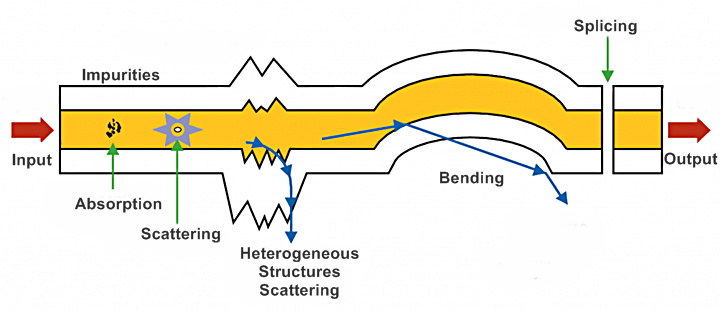
Intrinsic losses are inherent losses determined by the material properties, core structure, and physical characteristics of the optical fiber itself, which are difficult to completely eliminate during the fiber manufacturing process. They mainly occur through three mechanisms: absorption, scattering, and dispersion. The attenuation characteristics of intrinsic losses are basically fixed after the fiber leaves the factory, and their adverse effects need to be avoided by reasonably selecting fiber types and operating wavelengths.
 
General Types of Optical Fiber Losses
 

Material Absorption Loss

 
Material absorption refers to the process in which fiber material molecules absorb photon energy, converting optical energy into thermal energy or other forms of internal energy, thereby causing optical power attenuation. This loss is closely related to the fiber material composition, impurity content, and operating wavelength:
 

● Fused silica, as the mainstream fiber core material, has an optimal light transmission wavelength window. The 1300–1550 nm band is a low-loss window, widely used in optical fiber communication systems;

● Residual hydroxyl (OH⁻) ions in the fiber material are a key source of loss, forming a significant absorption peak at 1380 nm, which needs to be reduced through precision manufacturing processes;

● intrinsic impurities (such as transition metal ions) or lattice defects in the material cause selective absorption of photons at specific wavelengths, further exacerbating losses.


Scattering Loss

 
Scattering loss occurs when optical signals propagate in the fiber, and the inhomogeneity of the medium's microstructure changes the direction of light propagation. Some photons deviate from the forward transmission path and fail to reach the receiving end. It mainly includes two types: Rayleigh scattering and Mie scattering:
 

● Rayleigh scattering: Caused by microscale density fluctuations and compositional inhomogeneities formed during fiber manufacturing. Its loss intensity is inversely proportional to the fourth power of the wavelength, exerting a more significant impact in the short-wavelength band (e.g., 850 nm) and serving as one of the main loss sources for short-distance optical fiber transmission;

Mie scattering: Caused by macroscale defects such as irregularities at the core-cladding interface and impurity particles (e.g., dust, bubbles) in the core. The loss intensity is positively correlated with the size and concentration of impurities, which can be reduced by optimizing manufacturing processes and cleaning procedures.

 
Light Scattering
 

Dispersion Loss

 
Dispersion loss does not directly reduce optical power but widens optical pulses as the transmission distance increases, resulting in time differences in the arrival of optical signals of different frequencies and modes at the receiving end. This leads to signal superposition interference, indirectly reducing effective signal intensity and system bandwidth. It is mainly divided into three categories:
 

● Chromatic dispersion: Arises from the difference in propagation speeds of light of different wavelengths in the fiber. Longer wavelengths propagate faster, causing pulse broadening, which is more prominent in single-mode fibers;

Modal dispersion: Exists only in multimode fibers. Optical signals of different transmission modes travel different path lengths in the core, resulting in large time differences in arrival at the receiving end, which severely limits the transmission distance and bandwidth of multimode fibers;

Polarization Mode Dispersion (PMD): Caused by the geometric asymmetry of the fiber core material, stress generated during manufacturing, or external environmental stress. It makes the two orthogonal polarization states of optical signals propagate at different speeds, leading to pulse broadening and exerting a significant impact on high-speed, long-distance communication systems.

 
Fiber Optic Chromatic Dispersion
 

Extrinsic Losses

 
Extrinsic losses, also known as non-intrinsic losses, are caused by external factors such as fiber link construction and installation, interface configuration, operating environment, and mechanical stress. They are adjustable and are the key objects of control during the operation and maintenance of optical fiber communication systems. The main influencing factors and related calculations are as follows:
 

Interface loss: Including connector loss and splice loss, resulting from imperfect end-face geometry, core alignment deviation, surface contamination, and insufficient polishing quality of connectors/splices. The core evaluation indicators are Insertion Loss (IL) and Return Loss (RL), with their formulas provided as follows:

● Insertion Loss (IL) Formula: IL(dB) = -10 log₁₀ (Pₒᵤₜ/Pᵢₙ), where Pₒᵤₜ is the output optical power after passing through the interface, and Pᵢₙ is the input optical power.

● Return Loss (RL) Formula: 
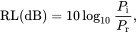
 

Return Loss Formula


where RL(dB) is the return loss in dB, Pi is the incident power, and Pr is the reflected power.

Mechanical stress loss: When the fiber is subjected to mechanical stress such as bending, stretching, or vibration, the refractive index distribution of the core and cladding changes, and some optical signals leak into the cladding, causing bending loss and stretching loss. Sharp bends have a more significant impact on the loss of single-mode fibers;

Other extrinsic factors: Deviations in the concentricity of the fiber core and cladding, mismatched connections between different types of fibers, and environmental changes such as temperature and humidity indirectly increase losses by affecting the transmission path and medium characteristics of optical signals.


Calculations of Optical Power Loss

 
The total loss of an optical fiber link is the sum of intrinsic loss, connector loss, splice loss, and safety margin. Accurately calculating the total loss is a core link in the design, link optimization, and performance verification of optical fiber communication systems.
 

Core Calculation Formulas


Basic Attenuation Formula: A(dB) = -10 log₁₀ (Pᵢₙ/Pₒᵤₜ), where Pᵢₙ is the input optical power and Pₒᵤₜ is the output optical power;

Total Loss Calculation Formula: Total Loss (dB) = Fiber intrinsic Loss + Connector Loss + Splice Loss + Safety Margin;

intrinsic Loss Calculation: intrinsic Loss (dB) = Maximum Attenuation Coefficient (dB/km) × Fiber Length (km);

Connector Loss Calculation: Connector Loss (dB) = Number of Connector Pairs × Single Connector Loss Tolerance (dB);

Splice Loss Calculation: Splice Loss (dB) = Number of Splices × Single Splice Loss Tolerance (dB).
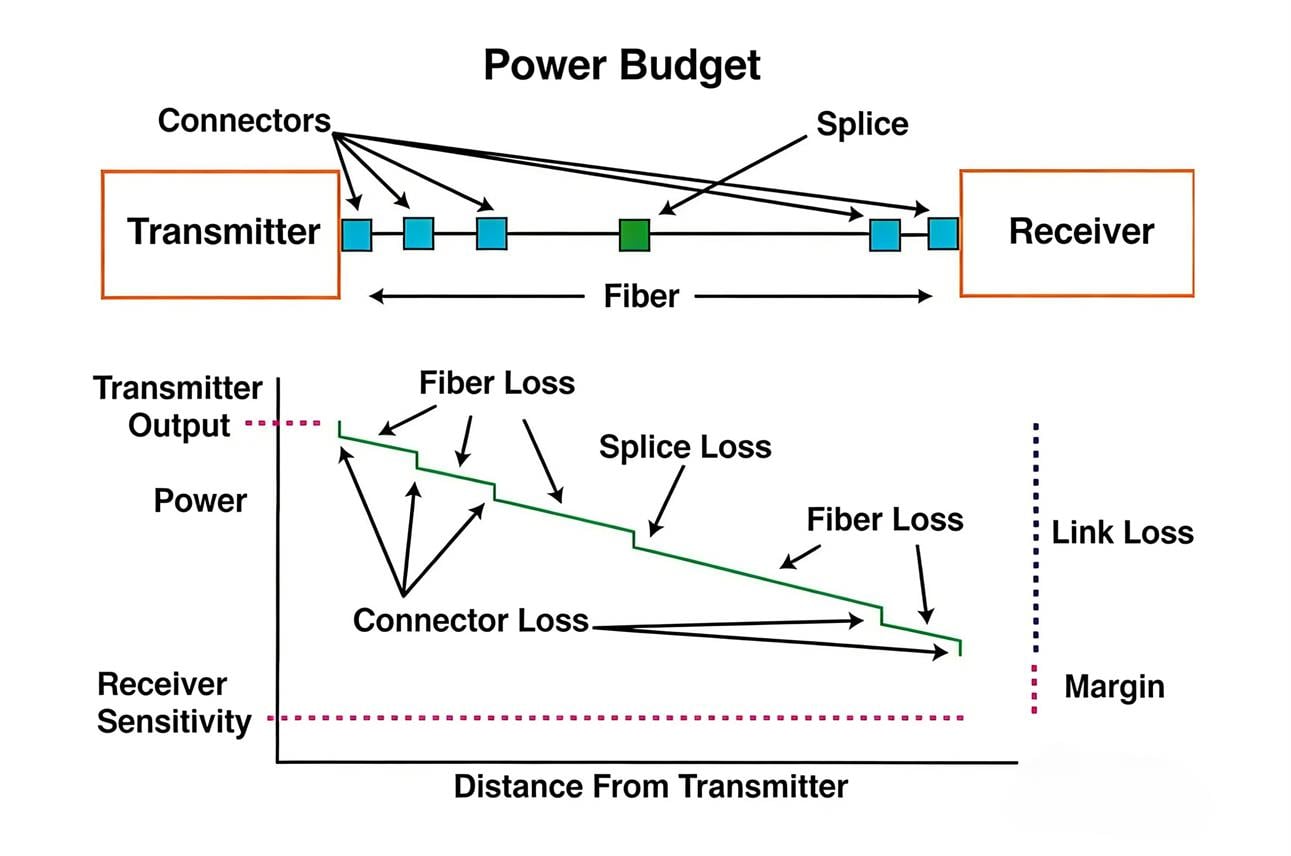
 
Fiber Power Budget Illustration
 

Engineering Calculation Example

 
Taking a single-mode fiber link as an example, combined with the Automatic Power Reduction (APR) function scenario, the total link loss is calculated. The specific parameters and calculation process are as follows:
 

Link Parameters: Single-mode fiber (G.652), operating wavelength 1310 nm, attenuation coefficient 0.4 dB/km, transmission distance 30 km; 2 pairs of connectors, single connector loss tolerance 0.3 dB; 4 splices, single splice loss tolerance 0.01 dB; safety margin 3.0 dB;

Sub-item Loss Calculation:

● Fiber intrinsic Loss = 30 km × 0.4 dB/km = 12.0 dB;

● Connector Loss = 2 × 0.3 dB = 0.6 dB;

● Splice Loss = 4 × 0.01 dB = 0.04 dB;

● Total Link Loss = 12.0 dB + 0.6 dB + 0.04 dB + 3.0 dB = 15.64 dB.

 
Engineering Tip: After calculating the total loss, ensure that the total loss is less than the difference between the transmitter output power and the receiver sensitivity (i.e., power budget). For mission-critical links, verify the worst-case (high attenuation, extreme temperature) and best-case loss levels, consider the loss degradation caused by connector mating cycles, and account for long-term factors such as aging and environmental humidity to ensure link stability.
 
 
The loss characteristics of different fiber types, operating wavelengths, and interface components vary. The following are typical industry parameter ranges. In practical applications, refer to fiber manufacturer data sheets and ITU-T recommendations (such as G.652, G.657 fiber standards).
 

Typical Attenuation Ranges of Common Fibers

 
Fiber Type/Operating Wavelength
Typical Attenuation (dB/km)
Multimode Fiber (MMF) 850 nm (OM2/OM3)
Approx. 1.0 – 3.0 dB/km (varies with modal conditions)
Multimode Fiber (MMF) 1310 nm (OM2/OM3)
Approx. 0.6 – 1.0 dB/km
Single-Mode Fiber (SMF) 1310 nm (G.652)
Approx. 0.35 – 0.5 dB/km
Single-Mode Fiber (SMF) 1550 nm (G.652)
Approx. 0.18 – 0.25 dB/km
 

Relationship Between Attenuation and Power Loss Percentage

 
Attenuation (dB/km)
Approx. Power Loss per Kilometer
10.0
Approx. 90%
3.0
Approx. 50%
0.1
Approx. 2%
 

Typical Loss Margins for Connectors/Splices

 
Component Type
Typical Loss (dB)
Notes
Single Connector (High-Quality UPC)
0.1 – 0.35
Depends on polishing quality, interface type, and cleanliness
Single Connector (APC)
0.1 – 0.3
Better return loss performance compared to UPC
Fusion Splice (Properly Executed)
0.01 – 0.05
Automated equipment + standardized procedures reduce loss
Mechanical Splice
0.05 – 0.3
Large loss variation; not suitable for critical links
 

How to Control and Optimize Optical Power Loss?

 
Reducing optical power loss requires a full-process management system integrating design, construction, and operation and maintenance. Through standardized operations, regular maintenance, and technological upgrades, precise control of link loss is achieved to ensure system performance.
 

Routine Inspection and Cleaning Maintenance

 
Interface contamination and end-face damage are the main causes of extrinsic losses, requiring a regular inspection and cleaning mechanism:
 

● Regularly inspect the integrity of connector end-faces and splices using a fiber optic microscope to identify defects such as scratches, dents, and contamination;

● Clean interfaces with alcohol wipes, lint-free swabs, or specialized fiber optic cleaning tools to avoid dust and oil residue, and promptly install dust caps after cleaning;

● Establish a loss performance log to record loss data after each inspection, cleaning, and maintenance, and track loss variation trends.


Loss Monitoring and Troubleshooting

 
Real-time loss monitoring and fault location through professional equipment help avoid communication risks in advance:
 

● Use an Optical Time-Domain Reflectometer (OTDR) to draw the fiber link loss distribution curve, accurately locating loss anomalies at splices, connectors, bends, and fiber breaks;

● Configure an optical power meter to monitor input and output optical power in real time, dynamically calculate link loss combined with stable signals from a light source, and automatically trigger abnormal alarms;

● Predict loss degradation risks based on historical loss data trend analysis and take targeted corrective measures (such as replacing connectors, optimizing routing).
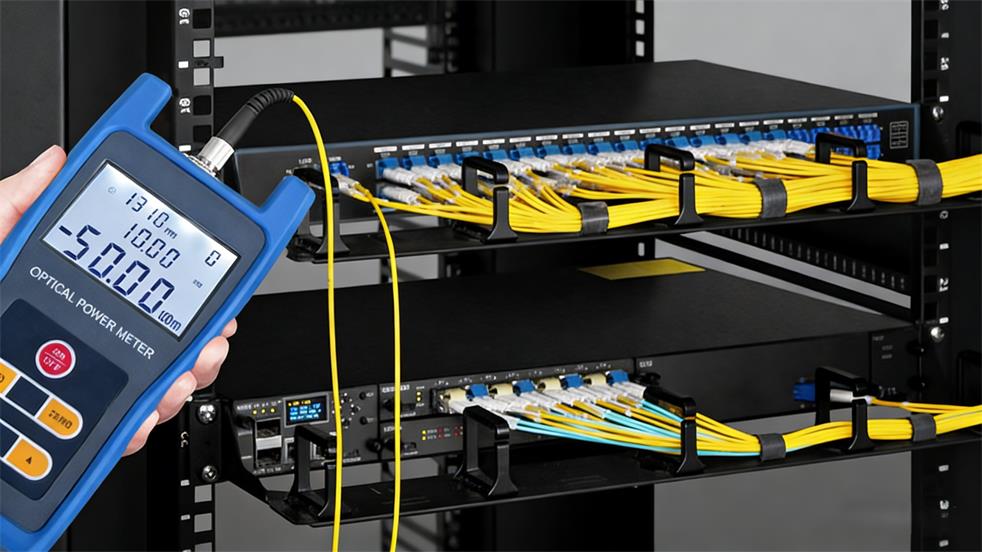
 
Fiber Optical Power Meter
 
 
Standardized operations during construction are key to controlling extrinsic losses. Strictly implement the following verification processes:
 

● Verify that the insertion loss and return loss of connectors and splices meet design specifications, and eliminate unqualified interfaces from service;

● Ensure no sharp bends or excessive stretching during fiber routing, and control the bending radius in line with fiber technical requirements (the bending radius of single-mode fiber is usually not less than 10 times the fiber diameter);

● Test the response accuracy of the Automatic Power Reduction (APR) function under abnormal scenarios such as power outages and fiber breaks to ensure proper operation of the trigger.


Automatic Power Reduction (APR) and Applications

 
Automatic Power Reduction (APR) is an important safety protection function in optical fiber communication systems. It does not directly reduce normal-state losses but ensures personnel safety and equipment stability through emergency power adjustment.
 

APR Technology Principle

 
The APR function continuously monitors the connection status of the optical fiber link. When anomalies such as fiber breaks or interface disconnections are detected, it automatically reduces the optical output power of the transmitter, controlling the power within a safe range to avoid harmful laser leakage.
 

APR Technology Advantages


Personnel Safety Protection: Controls leaked laser power below the eye-safe threshold, preventing technicians from laser irradiation injuries during maintenance and fault handling;

● Equipment Protection: Reduces strong back-reflected light generated when the fiber is disconnected, avoiding damage to sensitive components such as transmitters and optical detectors;

Improved System Reliability: Reduces the impact of abnormal operating conditions on overall network stability through rapid power adjustment, buying time for fault repair.


Optical Power Loss Testing and Measurement

 
Loss testing is a core means of quantifying loss levels and verifying link performance. Different tools are suitable for different test scenarios and should be selected based on actual needs.
 

Optical Time-Domain Reflectometer (OTDR): Its core function is to locate loss anomalies in the link. It can measure loss values at splices, connectors, and bends, and draw loss distribution curves, making it suitable for link troubleshooting and full-link loss evaluation;

Optical Power Meter: Directly measures the absolute values of input and output optical power, calculates link loss combined with known light source power, suitable for daily loss monitoring and single-point loss testing;

Light Source: Provides stable monochromatic optical signals for loss testing, ensuring the accuracy and repeatability of test results. It must match the fiber operating wavelength (e.g., 850 nm, 1310 nm, 1550 nm).
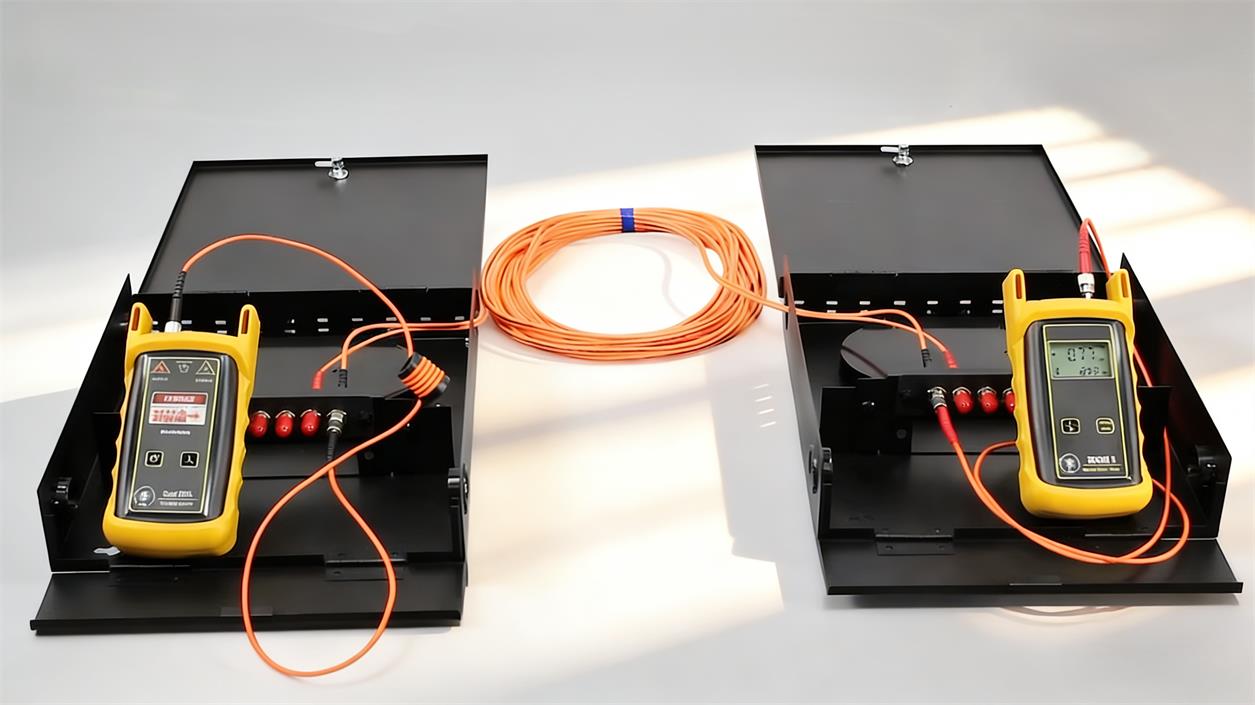
 
Fiber Loss Test
 

Conclusion

 
Optical power loss is a core limiting factor in optical fiber communication systems, and its control level directly determines the system's transmission distance, stability, and operating cost. Reducing optical power loss requires establishing a full-process management system: reasonably selecting fiber types, operating wavelengths, and interface components during the design phase to avoid intrinsic loss risks; standardizing operations during construction to reduce extrinsic losses; achieving precise control of loss changes through regular inspection, cleaning, and monitoring during operation and maintenance; and ensuring personnel and equipment safety with safety technologies such as APR.
 
By systematically addressing loss sources such as absorption, scattering, bending, and contamination, combined with scientific loss calculation, testing, and optimization methods, high-performance operation of optical fiber communication systems can be achieved, providing reliable technical support for various communication scenarios. In the future, with the development of loss-resistant fiber materials, precision manufacturing processes, and intelligent monitoring technologies, the control level of optical power loss will be further improved, driving optical fiber communication toward longer distances, higher speeds, and greater stability and reliability.
 

Frequently Asked Questions (FAQ)


What is the Acceptable Optical Power Loss Range in Fiber Optic Networks?

The loss budget varies by system design scenario: Single-mode long-distance communication systems (such as backbone networks) usually allow a total loss of 15-20 dB, with loss compensated by configuring repeaters; enterprise-level short-distance links (such as data centers) are typically designed with a loss of less than 10 dB, requiring no additional repeaters.
 

How Does APR Improve the Safety of Fiber Optic Networks?

When the fiber is broken or disconnected, APR quickly reduces the transmitter output power. On one hand, it prevents high-power laser leakage from damaging the eyes of maintenance personnel; on the other hand, it reduces the impact of strong back-reflected light on transmitter components, lowering the risk of equipment damage.
 

What is the Best Tool for Measuring Optical Power Loss?

There is no absolute "best" tool; selection depends on the scenario: The combination of an optical power meter and a light source is suitable for direct measurement of total link loss, featuring simple operation and low cost; OTDR is suitable for locating loss anomalies and accurately troubleshooting faults, making it ideal for link maintenance and fault handling.
 

How to Minimize Connector-Related Losses?

Core measures include: Using high-quality UPC/APC connectors to ensure polishing quality and core alignment accuracy; establishing a regular cleaning mechanism to avoid contamination; installing dust caps when connectors are not in use to prevent end-face damage; strictly controlling interface insertion/extraction force during installation to avoid mechanical damage.
 

What is the Difference in Bending Loss Between Single-Mode and Multimode Fibers?

Bending loss affects both types of fibers, but single-mode fibers (especially traditional G.652 fibers) are more sensitive to sharp bends, where small-radius bends easily cause optical signal leakage. New anti-bending fibers (such as G.657) significantly reduce bending loss by optimizing the core structure, suitable for scenarios with limited routing space. Multimode fibers have relatively lower bending loss but still require controlled bending radii.
 

Can APR Replace Routine Fiber Optic Maintenance?

No. APR is only an emergency safety function and cannot solve normal-state loss degradation issues (such as interface contamination, fiber aging, and accumulated bending loss). Regular inspection, cleaning, and monitoring remain core means of controlling loss and ensuring long-term stable operation of the system.
 
A 3 dB safety margin is a common practice in conventional link design, used to compensate for loss increments caused by environmental changes, component aging, and connector wear. For mission-critical links (such as medical and power communication links) or long-distance links, engineers may reserve a 3–6 dB margin to ensure compliance with power budget requirements under extreme operating conditions.
 
 
Comments: (0)

No comments have been posted yet.

Leave a Comment
You must be logged in to submit a comment.
Copyright © 2012-2026 Fiber-Mart.com All Rights Reserved. Privacy Notice. Terms of Service
Fibermart ISO9001OFCIEEEFibermart Secure Certificate
Product Tags: A | B | C | D | E | F | G | H | I | J | K | L | M | N | O | P | Q | R | S | T | U | V | W | X | Y | Z | 0-9
Email us