


.webp)


In today's networking world, PON (Passive Optical Network) and Ethernet are two widely used technologies with fundamentally different design philosophies. Understanding their differences is crucial for network planning, technology selection, and even daily operations. This article systematically outlines their core distinctions, from basic definitions to practical applications, presenting a clear technical comparison.
1. What is PON Network?
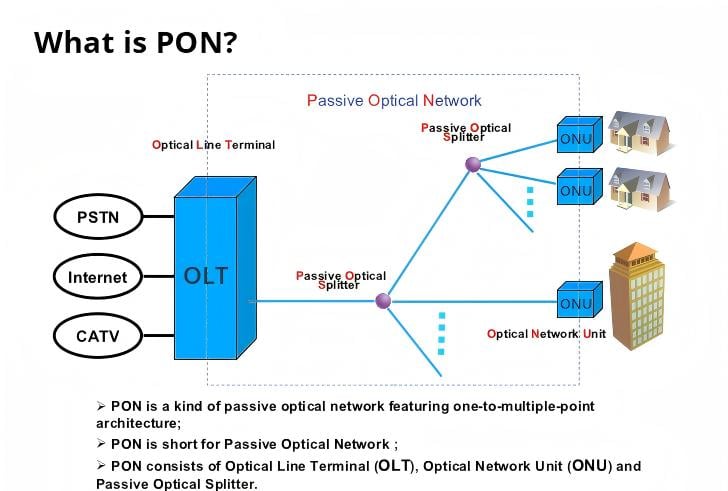
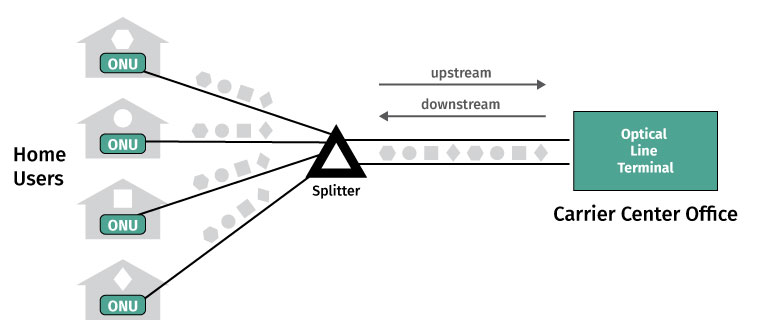
PON (Passive Optical Network) is a fiber-based access network technology. "Passive" refers to the fact that signal distribution points (like splitters) between the carrier's central office and the end-user do not require power. PON employs a Point-to-Multipoint (P2MP) tree topology, where one Optical Line Terminal (OLT) at the service provider's end serves multiple Optical Network Units (ONUs) at the user end, enabling efficient transmission of data, voice, and video services. Common PON standards include GPON and EPON.
2. What is Ethernet?
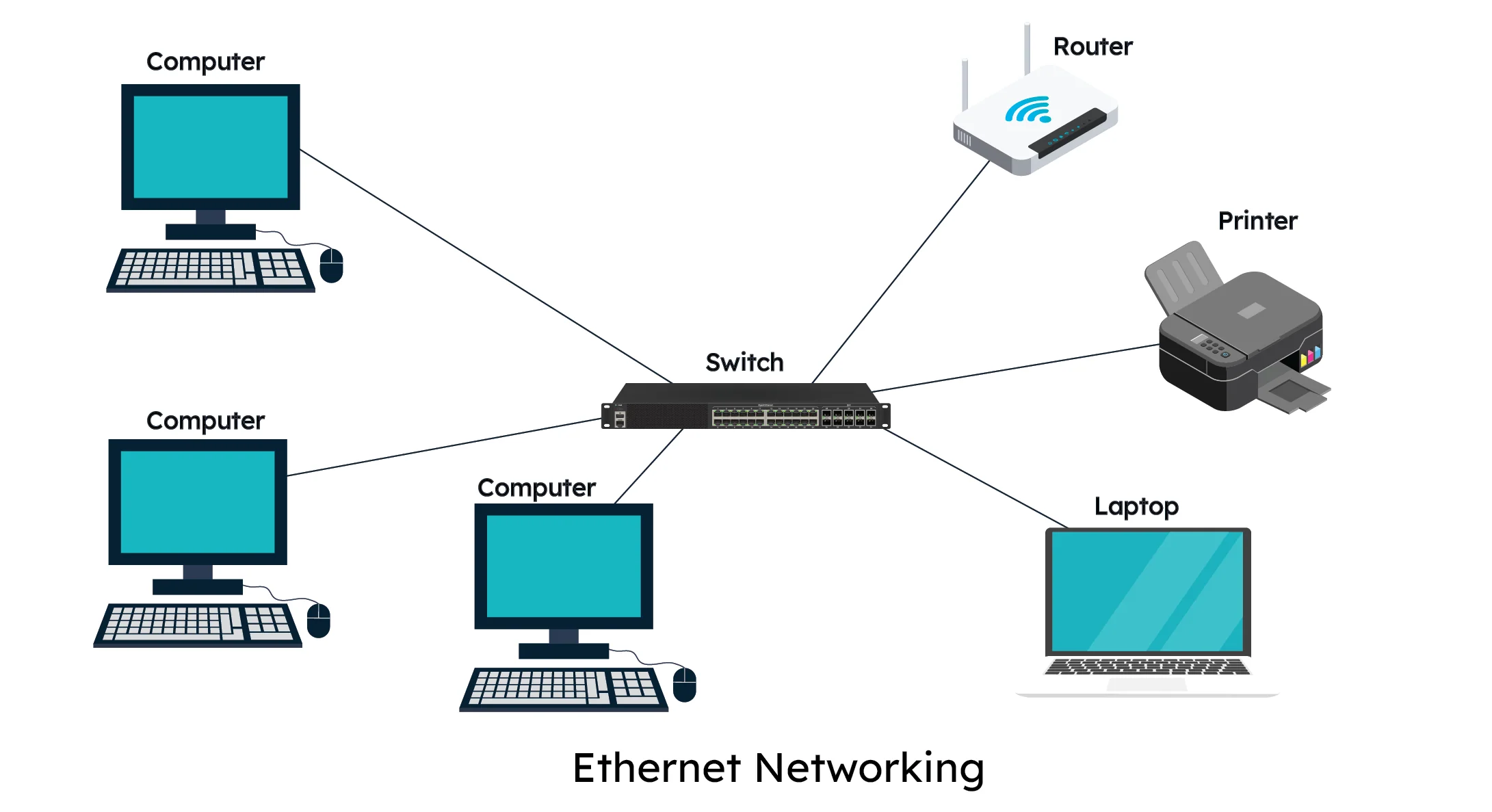
Ethernet is a classic Local Area Network (LAN) technology standard defined by the IEEE 802.3 series. It initially used bus topology and CSMA/CD protocols but has evolved to primarily use a star topology centered on switches. Ethernet uses MAC addresses for addressing and supports speeds ranging from 10Mbps to 400Gbps. It is the dominant networking technology for data centers, enterprise offices, and home networks.
3. Differences Between PON Network and Ethernet
The differences between these technologies stem from their distinct design goals.
● Design Goals
● PON: Originated from telecom carriers' need for large-scale, low-cost, wide-coverage fixed broadband access. Its core philosophy is sharing and saving—sharing the bandwidth and optical power of a single trunk fiber, and saving on costs for powered equipment and maintenance on the line side.
● Ethernet: Originated from the need for efficient, flexible, peer-to-peer interconnection in enterprise LANs. Its core philosophy is dedication and contention/switching—initially bandwidth contention via CSMA/CD, and in the modern era, port-dedicated bandwidth and peer-to-peer switching centered on switches.
● Fundamental Differences in Topology and Connection
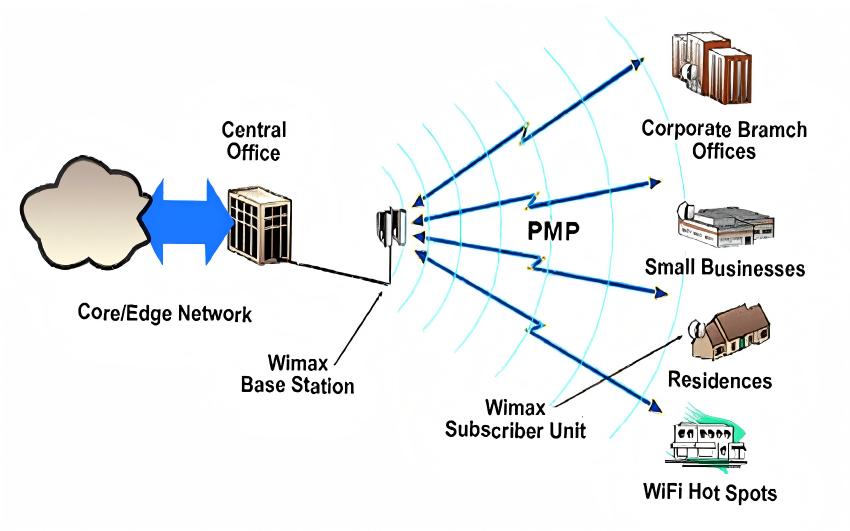
● PON: Strictly asymmetric, Point-to-Multipoint (P2MP) tree topology. One OLT port (PON port) connects logically to 32 to 128 or more ONUs via a passive optical splitter. This dictates its inherent operation: broadcast downstream, Time Division Multiple Access (TDMA) upstream.
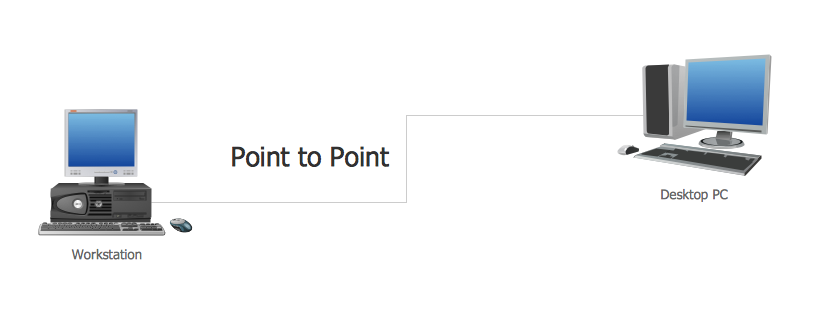
● Ethernet: Based on Point-to-Point (P2P) links. Switches enable arbitrary topologies (star, mesh, etc.). The relationship between devices is fundamentally peer-to-peer; any two ports have independent bidirectional channels on the physical link.
● Management and Operation Models
● PON: Strong central management. The OLT acts as the absolute control center, uniformly managing the registration, authentication, bandwidth allocation, and status monitoring of all its subordinate ONUs. The customer premise equipment (ONU) is a "dumb terminal."
● Ethernet: Distributed management. Each switch can be managed independently, cooperating through protocols like Spanning Tree Protocol (STP) and Link Aggregation Control Protocol (LACP). The network is flatter and has higher autonomy.
4. Architecture and Principles of PON Network vs. Ethernet
4.1 PON Network: A Network of Precise Timing Control
Architecture Details:
● OLT (Optical Line Terminal): Located in the carrier's central office, it is the brain and master controller of the PON network. An OLT chassis contains multiple PON line cards, each with multiple PON ports.
● ODN (Optical Distribution Network): Composed of purely passive components like single-mode fiber, optical splitters, adapters, and fiber splice closures. The splitter only divides and couples optical power without processing the signal.
● ONU/ONT (Optical Network Unit/Terminal): Located at the user side. ONT typically refers to home user equipment (optical modem), while ONU can refer to equipment for enterprise or multi-dwelling unit access.
Working Principle Deep Dive:
1. Downstream Direction (OLT → ONU): Uses broadcast. The continuous downstream frames sent by the OLT contain data for all ONUs and are broadcast via the splitter to each branch fiber. Every ONU receives all downstream traffic but only extracts data packets matching its own LLID (Logical Link Identifier), discarding the rest.
2. Upstream Direction (ONU → OLT): Uses Time Division Multiple Access (TDMA). This is the core and challenge of PON technology.
● The OLT determines the physical distance of each ONU through ranging, calibrating its delay to ensure all ONU time slots are aligned at the OLT, preventing collisions.
● The OLT uses a Dynamic Bandwidth Allocation (DBA) algorithm to monitor each ONU's traffic demand in real-time and dynamically allocate upstream time slots. Slots can be allocated at microsecond granularity, ensuring low latency for high-priority services (like voice) while efficiently utilizing upstream bandwidth.
● Each ONU can only "turn on its laser" to send data during the precise time window granted by the OLT and must remain silent at all other times.
Think of PON as a master of time management with strict central scheduling, ensuring numerous subordinates speak in an orderly fashion without interrupting each other.
4.2 Ethernet: Evolution from Collision Domains to Switching Fabrics
Architectural Evolution:
● Traditional Shared Ethernet (Legacy): Based on coaxial cable or hubs, all devices were in the same collision domain, following CSMA/CD protocols.
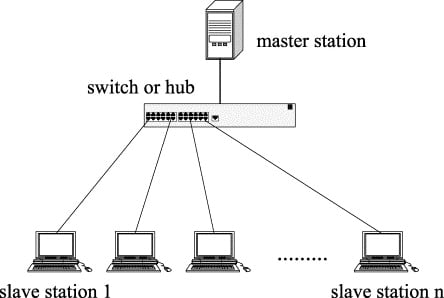
● Modern Switched Ethernet: Based on switches, each port is an independent collision domain, enabling full-duplex communication.
Working Principle Deep Dive:
1. MAC Address-Based Forwarding:
● A switch maintains an internal MAC address table, recording the MAC addresses of devices connected to each port.
● When a data frame enters the switch, the switch examines its destination MAC address, consults the address table, and forwards it precisely (unicast) out the corresponding port, rather than broadcasting (except for broadcast frames or unknown addresses).
2. Full-Duplex and Flow Control:
● Modern Ethernet operates entirely in full-duplex mode, with independent transmit and receive channels, eliminating collisions.
● Through flow control mechanisms like IEEE 802.3x Pause Frames, a receiver can temporarily instruct a sender to pause transmission, preventing buffer overflow.
3. Switching Core: The core is a high-speed switching fabric/bus, allowing all ports to perform line-rate data switching simultaneously at the hardware level.
Ethernet is like an efficient decentralized postal system. Each switch is a sorting center, quickly determining the delivery route based on the specific address (MAC address) on the envelope (data frame).
5. PON Network vs. Ethernet Transmission Medium: More Than Just "Wires"
5.1 PON Network: The Art of Fiber Optics
● Mandatory use of Single-Mode Fiber (SMF): Core wavelengths are 1310nm (upstream) and 1490nm/1550nm (downstream). Single-mode fiber has a small core diameter (9μm), low dispersion, and is suitable for long-distance (20km+) transmission.
● Optical Power Budget is Critical: Because splitters introduce significant optical power loss (~21dB for a 1:64 split), PON systems have strict budgets for optical link loss. The total loss from OLT transmit power to ONU receive sensitivity must be within the standard range, determining the maximum split ratio and transmission distance.
● Application of WDM Technology: Wavelength Division Multiplexing (WDM) is often used in ODNs where fiber is scarce. For example, in GPON, 1490nm is used for downstream data, 1550nm for broadcast TV, and 1310nm for upstream—all three wavelengths coexist on a single fiber.
5.2 Ethernet: A Diverse Choice of Media
● Twisted Pair (Dominates Short Range):
● Cat5e/Cat6: Supports up to 1Gbps for 100 meters, the absolute mainstay for office and home wiring.
● Cat6A/Cat7/Cat8: Supports 10Gbps or even 40Gbps over shorter distances (30-50 meters), used for high-performance workstations and data center top-of-rack connections.
● Fiber Optics (Dominates Long Range & High Speed):
● Multimode Fiber (MMF): Large core diameter (50/62.5μm), short transmission distance (a few hundred meters), low-cost equipment (optical modules), commonly used for intra-data center connections.
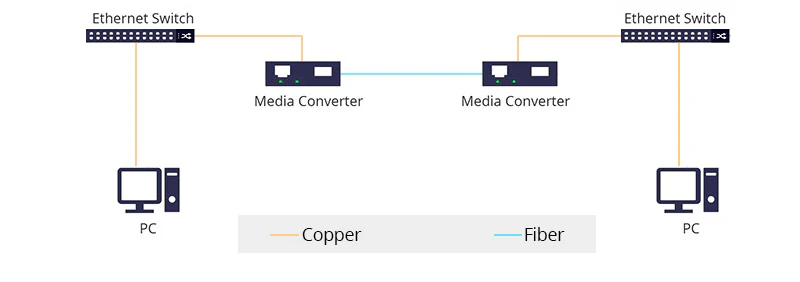
● Single-Mode Fiber (SMF): Transmission distances can reach tens of kilometers, the only choice for metropolitan area networks, backbone networks, and Data Center Interconnects (DCI). High-speed Ethernet (e.g., 100GE, 400GE) almost entirely relies on single-mode fiber and advanced modulation techniques.
● Coaxial Cable & Wireless: In specific historical or niche scenarios, Ethernet protocols can also run over coaxial cable (early days) or wireless media (Wi-Fi, essentially wireless LANs carrying Ethernet frames).
6. PON Network vs Ethernet Applications
6.1 PON Network: Why is it the King of Access Networks?
● Fiber to the Home (FTTH): Its cost-effectiveness is the absolute advantage. One trunk fiber serves a building or neighborhood, greatly saving trunk fiber and conduit resources. The shared bandwidth model closely matches the actual tidal flow characteristics of residential users (low during the day, high at night).
● Enterprise Dedicated Access: For small and medium-sized businesses, PON provides a more economical Gigabit/10Gigabit access solution compared to traditional Ethernet leased lines (like direct fiber). Carriers can configure Minimum Guaranteed Bandwidth and Maximum Bandwidth for each ONU.
● Video Surveillance Backhaul: The topology naturally matches the scenario of numerous dispersed cameras (ONUs) sending video streams back to a monitoring center (OLT), and fiber offers strong interference resistance.
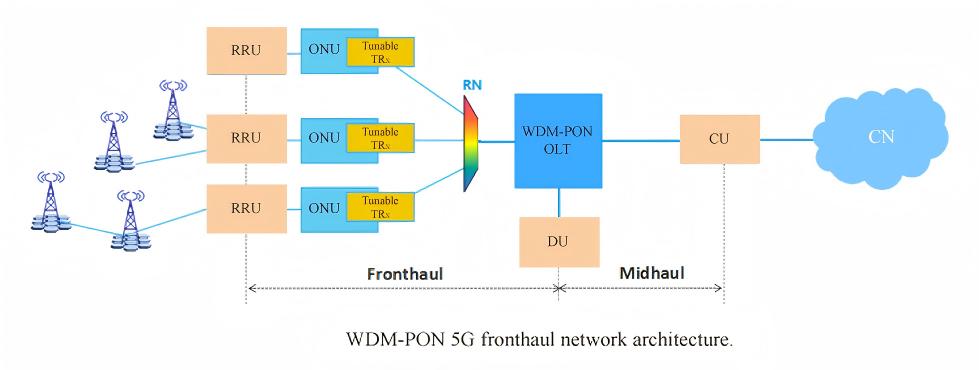
● 5G Fronthaul (MWDM/LWDM): Semi-active WDM-PON, evolved from PON architecture and WDM technology, has become one of the mainstream solutions for 5G fronthaul in China, providing low-cost, highly reliable connections between AAUs (Active Antenna Units) and DUs (Distributed Units).
6.2 Ethernet: The Ubiquitous Foundation of Interconnection
● Data Center Networks: Servers, storage, and switches are interconnected via high-speed Ethernet (25G, 100G, 400G). Characteristics like low latency, high throughput, and lossless networking (e.g., RoCE) are key.
● Enterprise Campus/Office Networks: All wired access points rely on Ethernet switches. VLANs for traffic isolation, and PoE (Power over Ethernet) for powering APs, cameras, and phones demonstrate its comprehensive service bearing and integrated power delivery capability.
● Industrial Internet and In-Vehicle Networks: Derivative TSN (Time-Sensitive Networking) Ethernet meets the stringent requirements for determinism and low latency in industrial automation and automotive in-vehicle networks through precise time synchronization and traffic scheduling—a feat difficult for traditional PON to achieve.
● Network Backbone and Transport: Core devices in carrier metropolitan and backbone networks are interconnected via IP over DWDM over Fiber, where the underlying interfaces are still high-speed Ethernet.
7. Product Selection Guide
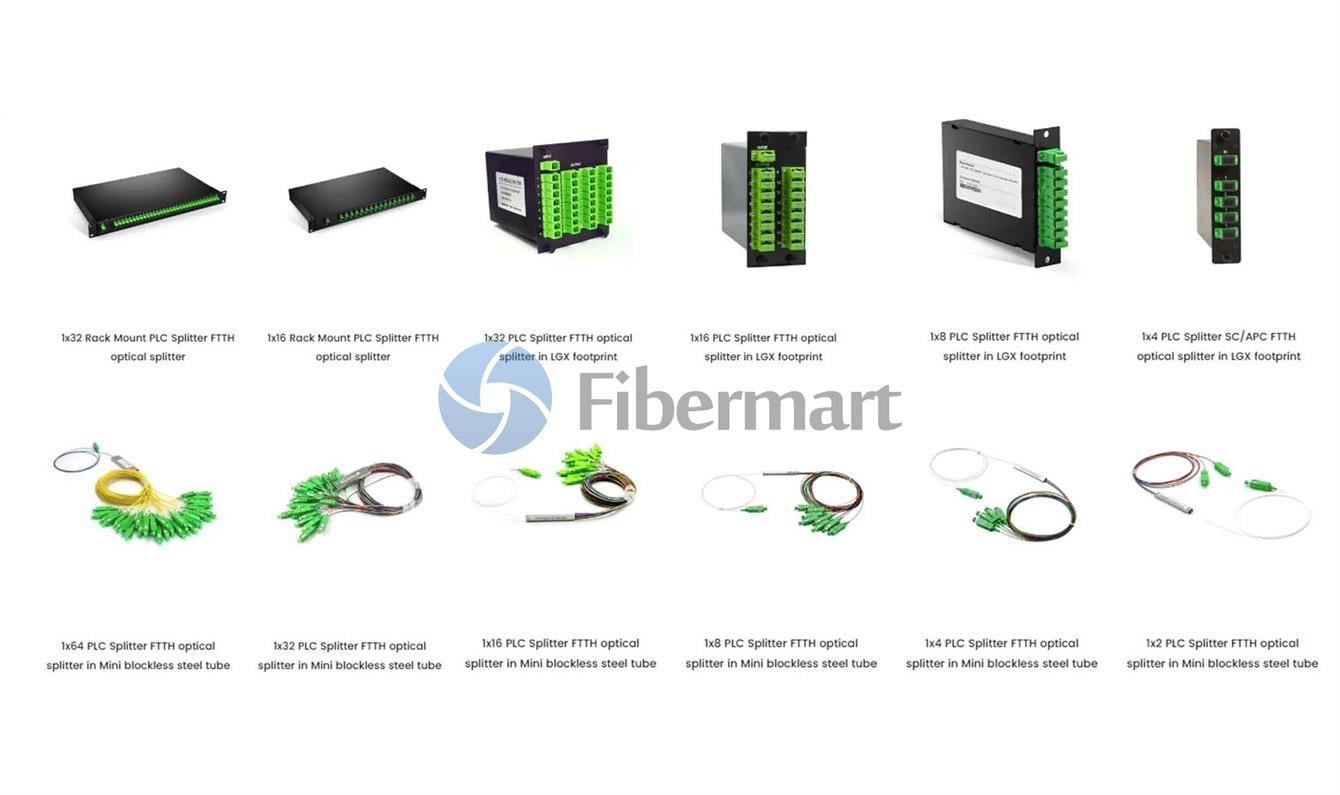
To help you quickly match your needs, the table below summarizes Fibermart's core product lines and their typical applications in PON and Ethernet networks:
|
Product Category |
Corresponding Technical Points & Key Features |
Typical Application & Location in PON/Ethernet Networks |
Value / Problem Solved |
|---|---|---|---|
|
PON ODN. Especially PM PLC Splitters, which maintain the polarization state of the optical signal during splitting, reducing Polarization Dependent Loss, crucial for high-performance networks. |
PON Network: Passive nodes located between OLT and ONU, in fiber distribution frames or splice boxes, enabling point-to-multipoint connections. |
Enables sharing of one trunk fiber among multiple users, key to the cost-effectiveness of FTTH/FTTB networks. PM types ensure high signal quality post-splitting. |
|
|
High-Speed Ethernet (Data Centers). A single interface supports 8-144 fibers, greatly increasing density. |
Ethernet Data Centers: Used for 40G/100G high-speed interconnects between switches and between switches and servers. |
Meets data center demands for high bandwidth and density, saves space, simplifies management, foundational for high-speed Ethernet backbones. |
|
|
Transmission medium for harsh environments. Adds a stainless steel or similar protective layer over a standard patch cable. |
PON/Ethernet general purpose: for outdoor, under-floor, industrial environments and other areas that may be subject to compression or rodent damage. |
Provides superior physical protection, enhancing network reliability and durability in harsh environments. |
|
|
Component of Ethernet high-speed interface technology. Supports SR4 (multimode short reach), LR4/CWDM4 (single-mode long reach), and other standards. |
Ethernet Core/Data Centers: Pluggable modules for switch and router ports, enabling 100G high-speed optical interfaces. |
Converts device electrical signals to/from optical fiber signals, the endpoint devices for building high-speed Ethernet physical links. |
|
|
For polarization-sensitive advanced applications. Specifically designed to transmit and maintain the polarization state of an optical signal. |
Specific subsystems within PON/Ethernet: Commonly used for input/output connections of fiber amplifiers, coherent transmission, or sensing systems. |
Ensures optical signal integrity is not compromised in systems requiring polarization stability, such as lasers, amplifiers, and measurement setups. |
8. Summary
PON is a centrally scheduled, shared network technology born for optimizing large-scale, wide-coverage access scenarios. It is like a city's public transportation system (e.g., subway), using precise scheduling (DBA/TDMA) on fixed routes (fiber) to transport a large number of users (ONUs) to their destination (OLT/internet) cost-effectively. Its essence lies in sharing, saving, and control.
Ethernet is a distributed switching, dedicated network technology born for achieving flexible, efficient, peer-to-peer interconnection. It is like a city's road network and interchange system, providing standard lanes (links) and rules (protocols), allowing any vehicle (data frame) to freely and quickly choose a path (switch forwarding) to its destination based on an address (MAC/IP). Its essence lies in flexibility, high speed, and peer-to-peer operation.
In the complex modern networking world, the two are not replacements for each other but rather collaborate in different layers, complementing each other's strengths. PON typically plays the role of "capillaries," responsible for aggregating massive user traffic, while Ethernet forms the "arteries" and "internal organ circulation," responsible for high-speed switching in data centers and enterprise cores. Understanding their deep-seated differences and design logic is fundamental for scientific network architecture design and technology selection.
FAQ about PLC Splitter and Fiber Patchcord in PON Networks
What role does an PLC splitter play in a PON network?
An optical splitter is the "core distributor" in a PON network. Its primary function is to split a single downstream optical signal from the central office (OLT) into multiple signals according to a specific ratio (e.g., 1:32, 1:64) and distribute them evenly to multiple end-users (ONUs). Simultaneously, it combines upstream signals from multiple users into a single fiber for transmission back to the OLT. It enables the point-to-multipoint architecture of "one fiber serving multiple users," making it a key passive component for conserving trunk fiber resources and reducing network deployment costs.
What role does a Fiber Patch Cord play in a PON network?
A patch cord is the "flexible connection line" in a PON network. It is a short segment of optical cable with connectors (e.g., SC, LC) on both ends, primarily used for:
● Equipment Connection: Flexibly connecting devices such as OLT equipment, ODFs (Optical Distribution Frames), optical splitter trays, and ONUs.
● Link Patching: Completing and managing optical path connections and routing within distribution frames or splitter enclosures.
● Testing & Maintenance: Serving as a test lead for signal testing during installation and maintenance.
What is the difference between the PLC Splitter and Fiber Patchcord?
● Functional Nature: An optical splitter is a "signal processing/distribution" device; a patch cord is a "signal transmission channel/connection" component.
● Technical Aspect: Splitters involve complex optical beam-splitting principles; patch cords primarily focus on low-loss physical connections.
● Passive Nature: Both are passive, but the splitter is a functional passive device, while the patch cord is a channel-type passive component.
Where are their typical locations in the PON network?
● PLC Splitter: Typically deployed at optical distribution points, such as within splitter enclosures in building equipment rooms, or in hallway/outdoor distribution boxes.
● Patch Cord: Found extensively anywhere a connection is needed, e.g., from the OLT port to the ODF in the central office, from the ODF to the trunk cable, from the splitter port to the subscriber drop cable, and finally connecting to the ONU at the customer's premises.
What should be considered when selecting PLC Splitter and Patchcord in PON?
● For PLCSplitters: The split ratio (e.g., 1:32), type (PLC planar waveguide is mainstream), and package form (suited for the installation scenario) must be determined based on network planning.
● For Patch Cords: Connector type (SC/LC, etc.), fiber type (single-mode G.652.D), ferrule end-face (APC/UPC – APC is often used on the OLT side in PON networks to reduce reflection), and length must be matched.





No comments have been posted yet.