


.webp)


1310nm DFB Laser Diode
In the realm of optoelectronics, few components have proven as pivotal as the Distributed Feedback (DFB) laser diode. Among its various iterations, the 1310nm DFB laser diode stands out for its unique combination of precision, reliability, and adaptability, making it an indispensable tool in telecommunications, data transmission, and industrial sensing.
The Science Behind 1310nm DFB Laser Diodes
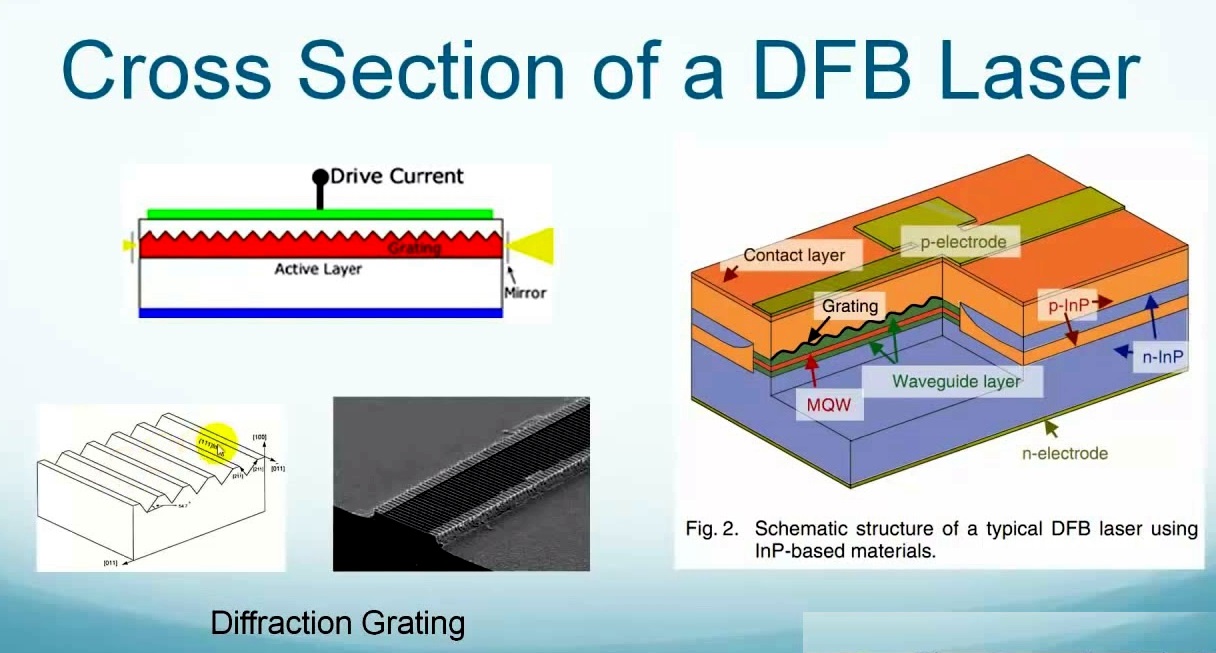
At its core, a DFB laser diode operates on the principle of stimulated emission, where electrons in a semiconductor material (typically indium phosphide, InP) transition from a higher energy state to a lower one, releasing photons in the process. What distinguishes DFB lasers from other types is their distributed feedback mechanism—a built-in grating structure within the laser cavity that selects and amplifies a single, narrow wavelength of light.
For 1310nm DFB lasers, this grating is precisely engineered to emit light at 1310 nanometers, a wavelength situated in the near-infrared spectrum. This wavelength is strategically chosen for its low attenuation in optical fibers, meaning signals transmitted via 1310nm lasers lose minimal strength over long distances. Unlike Fabry-Perot lasers, which rely on mirrors for feedback and may emit multiple wavelengths, DFB lasers produce a single-mode output—a key feature for high-speed, long-haul communication systems where signal clarity is paramount.
Key Advantages of 1310nm DFB Laser Diodes
Exceptional Wavelength Stability:The grating structure in DFB lasers ensures the emitted wavelength remains stable even when subjected to temperature fluctuations or current variations. This stability is critical in applications like dense wavelength-division multiplexing (DWDM), where multiple signals (each at distinct wavelengths) are transmitted simultaneously through a single fiber. A stable 1310nm signal prevents cross-talk and ensures reliable data retrieval.
Narrow Linewidth:1310nm DFB lasers exhibit an extremely narrow linewidth (often less than 1 MHz), meaning the light they emit is tightly concentrated around the 1310nm wavelength. This minimizes signal dispersion in optical fibers, allowing data to be transmitted over longer distances without degradation—a vital advantage for backbone networks spanning cities or countries.
High Output Power and Efficiency:Modern 1310nm DFB lasers, such as the 10mW variant, deliver consistent output power while maintaining energy efficiency. This balance makes them suitable for both short-range data centers and long-haul telecommunications, where power consumption and heat management are critical considerations.
Robustness in Harsh Environments:Designed with rugged semiconductor materials, these lasers withstand extreme temperatures, vibration, and humidity. This durability extends their lifespan in industrial settings, such as oil and gas sensing or environmental monitoring, where reliability under stress is non-negotiable.
Applications: Where 1310nm DFB Laser Diodes Shine
Telecommunications and Data Networks:The 1310nm wavelength is a cornerstone of fiber-optic communication systems. Its low attenuation in standard single-mode fibers makes it ideal for long-distance transmissions, such as inter-city or undersea cables. In metro networks, 1310nm DFB lasers enable high-speed data transfer (up to 100 Gbps and beyond) with minimal signal loss, supporting the ever-growing demand for video streaming, cloud computing, and 5G connectivity.
Sensing and Metrology:Beyond communication, 1310nm DFB lasers are integral to optical sensing technologies. Their narrow linewidth and stability make them perfect for fiber Bragg grating (FBG) sensors, which measure strain, temperature, or pressure in structures like bridges, pipelines, and aircraft. Additionally, they are used in LIDAR systems for precise distance measurement and 3D mapping, where accuracy and repeatability are essential.
Medical and Biomedical Imaging:In the medical field, 1310nm lasers are employed in non-invasive imaging techniques. Their ability to penetrate biological tissues without causing damage makes them useful for diagnosing conditions like skin cancer or monitoring blood flow.
CATV and Broadband Distribution:1310nm DFB laser diodes play a pivotal role in cable television (CATV) and broadband distribution networks, particularly in forward-path transmissions. Their high linearity and stable output power ensure clear signal delivery across multiple channels, even over extended distances. Equipped to handle the rigorous demands of analog and digital signal mixing, these lasers support the transmission of hundreds of TV channels and high-speed internet services simultaneously. The built-in optical isolators prevent interference from reflected signals, maintaining signal integrity and reducing noise—critical for delivering consistent (picture quality) and reliable connectivity to end-users. This application leverages the laser’s ability to operate efficiently in both point-to-multipoint and broadcast architectures, making it a backbone of modern broadband infrastructure.
Technical Specifications: Engineering Excellence in 1310nm DFB Laser Diodes
The performance of 1310nm DFB laser diodes is defined by a suite of precise technical specifications that underpin their reliability across diverse applications. These parameters, honed through advanced semiconductor engineering, ensure consistent operation in even the most demanding environments.
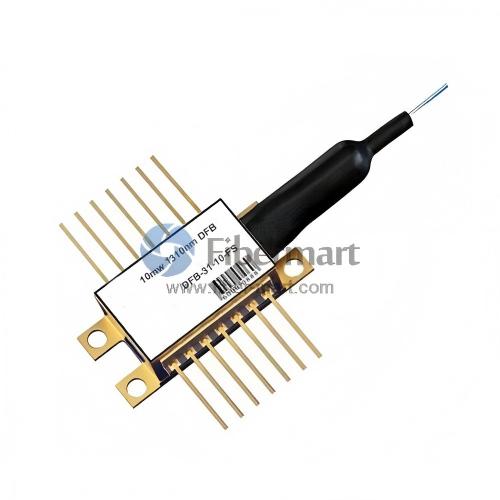
At the core of these lasers is a high-quality multi-quantum well (MQW) DFB chip, which enables efficient light generation and amplification. This chip is encased in a hermetically sealed 14-pin butterfly package, a design that integrates critical components to enhance stability: a thermoelectric cooler (TEC) regulates temperature fluctuations, ensuring the laser maintains its 1310nm wavelength even when operating in environments ranging from -20°C to 80°C. A built-in thermistor monitors temperature in real time, while a monitor photodiode tracks output power, allowing for precise adjustments to maintain optimal performance.
Optical characteristics further highlight their precision. The center wavelength is tightly controlled between 1300nm and 1320nm, with a spectral width (at -20dB) as narrow as 0.2nm, minimizing signal distortion in high-speed systems. Output power typically ranges up to 10mW, with options for higher ranges, while optical isolation of at least 30dB prevents back reflections from disrupting the laser cavity—critical for maintaining signal integrity in long-haul transmissions.
Electrical performance is equally robust. The laser operates with a forward voltage between 1.2V and 2V, and a threshold current as low as 10mA, ensuring energy efficiency. It supports modulation rates up to 2.5 Gb/s as standard, with a cut-off frequency exceeding 4GHz, making it suitable for high-bandwidth applications like CATV forward-path systems and point-to-point communication links.
In conclusion, the 1310nm DFB laser diode is a remarkable innovation in optoelectronics, combining precision, reliability, and adaptability to excel in a wide range of applications. Its unique distributed feedback mechanism ensures exceptional wavelength stability and a narrow linewidth, enabling high-speed, long-haul communication with minimal signal loss. The robustness of these lasers in harsh environments and their high output power and efficiency make them indispensable in telecommunications, sensing, medical imaging, and beyond.





No comments have been posted yet.