


.webp)


Fiber optic network design is a structured engineering process designed to plan how fiber optic infrastructure connects buildings, campuses, cities, and regions. It determines the cable routing, signal splitting and aggregation methods, and the technology selection for data transmission from the central office to end users. By 2026, this discipline will have become a core foundation supporting various applications such as residential broadband, mobile backhaul, and hyperscale data center interconnects.
Currently, several typical scenarios are demonstrating the practical application value of fiber optic network design: A medium-sized European city is deploying a fiber-to-the-home (FTTH) network for 120,000 households, requiring designers to plan routes through congested public utility corridors while reserving space for a 25G passive optical network (PON) upgrade; a university campus is replacing traditional copper cables with a modern fiber optic network supporting 400G core links and wireless backhaul to meet the access needs of thousands of concurrent devices; meanwhile, a regional operator is upgrading its backbone network using dense wavelength division multiplexing (DWDM) technology to cope with the explosive growth in bandwidth brought about by streaming media, cloud computing, and edge applications.
Decisions made during the design phase have profound impacts lasting decades. A well-designed network achieves stable performance, minimal maintenance costs, and reserves space for future expansion without incurring high rework costs. Conversely, shortcuts in planning—such as skipping site surveys, underestimating needs, or failing to properly document infrastructure information—directly translate into operational problems and budget overruns, persisting for 20 to 30 years of the physical infrastructure's lifespan.
Principle and Goal of Fiber Optic Network Design
Design Goal
High-quality fiber optic network design revolves around four core Goal, forming the basic framework of the design work:
● Reliability: Minimizing single points of failure and ensuring network availability exceeding 99.99%;
● Scalability: Adapting to user growth, bandwidth increases, and technology upgrades;
● Cost-Effectiveness: Achieving a balance between performance requirements and actual capital and operational budgets;
● Maintainability: Establishing a clear documentation system and easily accessible infrastructure for troubleshooting and maintenance.
Basic Concepts: Hierarchical Structure of Fiber Optic Networks
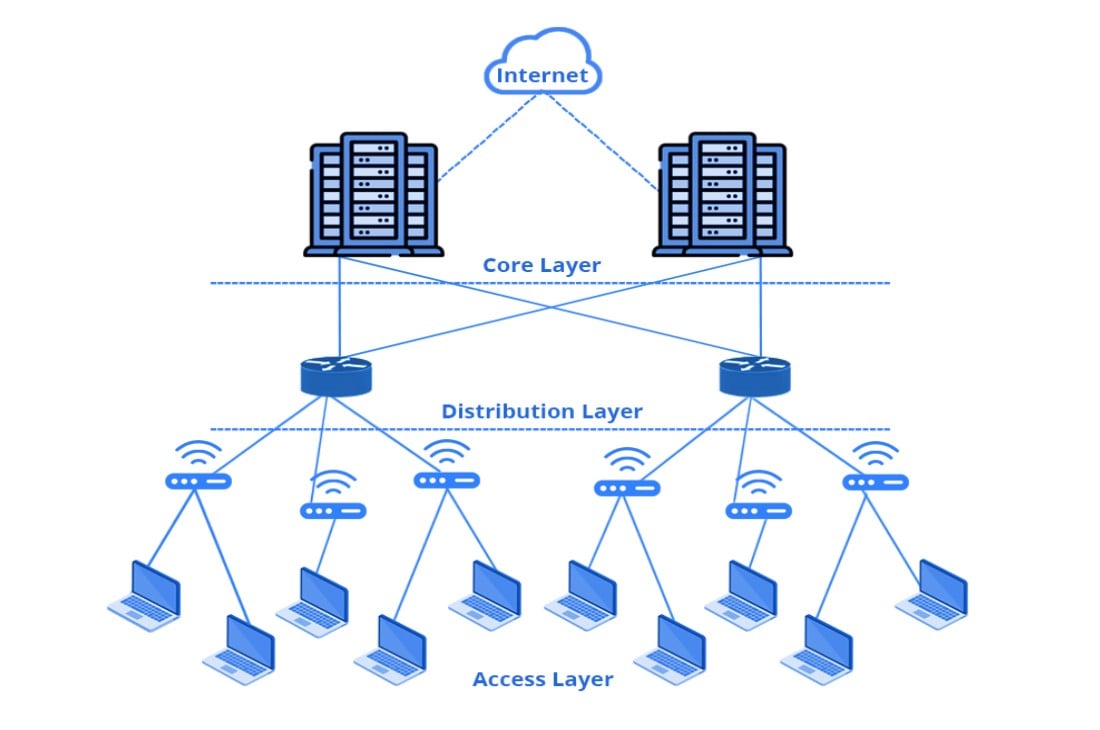
Most metropolitan area, campus, and FTTH networks employ a three-tiered hierarchical structure: access layer, aggregation layer, and core layer. This layered design simplifies troubleshooting, supports modular upgrades, and allows different teams to focus on their respective areas of work.
Each layer plays a specific role in the transmission of data from the end user to the Internet:
● Access Layer: As the "last mile" connecting individual buildings, in FTTH networks it includes the optical line terminal (OLT) at the central office, passive fiber splitters, drop fiber, and optical network units (ONUs) at the user end. Gigabit Passive Optical Network (GPON), 10 Gigabit Symmetric Passive Optical Network (XGS-PON), and emerging 25G/50G PON technologies are all applied at this layer.
● Aggregation Layer: Aggregates traffic from multiple access nodes and executes routing policies. A typical form is an aggregation ring serving urban areas or campus buildings, usually employing 10G/25G/100G Ethernet or metropolitan area DWDM systems.
● Core Layer: As the high-speed backbone network carrying aggregated traffic between areas or major facilities, this layer prioritizes low latency, low hop count, and path diversity, employing 100G/400G Ethernet or Dense Wavelength Division Multiplexing (DWDM) technology.
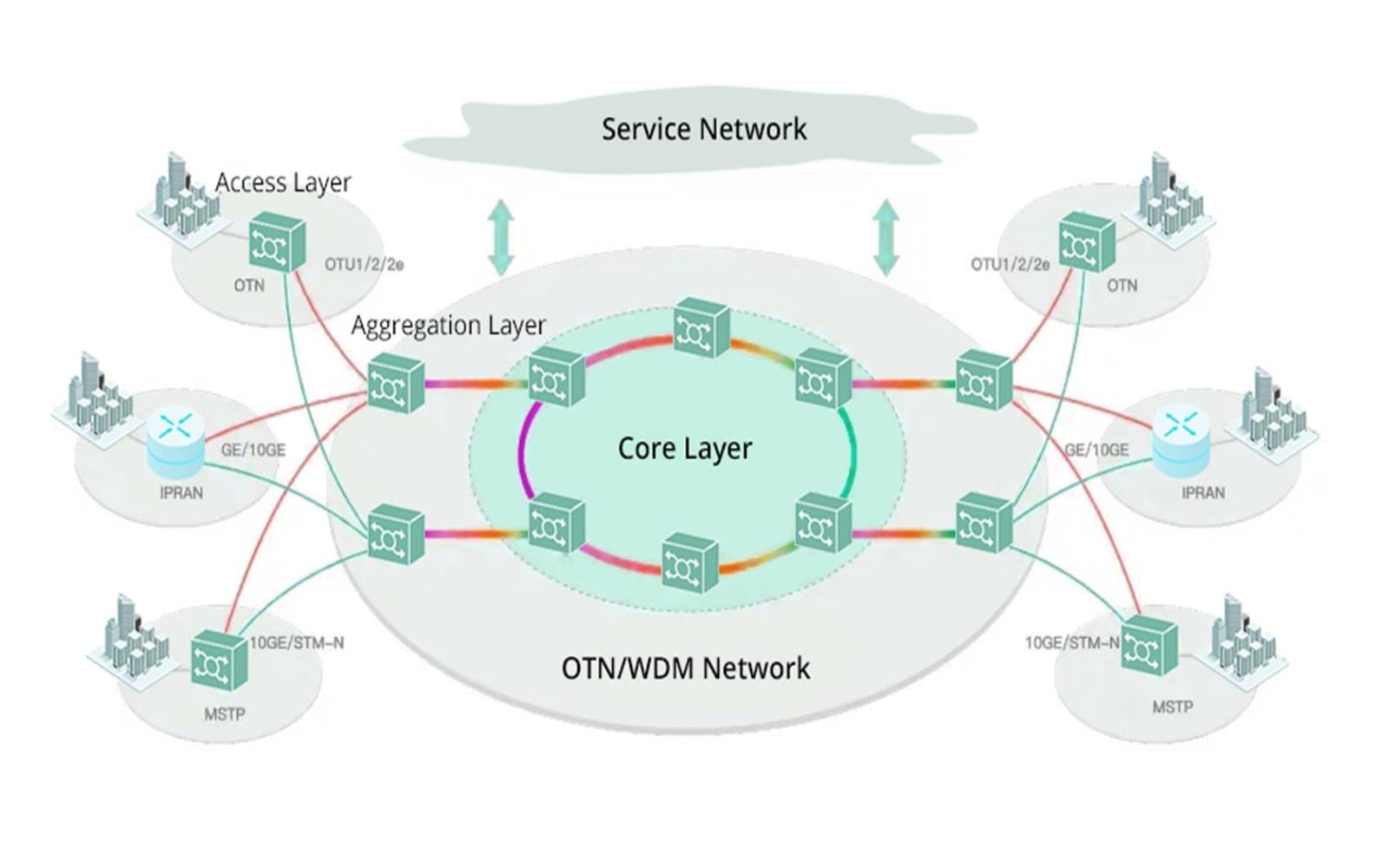
In addition to the logical layers, designers must also consider Outdoor Facilities (OSP) and Indoor Facilities (ISP): Outdoor facilities include on-site conduits, poles, manholes, and enclosures, while indoor facilities encompass equipment rooms, cabinets, and patch panels within buildings. Both must adhere to their respective design principles and work in tandem to ensure the overall network's proper functioning.
Planning Inputs and Site Analysis
Elements of Planning Inputs
Rigorous input data collection is a primary principle in fiber optic network design. Accurate maps, utility records, building data, and demand forecasts are not optional but fundamental to all design work. Designers who skip this step are likely to encounter high unexpected costs during the construction phase.
In 2026, the input data required for comprehensive design includes:
● Geographic Information System (GIS) base map: containing accurate street layouts, parcel boundaries, and topographic data;
● Existing infrastructure records: pipe locations, pole ownership, conduit capacity, and manhole/handhole locations;
● Zoning and permitting data: construction restrictions, road excavation schedules, and right-of-way requirements;
● Demand data: number of single-family homes, multi-family homes, and businesses in each area
● User forecasts: user penetration rates and bandwidth requirements per user over the next 5-10 years;
● Core tenant information: schools, hospitals, and business parks that may drive early deployment.
Importance of Site Survey and Analysis
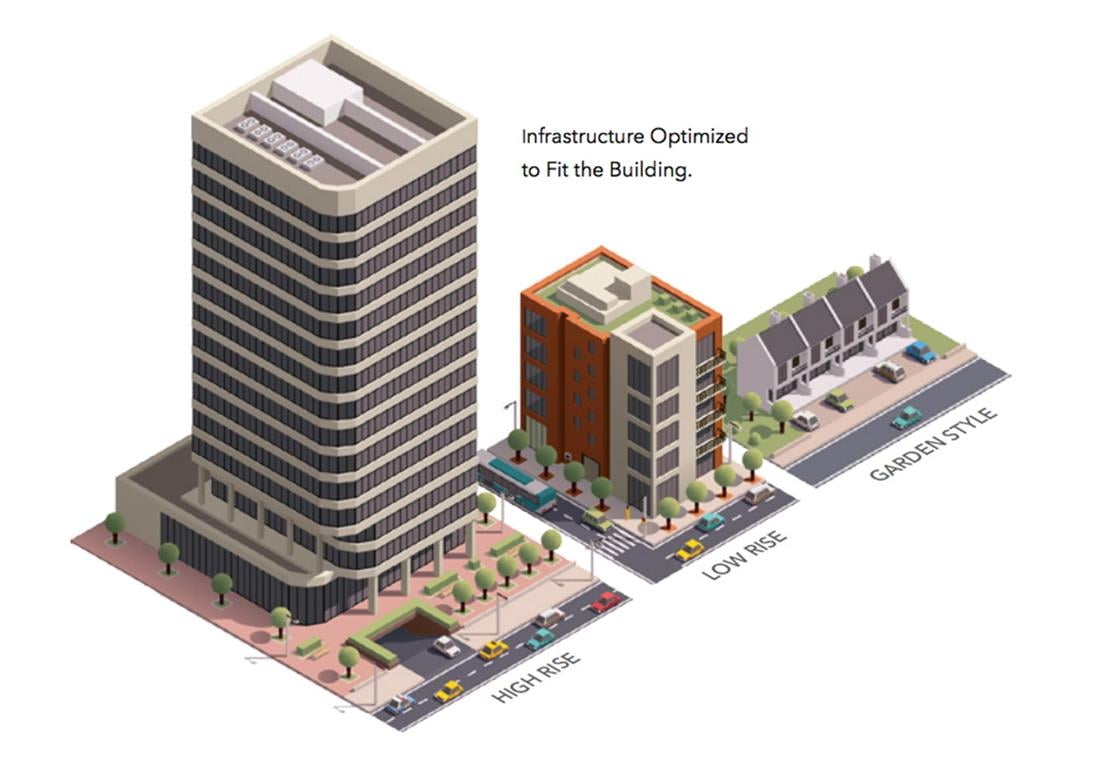
Desktop analysis is the starting point for design, while site surveys are used to verify the accuracy of recorded information. Site inspections can confirm whether poles can withstand additional loads, whether manholes are flooded or inaccessible, and whether pipes marked "available" actually have remaining capacity. Communication with local authorities and owners can also uncover constraints not recorded in the database.
The cost impact of inaccurate input data is extremely serious. In a suburban FTTH deployment project in 2024, due to an error in recording pipe locations, the construction team discovered that the existing infrastructure deviated from the drawings by 15 meters, requiring a complete redesign of the route for that area, adding three weeks to the construction period and €180,000 in excavation costs.
Tasks to be Completed Before Design
● Obtain and verify the GIS base map of the target area;
● Apply for as-built documentation from the public utilities department and verify sample locations on-site;
● Perform pole load analysis on overhead routes;
● Check the capacity and condition of manholes and handholes;
● Communicate with licensing authorities to clarify timelines and constraints;
● Survey population density and building types to provide a basis for architecture selection;
● Document regional geographical challenges, such as flood zones, rocky terrain, or congested passageways.
Network Architecture and Topology Selection
Mainstream Architecture Types
Architecture and topology decisions determine signal transmission paths, resilience implementation methods, and network scalability. In 2026, designers typically employ a variety of mature architectures to adapt to different application scenarios:
● Point-to-Point Ethernet: Provides a dedicated fiber pair for each user, offering the highest bandwidth and simplest structure, but requiring more fiber optic cable; commonly used in enterprise and data center connections;
● GPON/XGS-PON: Passive optical networks using splitters, allowing 32-64 users to share a feeder fiber, becoming a mainstream choice for residential FTTH due to its cost-effectiveness;
● 25G/50G PON: Emerging standards supporting higher symmetrical speeds, backward compatible with existing PON infrastructure;
● Wavelength Division Multiplexing (WDM): Multiplexes multiple wavelengths on a single fiber, suitable for high-capacity core networks and metropolitan area transmission.
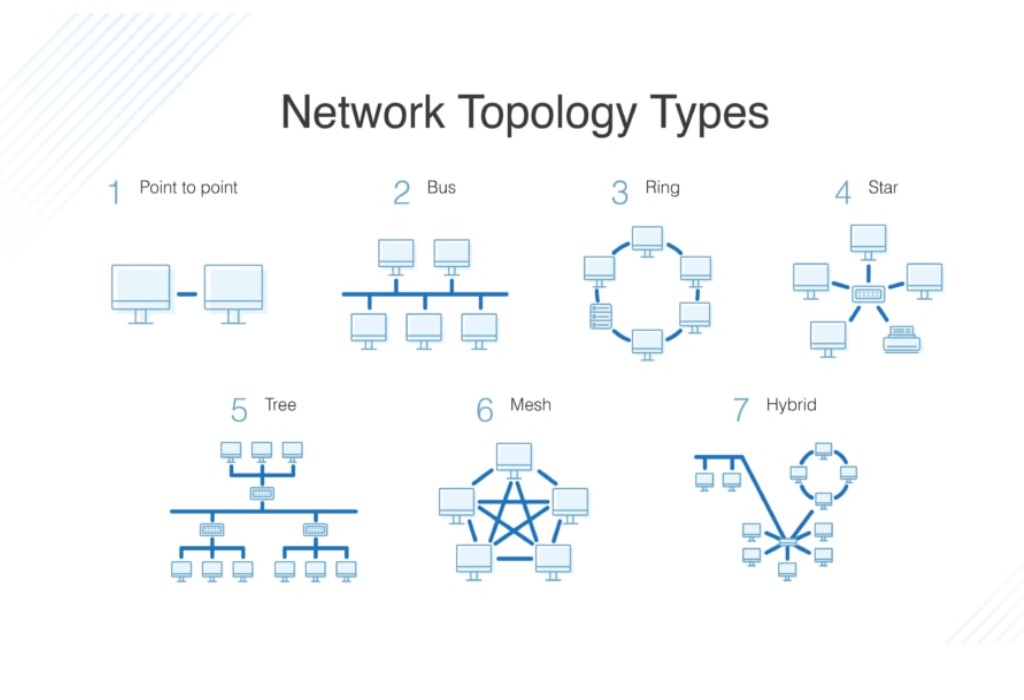
Topology Guidelines for 2026 Deployment
● Ring Topology: Suitable for urban aggregation and convergence networks. Dual reverse rotating rings can reroute traffic within 50 milliseconds in the event of a fiber optic cable break, achieving rapid failover and eliminating single points of failure.
● Tree/Star Topology: The standard choice for the FTTH access layer, prioritizing cost-effectiveness over redundancy. The feeder fiber optic cable from the central office radiates to each household through splitters.
● Mesh Topology: Applied to core networks and critical commercial areas. Multi-path design ensures service continuity even in the event of multiple simultaneous failures.
Redundancy Design and Splitting Ratio Planning
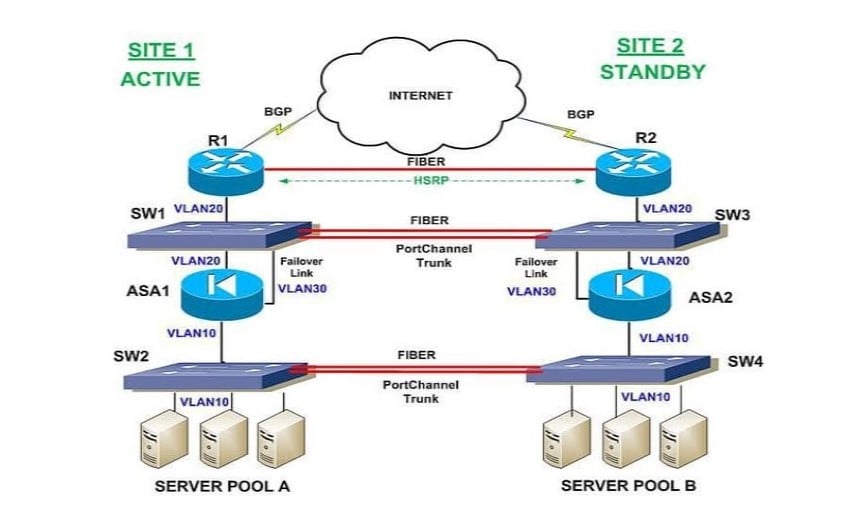
Redundancy design must focus on path diversity: Critical commercial areas should be dual-homed to different aggregation nodes with independent physical paths. If two connections share the same conduit group, a single excavation operation may cause simultaneous interruptions to "redundant" services.
In PON-based FTTH network design, the splitting ratio needs to balance several factors:
● 1:32 splitting ratio: Suitable for most residential deployments, balancing transmission distance and acceptable oversubscription rates;
● 1:64 splitting ratio: Reduces the number of optical cables, but increases splitter insertion loss, limiting single-user bandwidth;
● High splitting ratios require rigorous power budget analysis to ensure the signal reaches the furthest ONU.
Detailed Principle of Three-Layer Network Design
The three-layer model is not only an organizational management tool, but also a design principle for improving scalability, simplifying troubleshooting, and supporting upgrade planning. Each layer has clear Goal, technology selections, and design considerations.
Core Layer Design
As the high-speed backbone connecting major aggregation points, data centers, and internet switching points, the core layer's design focuses on raw performance and resilience:
● Deploy DWDM or high-capacity Ethernet (100G/400G) to carry aggregated traffic from multiple aggregation nodes;
● Reduce hop count between major sites to lower latency;
● Ensure physically independent path diversity between all core nodes;
● Design a fast protection switching mechanism, typically using Automatic Protection Switching (APS) protocol to achieve switching within 50 milliseconds;
● Reserve sufficient core capacity redundancy (typically 50%-100%) to cope with traffic growth.
Aggregation Layer Design
The aggregation network aggregates access layer traffic and serves as a policy enforcement point. Key design considerations include:
● Terminating aggregation rings serving urban areas, industrial parks, or rural regions;
● Implementing Quality of Service (QoS) policies and traffic prioritization at this layer;
● Employing resilient ring topologies when budget allows;
● Defining access technologies (PON, point-to-point) from core transmission;
● Planning capacity based on user numbers and per-user bandwidth growth requirements.
Access Layer Design
The access layer is responsible for the "last mile" of building connectivity. Design considerations include:
● Deploying Optical Line Terminals (OLTs) in central offices or remote cabinets to terminate PON or Ethernet access links;
● Planning splitter locations, balancing feeder fiber efficiency and drop cable length;
● Determining junction box and distribution box sizes based on the expected number of fiber optic connections in each area;
● Designing easily maintainable access methods, allowing technicians to operate components without significantly impacting service;
● Selecting a centralized or distributed splitter architecture based on population density. V. Outdoor Facilities (OSP) Design Principles
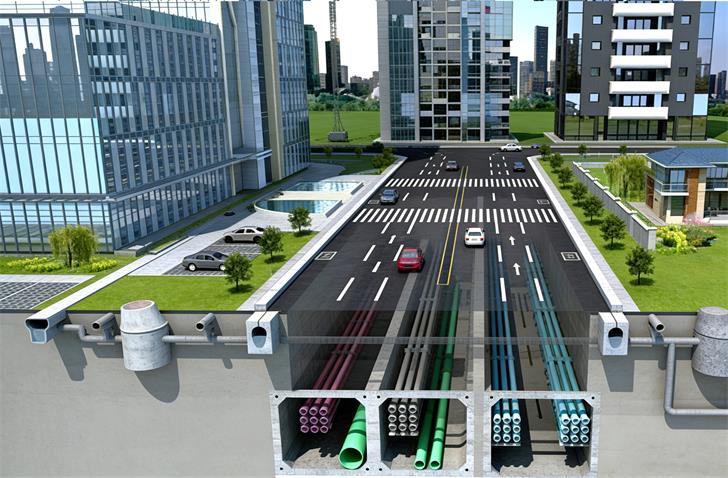
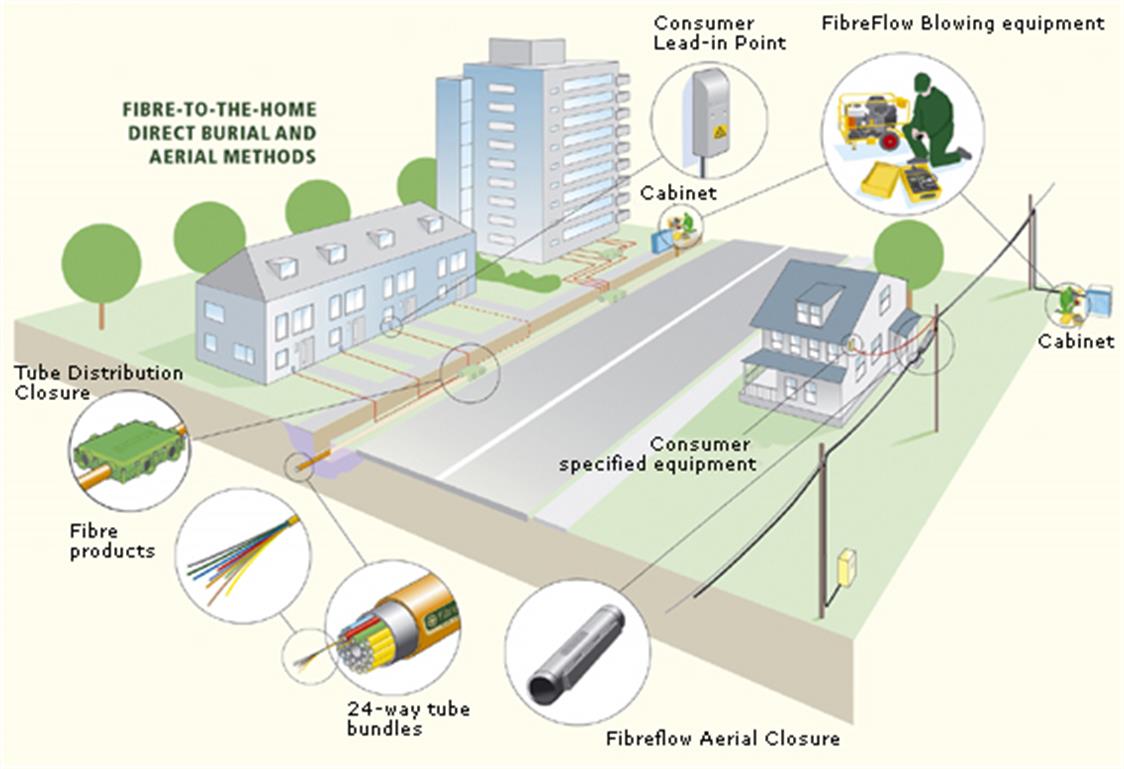
Outdoor facilities design encompasses the civil infrastructure that carries and protects the fiber optic cable, including routing, ducting systems, manholes, poles, and enclosures. This represents the largest share of capital expenditure in most projects, typically accounting for 60%-70% of the total cost in FTTH projects.
Routing Principles
● Reuse existing infrastructure as much as possible; using available ducts and poles can significantly reduce civil engineering costs.
● Avoid congested public utility access routes with limited space and complex coordination.
● Plan right-of-way and road crossing permits as early as possible; these matters often determine the project timeline.
●Consider maintenance convenience when planning routes; avoid burying fiber optic cables in private driveways to reduce long-term maintenance challenges.
● Maintain a safe distance between fiber optic routes and high-voltage power lines in accordance with applicable standards.
Duct and Cable Strategy
In FTTH construction in the 2020s, microduct systems combined with air-blown fiber optics have become the standard solution. This approach supports phased capacity expansion—deploying the ducting infrastructure once, and then adding fiber optics as needed. Traditional loose-tube optical cables remain suitable for high-density feeders and backbone routes with clearly defined capacity requirements.
Mechanical Constraints
While optical fibers possess resilience, they have physical limits that must be strictly adhered to in design:
● The minimum bending radius of modern bend-resistant optical fibers (G.657 standard) is typically 15-30 mm;
● Control traction tension during installation to prevent micro-bending losses;
● Meet isolation requirements from power lines to avoid sources of electromagnetic interference;
● Select appropriate junction boxes based on the deployment environment (aerial, buried, underwater).
Environmental Considerations
● In cold climates, the burial depth of conduits must be determined based on the thickness of the permafrost layer;
● Conduct flood risk assessments for manholes and ground-mounted cabinets;
● Balance aerial versus buried options: aerial is less expensive but more susceptible to storms and accidents; buried is more expensive but offers better protection and a longer lifespan;
● In areas with high rodent activity, use armored optical cables or conduits for protection.
Optical Budget and Performance Calculation
The Significance of Optical Budget
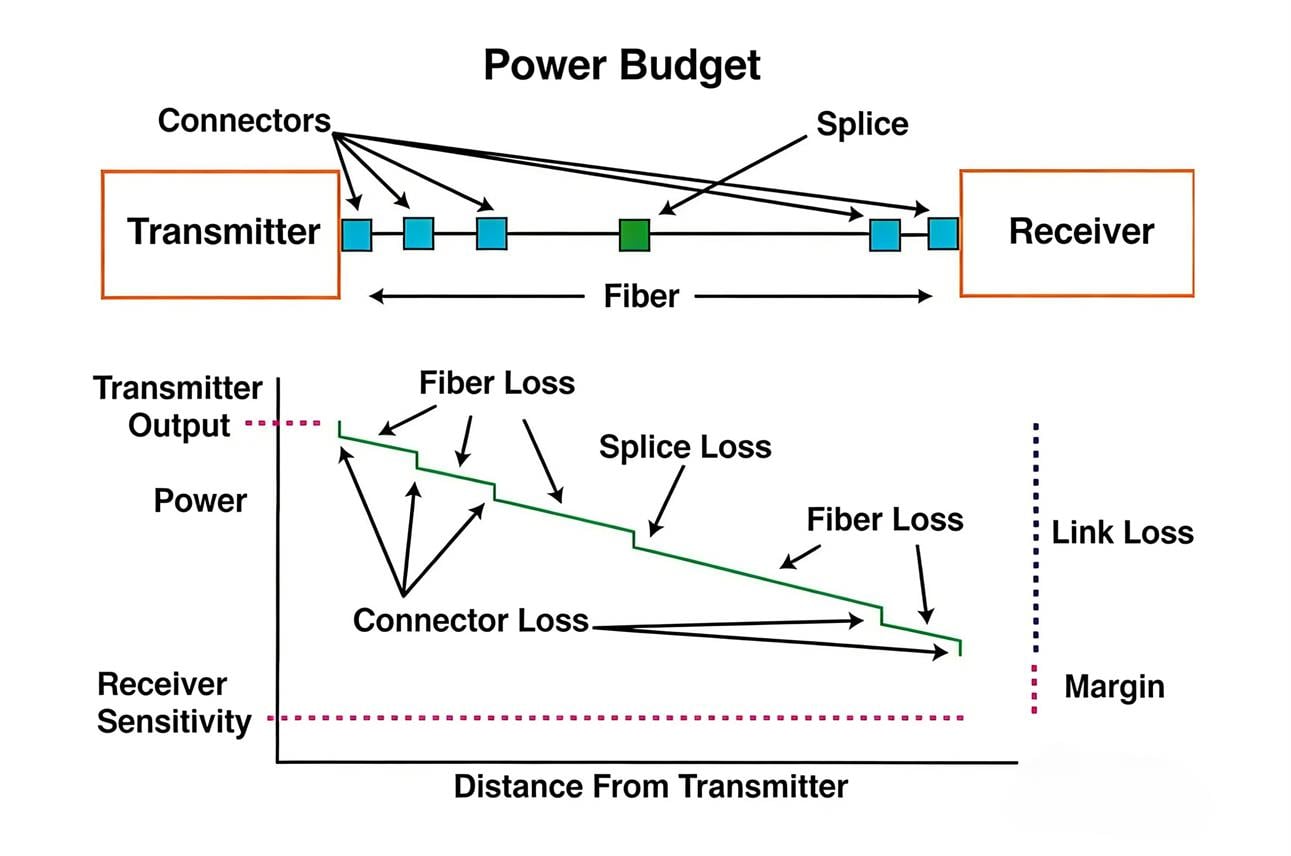
Optical budget calculation is a core design principle for ensuring that the signal power at the receiver exceeds the sensitivity threshold of the selected technology. Calculation errors can lead to complete connection failure or increased bit error rate.
The optical budget refers to the total allowable loss between the transmitter and receiver. A typical budget for a GPON Class B+ system is 28 dB, while XGS-PON and 100G DWDM systems have their own specifications, which designers must verify against the manufacturer's datasheet.
Loss Components
● Fiber Attenuation: Standard single-mode fiber attenuation is approximately 0.35 dB/km at 1310 nm wavelength and approximately 0.2 dB/km at 1550 nm wavelength;
● Fusion Splice Loss: Fusion splices typically have a loss of 0.02-0.1 dB/s, while mechanical splices have a loss of 0.1-0.5 dB/s;
● Connector Loss: Each mating connector typically has a loss of 0.3-0.5 dB;
● Splitter Insertion Loss: A 1:32 splitter introduces approximately 17 dB of loss, and a 1:64 splitter introduces approximately 20 dB of loss;
● Aging and Maintenance Margin: Typically, 1-3 dB is reserved to address performance degradation throughout the network's lifespan.
Practical Calculation Example
Taking a 1:32 split-type GPON access network serving a 12km rural area as an example, the loss budget is calculated as follows:
● Feeder fiber (8km × 0.35dB/km): 2.8dB;
● Distribution fiber (4km × 0.35dB/km): 1.4dB;
● Splitter (1:32): 17.0dB;
● Two junction boxes (6 fusion splices × 0.05dB): 0.3dB;
● Connectors (4 pairs × 0.3dB): 1.2dB;
● Aging margin: 2.0dB;
● Total: 24.7dB.
This result is within the 28dB budget range for a Class B+ system, allowing for margins for additional fusion splices or connector degradation.
Budget Calculation Key Points
●Always use the worst-case specification for components, not typical values;
● Model each independent path, including the longest feeder-entry combination path;
● Allow for future maintenance, welding, and component aging;
● Verify calculation results against the equipment manufacturer specifications of the deployed technology.
Documentation: Maps, Diagrams, and Welding Plans
Essential Document Types
Comprehensive documentation is a design principle in itself. A well-documented network ensures smooth construction, efficient operation, and support for future expansion; incomplete documentation leads to chaos, errors, and high on-site troubleshooting costs. Essential documents include:
● GIS-based routing map: Overlaying fiber optic cable paths onto an accurate base map, distinguishing between feeders, distribution networks, and drop sections;
● Structural diagram: A logical diagram showing the topology, node relationships, and traffic flow between components;
● Physical connection diagram: Detailed drawings including distances, splice points, cabinet locations, and manhole markings;
● Fiber optic distribution diagram: Marking the connection relationships between fibers and endpoints, providing a basis for commissioning and troubleshooting;
● Splice diagram: Recording the fiber pairing relationships for each junction box, including color codes and conduit/ribbon locations.
By 2026, digital twins and fiber optic management systems will provide powerful capabilities for planning and full lifecycle management. Modern Operations Support Systems (OSS) integrate GIS data, inventory management, and optical budget calculations; however, the value of these tools depends on data quality—even sophisticated platforms can produce erroneous results if filled with inaccurate information. Therefore, rigorous data collection and verification must be prioritized.
Standardization and Clarity Requirements
Unified naming and numbering standards can prevent hours of on-site troubleshooting:
● Fiber optic cable names must identify the route, capacity, and installation stage;
● Fiber optic cable numbering must be consistent with color coding and industry standards;
● Standardized fusion splice diagram formats should be used for easy understanding by all trained technicians;
● Clear symbols should be used to distinguish between cable types, shell types, and connection points.
Conclusion
Fiber optic network design is a structured engineering discipline that integrates architectural principles, optical physics, civil engineering planning, and long-term operational thinking. A well-designed network in 2026 will continue to operate stably into the 2040s and beyond, adapting to technological changes and bandwidth demands that we can only partially foresee at present.
The principles covered in this guide—from rigorous input data collection and optical budget verification to standardized documentation—constitute a complete design framework. Any deficiency in any process will have consequences during construction, commissioning, or years of operation (such as when capacity bottlenecks or maintenance difficulties arise).
For organizations planning to deploy fiber optic networks in 2026 and beyond, the core lesson is clear: invest sufficient time upfront in design work. Civil engineering infrastructure represents a significant capital investment, and its lifespan will span multiple generations of electronic equipment. Properly planning routing, conduit size, and backup capacity from the outset avoids high rework costs, reduces downtime during upgrades, and ensures the network grows with the digital world it supports.
Fiber Network Design Guide: FAQs
1. How to select fiber types (single-mode vs. multi-mode) for different network layers?
Fiber selection depends on each layer’s distance, bandwidth needs, and cost:
● Backbone: Only SMF, with low attenuation (0.2dB/km at 1550nm) and long transmission (tens of km), ideal for DWDM systems (e.g., G.652D, G.655).
● Distribution: SMF for 1-10km; MMF for ≤500m (campus/park) to cut costs, unsuitable for long-distance high-speed use.
● Access: MMF for ≤200m (building wiring); SMF for rural areas (several km) for stability, compatible with FTTH modules.
2. What fiber jumper should we used in fiber optic network?
Focus on three core points:
● Fiber type (single-mode G.652D/G.657A1 for long-distance/indoor bending scenarios, multi-mode OM3/OM4 for short-distance high-bandwidth requirements);
● Fibermart Connector model (SC/LC for different ports, APC end-face for low-loss scenarios like CATV);
● Length redundancy (reserve 0.5-1m in equipment rooms, consider routing bending radius for pipelines/shafts to avoid tensile loss).
3. How to choose PLC splitters with network requirements?
Prioritize centralized locations such as ODF racks and fiber distribution boxes for easy maintenance and reduced pigtail loss. Determine the splitting ratio based on "user density + optical power budget": Fibermart 1x8/1x16 plc splitter for building distribution, 1x32/1x64 plc splitter for wide-coverage scenarios. Reserve 10%-20% redundancy to avoid inability to expand after full configuration.
4. What compatibility issues should be avoided in fiber transceiver selection during construction?
Focus on avoiding two types of issues:
● Rate and link adaptation (Fibermart 10G SFP+ for 10G links, which must match the fiber type; single-mode modules cannot be used with multi-mode fibers);
● Vendor compatibility (non-original modules may cause port negotiation failure; prioritize same-brand or certified modules to reduce debugging costs).
5. How to choose between AOC and traditional fiber jumpers in construction?
Prioritize AOC for short-distance scenarios (≤100m) – it’s plug-and-play without fusion splicing, suitable for inter-equipment connection in cabinets and saves construction time. Choose traditional jumpers like Fibermart's for long-distance scenarios (>100m). Limited by active design, AOC has short transmission distance and is susceptible to electromagnetic interference, unsuitable for complex routes like pipelines and outdoors.
6. How to control connection loss between jumpers, transeivers and PLC splitters during construction?
Key to three points:
● End-face cleaning (wipe connectors with anhydrous alcohol to avoid excessive insertion loss caused by dust);
● Standard insertion/extraction (avoid violent operation to damage ceramic ferrules, confirm buckles are locked after insertion);
● Routing arrangement (jumper bending radius ≥15 times the fiber diameter, avoid winding and extrusion to reduce macrobending loss).





No comments have been posted yet.