


.webp)


In the rapidly evolving landscape of optical communication and sensing technologies, the fiber optic circulator stands out as a pivotal passive component. Its unique ability to enable bi-directional signal transmission over a single optical fiber has revolutionized how data and sensory information are handled in modern systems. This guide delves into the core principles, key applications, and critical considerations for selecting a fiber optic circulator, shedding light on why it remains indispensable in industries ranging from telecommunications to aerospace.
Core Principles of a Fiber Optic Circulator
The functionality of a fiber optic circulator is rooted in fundamental optical physics and innovative design, which together enable its non-reciprocal and efficient signal routing. Understanding these principles is key to leveraging the component’s full potential in various systems.
Non-Reciprocity: The Fundamental Mechanism
At the core of every fiber optic circulator is the principle of non-reciprocity. Unlike reciprocal optical components (such as couplers or splitters, which treat signals symmetrically regardless of direction), a fiber optic circulator enforces unidirectional signal flow. For instance, in a 3-port model, a signal entering Port 1 will be routed exclusively to Port 2, a signal entering Port 2 will travel to Port 3, and one entering Port 3 will exit through Port 1—with no reverse path allowed. This behavior is achieved using magneto-optical materials (e.g., yttrium iron garnet, YIG), which interact with external magnetic fields to rotate the polarization of light. This polarization rotation guides signals along the intended sequential path, preventing reverse leakage and ensuring signal integrity.

Primary Types of Fiber Optic Circulators
Fiber optic circulators are categorized into two main types, each optimized for specific use cases based on polarization handling:
Polarization-Insensitive (PI) Circulators: These models are designed to accommodate signals with random polarization states, a common scenario in long-haul communication networks where polarization can shift during transmission. PI circulators minimize insertion loss and maintain high isolation regardless of polarization changes, making them ideal for general-purpose applications like WDM (Wavelength-Division Multiplexing) networks and basic sensing setups.
Polarization-Maintaining (PM) Circulators: PM circulators preserve the original polarization state of incoming signals, a critical requirement for precision applications. In systems like high-power laser setups, fiber optic sensors for strain or temperature monitoring, or coherent communication links, consistent polarization is essential for accuracy. PM circulators achieve this by aligning the signal’s polarization with a dedicated axis (e.g., slow axis) in the fiber, ensuring minimal polarization distortion.
Key Performance Metrics
The effectiveness of a fiber optic circulator is evaluated using three critical metrics:
Isolation: Measures the component’s ability to block unintended signal leakage between non-sequential ports (e.g., from Port 1 to Port 3 in a 3-port model). High isolation (typically ≥50 dB) prevents cross-talk, a major threat to signal integrity in dense communication networks.
Insertion Loss: Represents the power loss incurred as a signal passes through the circulator. Low insertion loss (usually ≤0.8 dB) is vital to avoid degrading signal strength, especially in long-haul systems where power margins are tight.
Environmental Stability: Ensures the fiber optic circulator maintains consistent performance under harsh conditions, such as temperature fluctuations (-40°C to 85°C), vibration, and humidity. This is critical for outdoor deployments (e.g., telecom towers) or industrial sensor applications.
Key Applications of Fiber Optic Circulator
The versatility of the fiber optic circulator stems from its ability to solve unique challenges in signal routing and management. Its applications span multiple high-tech industries, each relying on its non-reciprocal properties to enhance system efficiency.
Optical Communication Networks
In telecommunications, the fiber optic circulator is a linchpin for maximizing bandwidth and enabling bi-directional transmission:
Bi-Directional Transmission: By routing send and receive signals over a single fiber (instead of two separate fibers), it halves the infrastructure cost and simplifies network design. This is particularly valuable in access networks (e.g., FTTH, Fiber-to-the-Home) where minimizing fiber deployment is a priority.
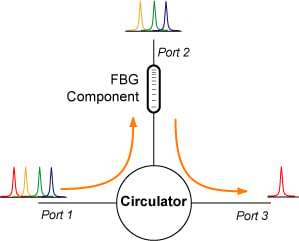
WDM Systems and OADMs: In WDM networks, which transmit multiple data streams (each at a unique wavelength) over one fiber, the fiber optic circulator works with Optical Add-Drop Multiplexers (OADMs). It enables OADMs to “drop” (extract) or “add” (insert) specific wavelengths without disrupting other signals, a key feature for flexible network management.
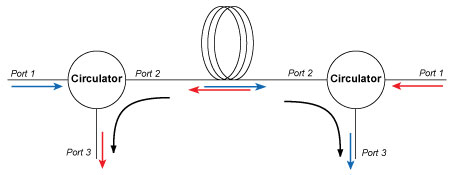
Dispersion Compensation Modules (DCMs): Long-haul signals suffer from chromatic dispersion (spreading of pulses over distance). DCMs correct this by routing signals through dispersion-compensating fiber, and the fiber optic circulator ensures signals follow the correct path—from the main fiber to the DCM and back—without leakage.
Fiber Optic Sensing Systems
Fiber optic sensors rely on the fiber optic circulator to separate outgoing test signals from incoming reflected data, enabling precise measurements:
Optical Time-Domain Reflectometers (OTDRs): OTDRs detect faults (e.g., fiber breaks, splice losses) by sending short laser pulses into the fiber and analyzing reflected signals. The fiber optic circulator diverts reflected pulses to a detector (instead of back to the laser source), allowing the OTDR to calculate fault distances with high accuracy.
Distributed Fiber Sensors (DFOs): Used for monitoring temperature, strain, or vibration in large-scale infrastructure (e.g., pipelines, bridges, power grids), DFOs use the fiber optic circulator to route laser pulses into the sensor fiber and direct backscattered signals to a receiver. This enables real-time, continuous monitoring over tens of kilometers.
High-Power Laser Applications
High-power laser systems (e.g., industrial cutting, medical lasers, laser-based machining) face the risk of back reflections damaging sensitive components (e.g., laser diodes). The fiber optic circulator mitigates this risk:
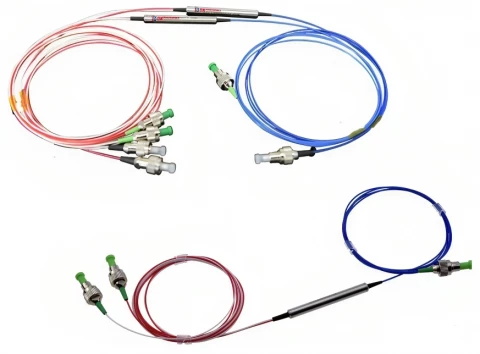
Back Reflection Protection: High-power fiber optic circulators (capable of handling 1W to 5W or more) divert back reflections away from the laser source, protecting it from overheating or permanent damage.
Bidirectional Pumping for Optical Amplifiers: Optical amplifiers (e.g., EDFAs, Erbium-Doped Fiber Amplifiers) boost signal strength in long-haul networks. They use “pump” lasers to energize the erbium-doped fiber, and the fiber optic circulator routes pump light into the amplifier while preventing amplified signals from interfering with the pump source—optimizing amplification efficiency.
Selection Considerations for Fiber Optic Circulator
Choosing the right fiber optic circulator requires aligning its specifications with the unique demands of the application. Below are the key factors to evaluate:
Port Configuration
Port count determines the circulator’s ability to route signals across different paths:
3-Port Circulators:
The most common type, used in simple bi-directional setups (e.g., OTDR testing, point-to-point communication, or basic sensor systems). They offer a cost-effective solution for applications requiring sequential 1→2→3→1 routing.

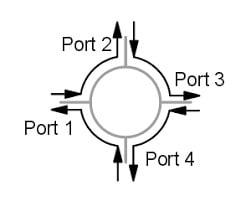
4-Port Circulators:
Designed for complex systems that need additional routing paths (e.g., multi-channel sensing, advanced WDM networks, or systems with multiple amplifiers). They enable sequential 1→2→3→4→1 routing, supporting more flexible signal management.
Wavelength Compatibility
Different applications operate at specific wavelength bands, and the fiber optic circulator must be tuned to these bands to ensure optimal performance:
1310 nm and 1550 nm: The standard bands for telecom networks (1310 nm for short-haul, 1550 nm for long-haul due to lower attenuation).
1064 nm: Used in industrial lasers, laser-based sensors (e.g., LIDAR), and medical equipment.
C+L Bands (1520–1620 nm) and S+C+L Bands (1460–1625 nm): Wideband bands for high-capacity WDM networks, as they support more wavelengths and increase overall bandwidth.
Cost and Customization
Budget and application-specific needs influence the choice of fiber optic circulator:
Cost Ranges: Entry-level PI circulators (e.g., 3-port 1310/1550 nm models) start at approximately $115, making them suitable for general use. Specialized models—such as high-power PM circulators (e.g., 1550 nm 5W PM) or wideband S+C+L circulators—range from $242 to over $1,200, reflecting their advanced design.
Customization Options: Manufacturers like Fibermart offer tailored fiber optic circulator solutions, allowing users to adjust parameters such as wavelength range, port count, connector type (e.g., SC, LC), and packaging (e.g., module-style for rack mounting). This ensures the component fits seamlessly into existing systems.
Conclusion
The fiber optic circulator is far more than a passive component - it is a catalyst for efficient, high-performance optical systems. Its non-reciprocal design, combined with high isolation, low insertion loss, and environmental resilience, makes it indispensable in telecommunications, sensing, and high-power laser applications. By understanding its core principles, key use cases, and selection criteria, engineers and system designers can unlock the full potential of the fiber optic circulator to build networks and sensors that are more reliable, cost-effective, and scalable. As demand for faster data transmission and more precise sensing grows, the fiber optic circulator will continue to evolve—solidifying its role as a cornerstone of modern optical innovation.
Shop and buy Fibermart optical circulators at HERE





No comments have been posted yet.