


.webp)


In the realm of optical networking, fiber optic pigtails and patch cords are two indispensable components that lay the foundation for seamless data transmission. While both serve the core purpose of facilitating optical connectivity, their distinct designs, functionalities, and application scenarios make them irreplaceable in their own right.
Fundamental Definitions: What Sets Them Apart at the Core?
Fiber Optic Pigtail: The Permanent Termination Link
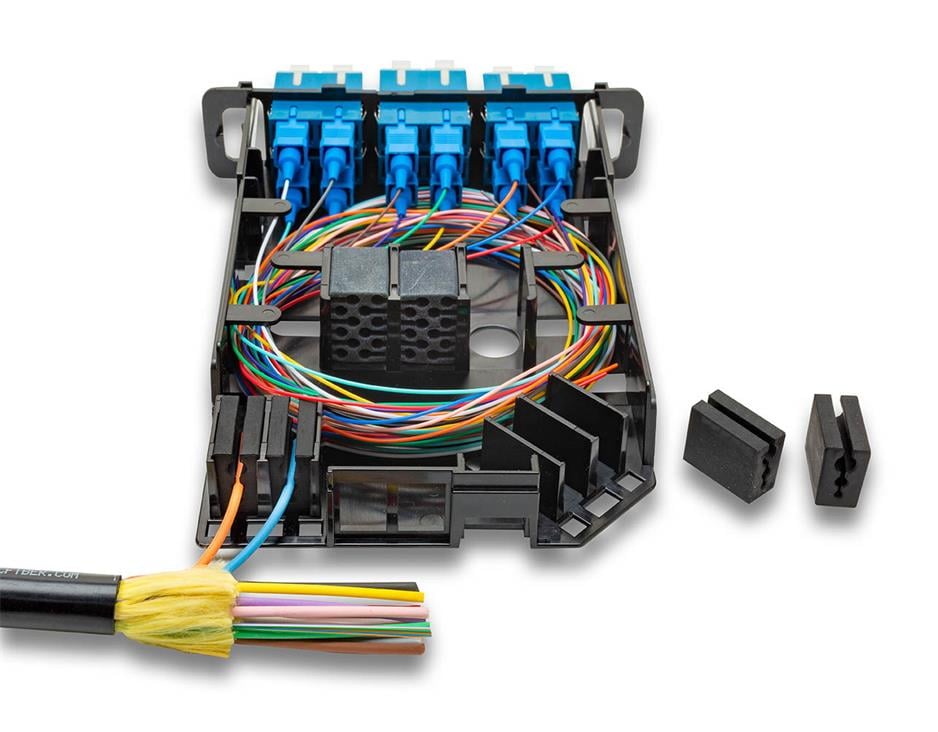
A fiber optic pigtail is a specialized optical component characterized by a short length of optical fiber with a pre-installed, factory-terminated connector on one end and a bare, unterminated fiber on the other. Typically ranging in length from a few centimeters to several meters, pigtails are engineered for permanent fusion splicing to the main fiber cable plant. This design allows them to act as the critical interface between the raw, field-deployed fiber cables and network equipment or distribution panels. Constructed with precision, pigtails feature high-quality connectors (such as LC, SC, FC, ST, or E2000) and are available in single-mode (OS2, 9/125μm) and multimode (OM1, OM2, OM3, OM4, OM5, with core/clad diameters of 50/125μm or 62.5/125μm) configurations, as well as armored variants for harsh environments.
Fiber Optic Patch Cord: The Versatile Plug-and-Play Connector
Also known as fiber jumper cables, fiber optic patch cords are fully connectorized optical assemblies with factory-terminated connectors on both ends. Designed as plug-and-play solutions, they are crafted to establish temporary or semi-permanent connections between active network equipment (such as servers, switches, and routers), cross-connects, and patch panels. Patch cords come in simplex (for unidirectional communication) and duplex (for bidirectional data transfer) setups, supporting a wide range of fiber modes and connector types to ensure universal compatibility. Their robust construction includes options like standard, armored, and bend-insensitive designs, with flame-retardant jacketing (OFNR/OFNP, PVC, LSZH) to meet diverse installation requirements in data centers, enterprises, and telecommunications systems.
Structural Differences: Design Features That Define Functionality
Connector Configuration
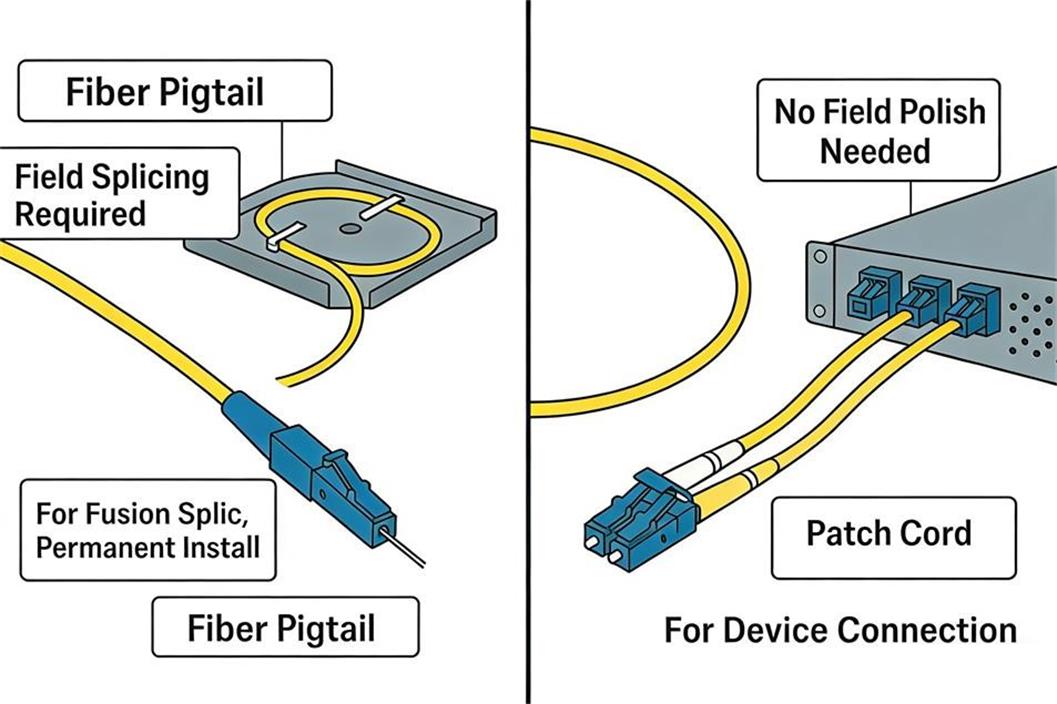
The most apparent structural difference between pigtails and patch cords lies in their connector setups. Fiber optic pigtails have a "single-ended" connector design: one end is equipped with a precision-engineered connector (e.g., LC, SC, FC) that mates with network devices or adapters, while the other end remains bare to enable fusion splicing with the main fiber cable. This bare end is stripped of its jacket and buffer, exposing the fiber core for permanent joining via fusion splicing.

In contrast, fiber optic patch cords feature "double-ended" connectorization, with factory-polished connectors on both ends. These connectors are aligned and polished to minimize insertion loss and back reflection, ensuring optimal signal transmission when mated with adapters or equipment ports. The uniformity of the connectors on both ends allows patch cords to function as direct links between two compatible devices or components, eliminating the need for splicing during installation.
Cable Length and Flexibility
Fiber optic pigtails are typically shorter in length compared to patch cords. Their design is optimized for termination at distribution points, so lengths usually range from 0.5 meters to 5 meters, with customization options for specific installation needs. The shorter length ensures that the pigtail can be neatly routed within termination boxes or panels without excess cable, reducing the risk of signal loss due to unnecessary bends or tangles. Additionally, pigtails may come in multi-fiber bundles (such as 12-fiber or 24-fiber configurations) with fan-out kits, allowing for efficient termination of multiple fibers in a single setup.
Patch cords, on the other hand, are available in a broader range of lengths, from 1 meter to 30 meters or more, to accommodate various networking scenarios. Whether connecting equipment within a data center rack or linking devices across a large enterprise floor, the flexible length options of patch cords make them highly adaptable. Their construction often includes a tight-buffered cable design (with an outside diameter of 2.0mm or similar) that balances flexibility and durability, enabling easy routing while protecting the fiber core from mechanical damage.

Protective Features and Jacketing
Both components are designed with protective jacketing, but the type and purpose vary based on their application. Fiber optic pigtails may feature jackets made of PVC, LSZH (Low Smoke Zero Halogen), OFNR (Optical Fiber Non-Conduit Riser), or OFNP (Optical Fiber Non-Conduit Plenum) materials. Armored pigtails are also available for industrial or outdoor use, featuring a rugged outer sheath that shields the fiber from moisture, physical impact, and environmental hazards. The jacketing of pigtails is primarily focused on protecting the splice point and the bare fiber end during and after installation.
Patch cords prioritize flexibility and safety in dynamic environments. Their jacketing options include flame-retardant OFNR and OFNP for compliance with building codes in riser and plenum spaces, as well as PVC and LSZH for general use. Bend-insensitive designs are a key feature of modern patch cords, allowing for tighter bending radii (as low as 10mm for the optical fiber) without significant signal loss, making them ideal for crowded data center racks where space is limited.
Operational Principles: How They Facilitate Optical Connectivity
Fiber Optic Pigtail: Permanent, Low-Loss Splicing
The operational principle of a fiber optic pigtail revolves around creating a permanent, low-attenuation connection between the main fiber cable and network equipment. The bare end of the pigtail is fusion-spliced to the field fiber, a process that fuses the two fiber cores together using heat, forming a continuous optical waveguide. This method ensures minimal signal loss (insertion loss <0.25dB) and high return loss (≥50dB), as the fusion splice eliminates gaps or misalignments that could degrade signal integrity. The factory-terminated connector on the other end of the pigtail provides a standardized interface for connecting to adapters or equipment ports, ensuring compatibility and reliability.

Fiber Optic Patch Cord: Removable, High-Performance Interconnection
Fiber optic patch cords operate as passive optical bridges, enabling removable and reconfigurable connections between two endpoints. Their core principle is to maintain signal integrity through precise connector alignment and low insertion loss. The factory-polished ferrules of the connectors ensure exact core alignment when mated with adapters, minimizing back reflection and insertion loss (≤0.25dB). Unlike pigtails, patch cords do not require splicing; they rely on mechanical connections that can be easily disconnected and reconnected, making them ideal for scenarios where network configurations may need to be modified or upgraded. The duplex configuration of patch cords supports bidirectional communication, allowing data to be transmitted and received simultaneously, which is essential for high-speed network applications.
Application Scenarios: Where Each Component Excels
Ideal Use Cases for Fiber Optic Pigtails
Fiber optic pigtails are best suited for applications that require permanent, high-reliability connections, particularly in distribution and termination points. Key use cases include fusion splicing in distribution panels, where pigtails are widely used in fiber distribution panels and termination boxes to terminate main fiber cables, allowing for organized and efficient connectivity to network equipment. In FTTH (Fiber-to-the-Home) deployments, pigtails splice the distribution fiber to the drop cable, providing a reliable connection to residential or commercial premises. For enterprise backbone cabling, pigtails facilitate the termination of backbone fibers in office buildings, linking horizontal cabling systems to core network equipment. Additionally, armored and waterproof pigtails are deployed in harsh industrial or outdoor settings, where protection against moisture, dust, and physical damage is critical.
Ideal Use Cases for Fiber Optic Patch Cords
Fiber optic patch cords are designed for flexible, temporary, or semi-permanent connections, making them indispensable in dynamic networking environments. In data center interconnections, patch cords connect servers, switches, storage area networks (SAN), and patch panels, enabling quick reconfiguration and scalability. Within telecommunications central offices, patch cords facilitate cross-connections between equipment, allowing for easy maintenance and upgrades. For test and measurement setups, patch cords are essential for laboratory, production, and field service testing, as they provide a removable connection for measuring optical performance. In enterprise network environments, patch cords connect desktop devices, printers, and other peripherals to the network, supporting easy moves, adds, and changes.
Key Comparison Summary: Pigtail vs Patch Cord
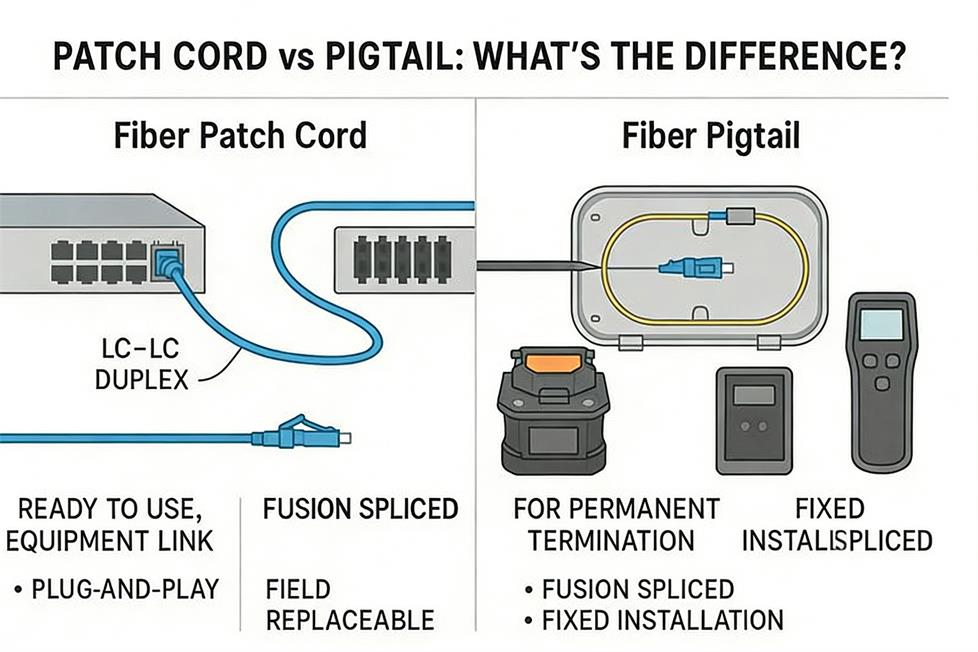
When comparing fiber optic pigtails and patch cords, their core characteristics highlight clear distinctions. In terms of connector configuration, fiber optic pigtails feature a single-ended design with one connector and one bare end, while fiber optic patch cords are double-ended with connectors on both ends. For connection type, pigtails rely on permanent fusion-spliced connections, whereas patch cords use removable mechanical connections. Length ranges differ significantly: pigtails typically span 0.5m to 5m with customizable options, while patch cords offer a wider range from 1m to 30m or more. The core function of pigtails is the termination of main fiber cables, while patch cords specialize in interconnecting equipment and components. Both components maintain low insertion loss (pigtails <0.25dB, patch cords ≤0.25dB) and high return loss (≥50dB) for optimal signal performance. In terms of flexibility, pigtails have low flexibility due to their permanent installation nature, while patch cords offer high flexibility with reconfigurable capabilities. Finally, their key applications align with their design purposes: pigtails excel in distribution panels, FTTH, and backbone termination, while patch cords are ideal for data centers, telecom offices, and test setups.
Choosing the Right Component: Factors to Consider
Selecting between a fiber optic pigtail and a patch cord depends on several critical factors, including the nature of the connection, network requirements, and installation environment. First, consider connection permanence: if the connection needs to be permanent and low-maintenance, a pigtail is the ideal choice. For removable or reconfigurable connections, a patch cord is more suitable. Network flexibility is another key factor: environments that require frequent upgrades or reconfigurations (such as data centers) benefit from patch cords, while static networks (such as residential FTTH) can rely on pigtails. The installation location also plays a role: harsh environments (industrial, outdoor) may require armored pigtails for protection, while indoor settings (offices, data centers) can use standard patch cords. Additionally, signal requirements should be evaluated: high-speed, long-haul applications may prioritize pigtails for their low splicing loss, while short-distance, high-bandwidth connections can use patch cords without compromising performance.
Fiber optic pigtails and patch cords are both essential components in optical networking, but their distinct designs, operational principles, and applications make them suited for different scenarios. Pigtails excel in permanent, low-loss terminations, providing reliable connectivity in distribution points and harsh environments. Patch cords, on the other hand, offer flexibility and reconfigurability, making them ideal for dynamic data centers, telecom offices, and test setups.





No comments have been posted yet.