


.webp)


| Key Jargon | |
| Local Area Network (LAN) | Local area network is a computer network that connects computers and devices in a limited geographical area such as home, school, computer laboratory or office building. The defining characteristics of LANs, in contrast to Wide Area Networks (WANs), include their usually higher data-transfer rates, smaller geographic area, and lack of a need for leased telecommunication lines. |
|---|---|
| Personal Area Network (PAN) | Personal area network is a computer network used for communication among computerized devices,typically within a range of 10 meters. These interconnected devices might include laptop computers, PDAs, cellphones, printers, PCs or other wearable computer devices. Personal area networks can be constructed with cables or be wireless. PANs can be viewed as a special type (or subset) of local area network (LAN) that supports one person instead of a group. |
| Campus Area Network (CAN) | Campus area network is a computer network made up of an interconnection of Local Area Networks (LANs) within a limited geographical area. The networking equipment (switches, routers) and transmission media (optical fiber, copper plant, Cat 5 cabling etc.) are almost entirely owned by the campus tenant/owner: an enterprise, university, government etc. A campus area network is smaller than a Wide Area Network (WAN) or Metropolitan Area Network (MAN). |
| Wide Area Network (WAN) | Wide area network is a telecommunication network that covers a broad area (i.e., any network that links across metropolitan, regional, and national boundaries). Business and government entities utilize wide area networks to relay data among employees, clients, buyers, and suppliers from various geographical locations. In essence this mode of telecommunication allows a business to effective carry out its daily function regardless of location. |
| Metropolitan Area Network (MAN) | Metropolitan area network is a computer network that usually spans a city or a large campus. A metropolitan area network usually interconnects a number of Local Area Networks (LANs) using a high-capacity backbone technology (such as fiber optic links), and provides up-link services to Wide Area Networks (WANs) and the Internet. |
| Storage Area Network (SAN) | Storage area network is a dedicated storage network that provides access to consolidated, block level storage. Storage area networks primarily are used to make storage devices (such as disk arrays, tape libraries, and optical jukeboxes) accessible to servers so that the devices appear as locally attached to the operating system. A storage area network typically has its own network of storage devices that are generally not accessible through the regular network by regular devices. |
| Gigabit Ethernet (GbE or GE) | Gigabit Ethernet is a term describing various technologies for transmitting Ethernet frames at a rate of a gigabit per second (1,000,000,000 bits per second) in computer networking. The first Gigabit Ethernet standard (802.3z) was ratified by the IEEE[1] 802.3 Committee in 1998. It came into use beginning in 1999, gradually supplanting Fast Ethernet in wired local networks, where it performed considerably faster. There are 10-GbE, 40-GbE and 100-GbE high-speed computer network standards available. |
| Metro Ethernet | Metro Ethernet is a computer network that covers a metropolitan area and that is based on the Ethernet standard. It is commonly used as a metropolitan access network to connect subscribers and businesses to a larger service network or the Internet. Businesses can also use Metro Ethernet to connect branch offices to their Intranet. An Ethernet interface is much less expensive than a SONET/SDH or PDH interface of the same bandwidth. |
| Synchronous Optical Network (SONET) | Synchronous optical network and Synchronous Digital Hierarchy (SDH) are standardized multiplexing protocols that transfer multiple digital bit streams over optical fiber using lasers or Light-Emitting Diodes (LEDs). This method was developed to replace the Plesiochronous Digital Hierarchy (PDH) system for transporting larger amounts of telephone calls and data traffic over the same fiber without synchronization problems. SONET/SDH allowed for the simultaneous transport of many different circuits of differing origin within a single framing protocol. SONET/SDH is not itself a communications protocol per se, but a transport protocol. |
| Fibre Channel (FC) | Fibre Channel is a Gigabit-speed network technology primarily used for storage networking. It is standardized in the T11 Technical Committee of the InterNational Committee for Information Technology Standards (INCITS). Fibre Channel was primarily used in the supercomputer field, but now, has become the standard connection type for Storage Area Networks (SANs) in enterprise storage. Despite its name, Fibre Channel signaling can run on both twisted pair copper wire and fiber optic cables. |
| Software-Defined Network (SDN) | Software-defined network is an emerging paradigm in computer networking that allows a logically centralized software program to control the behavior of an entire network. Through the Controller, network administrators can quickly and easily make and push out decisions on how the underlying systems (switches, routers) of the forwarding plane will handle the traffic. The most common protocol used in software-defined networks to facilitate the communication between the Controller (the Southbound API) and the switches is currently OpenFlow[2]. Software-defined network is dynamic, manageable, cost-effective, and adaptable, making it ideal for the high-bandwidth, dynamic nature of today's applications. |
| FTTX (Fiber-To-The-X) |
FTTX is a generic term for any broadband network architecture that uses optical fiber to replace all or part of the usual metal local loop used for last mile telecommunications. It is originated as a generalization of several configurations of fiber deployment (FTTN, FTTC, FTTB, FTTH etc.). FTTN (Fiber-To-The-Node): Fiber is terminated in a street cabinet up to several kilometers away from the customer premises, with the final connection being copper. Fiber-to-the-node is often seen as an interim step towards full FTTH and is currently used to deliver advanced triple-play services. FTTC (Fiber-To-The-Cabinet): Similar to FTTN, but the street cabinet is closer to the user's premises; typically within 300m. FTTB (Fiber-To-The-Building or Fiber-To-The-Basement): Fiber reaches the boundary of the building, such as the basement in a multi-dwelling unit, with the final connection to the individual living space being made via alternative means. FTTH (Fiber-To-The-Home): Fiber reaches the boundary of the living space, such as a box on the outside wall of a home. FTTP (Fiber-To-The-Premises): Used in several contexts as a blanket term for both FTTH and FTTB, or where the fiber network includes both homes and small businesses. |
| Active Optical Network (AON) | Active optical network is a point-to-multipoint optical communication system, consisting of Optical Network Unit (ONU), Optical Line Terminal (OLT) and fiber optic transmission line. Active optical networks rely on electrically powered network equipment to distribute the signal, such as a switch or router, to manage signal distribution and direct signals to specific customers. Normally, signals need optical-electrical-optical transformation in the active optical network. Each signal leaving the central office is directed only to the customer for whom it is intended. |
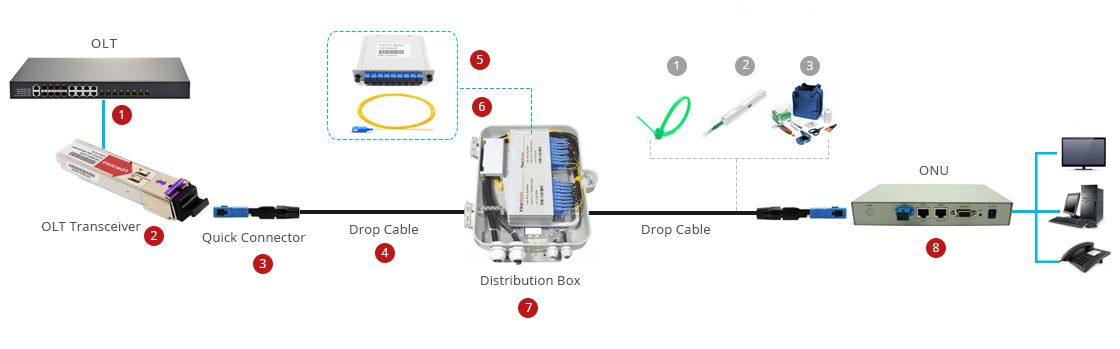
| Passive Optical Network (PON) | Passive optical network is an ideal long-term solution, a combination of Asynchronous Transfer Mode (ATM) multiservice multi-bit-rate support capabilities and passive optical network transparent broadband transfer ability, represents the latest development direction of broadband access technology in twenty-first Century. Passive optical network is a form of fiber optic access network, uses point-to-multipoint fiber to the premises in which unpowered optical splitters are used to enable a single optical fiber to serve multiple premises. A passive optical network consists of an Optical Line Terminal (OLT) at the service provider's central office and a number of Optical Network Units (ONUs) near end users. It reduces the amount of fiber and central office equipment required compared with point-to-point architectures. Common passive optical networks include ATM Passive Optical Network (APON), Broadband Passive Optical Network (BPON), Ethernet Passive Optical Network (EPON), Gigabit Passive Optical Network (GPON) and 10 Gigabit Passive Optical Network (10G-PON or XG-PON). In recent years, the Wavelength Division Multiplexing - Passive Optical Network (WDM-PON) technology has been widely used in FTTX applications. |
| Optical Line Termination (OLT) |
Optical line termination (or terminal) is a device which serves as the service provider endpoint of a Passive Optical Network (PON). It provides two main functions:
To perform conversion between the electrical signals used by the service provider's equipment and the fiber optic signals used by the passive optical network. To coordinate the multiplexing between the conversion devices on the other end of that network (called either optical network terminals or optical network units). |
| Wavelength-Division Multiplexing (WDM) | Wavelength-division multiplexing is a technology which multiplexes a number of optical carrier signals onto a single optical fiber by using different wavelengths (colours) of laser light in fiber optic communications. Each laser is modulated by an independent set of signals. This technique enables bidirectional communications over one strand of fiber, as well as multiplication of capacity. The term wavelength-division multiplexing is commonly applied to an optical carrier (which is typically described by its wavelength), whereas frequency-division multiplexing typically applies to a radio carrier (which is more often described by frequency). |
| Coarse Wavelength-Division Multiplexing (CWDM) | Coarse wavelength-division multiplexing typically has the capability to transport up to 16 channels (wavelengths) in the spectrum grid from 1270 nm to 1610 nm with a 20 nm channel spacing. Each channel can operate at either 2.5, 4 or 10 Gbps. It can not be amplified as most of the channels are outside the operating window of the Erbium-Doped Fiber Amplifier (EDFA). Coarse wavelength-division multiplexing is used in a shorter overall system reach of approximately 100 kilometers. |
| Dense Wavelength-Division Multiplexing (DWDM) | Dense wavelength division multiplexing employs multiple light wavelengths to transmit signals over a single optical fiber. It is a crucial component of optical networks because it maximizes the use of installed fiber cable and allows new services to be quickly and easily provisioned over existing infrastructure. Channel plans vary, but a typical dense wavelength division multiplexing system would use 40 channels at 100 GHz spacing or 80 channels with 50 GHz spacing. Some technologies are capable of 25 GHz spacing (sometimes called ultra dense WDM). Dense wavelength division multiplexing is used in a long-haul transmission. |
| Erbium-Doped Fiber Amplifier (EDFA) | Erbium-doped fiber amplifier was originally developed to replace SONET/SDH Optical-Electrical-Optical (OEO) regenerators which are practically obsolete. It can amplify any optical signal in their operating range, regardless of the modulated bit rate. In terms of multi-wavelength signals, so long as the erbium-doped fiber amplifier has enough pump energy available to it, it can amplify as many optical signals as can be multiplexed into its amplification band (though signal densities are limited by choice of modulation format). Erbium-doped fiber amplifiers therefore allow a single-channel optical link to be upgraded in bit rate by replacing only equipment at the ends of the link, while retaining the existing erbium-doped fiber amplifier or series of erbium-doped fiber amplifiers through a long haul route. |
| Add-Drop Multiplexer (ADM) | Add-drop multiplexer is a multiplexer combines, or multiplexes, several lower-bandwidth streams of data into a single beam of light. "Add" and "drop" here refer to the capability of the device to add one or more new wavelength channels to an existing multi-wavelength WDM signal, and/or to drop (remove) one or more channels, passing those signals to another network path. This is used as a local "on-ramp" and "off-ramp" to the high-speed network. An add-drop multiplexer may be considered to be a specific type of Optical Cross-Connect (OXC). |
IEEE is one of the leading standards-making organizations in the world. IEEE performs its standards making and maintaining functions through the IEEE Standards Association (IEEE-SA). The IEEE 802 Standard comprises a family of networking standards that cover the physical layer specifications of technologies from Ethernet to wireless. IEEE 802 is subdivided into 22 parts that cover the physical and data-link aspects of networking. One of the more notable IEEE standards is the IEEE 802 LAN/MAN group of standards which includes the IEEE 802.3 Ethernet standard and the IEEE 802.11 Wireless Networking standard.
802.3 Ethernet: "Grandaddy" of the 802 specifications. Provides asynchronous networking using "carrier sense, multiple access with collision detect" (CSMA/CD) over coax, twisted-pair copper, and fiber media. Current speeds range from 10 Mbps to 10 Gbps. 802.11 Wireless Networking: Wireless LAN Media Access Control and Physical Layer specification. 802.11a, b, g, etc. are amendments to the original 802.11 standard. Products that implement 802.11 standards must pass tests and are referred to as "Wi-Fi certified".
OpenFlow is a communications protocol that gives access to the forwarding plane of a network switch or router over the network. The Open Networking Foundation (ONF), a user-led organization dedicated to promotion and adoption of Software-Defined Networking (SDN), manages the OpenFlow standard. ONF defines OpenFlow as the first standard communications interface defined between the control and forwarding layers of an SDN architecture. OpenFlow allows direct access to and manipulation of the forwarding plane of network devices such as switches and routers, both physical and virtual (hypervisor-based). It is the absence of an open interface to the forwarding plane that has led to the characterization of today's networking devices as monolithic, closed, and mainframe-like. A protocol like OpenFlow is needed to move network control out of proprietary network switches and into control software that's open source and locally managed.
In simpler terms, OpenFlow allows the path of network packets through the network of switches to be determined by software running on multiple routers (minimum two of them—primary and secondary—has a role of observers). This separation of the control from the forwarding allows for more sophisticated traffic management than is feasible using access control lists (ACLs) and routing protocols. Its inventors consider OpenFlow an enabler of SDN. OpenFlow has gained favor in applications such as VM (virtual machine) mobility, mission-critical networks, and next generation IP-based mobile networks.
Bulk Fiber Optic Cable OM3, OM4 Fiber, Tight Buffer, Indoor & Outdoor, LSZH, Figure8, ADSS Fiber Cables |
Fiber Optic Patch Cable 10G Patch Cable, Single Mode, Multimode, Armored, MPO/MTP Turnk Cables, & Pigtails |
Fiber Optic Transceiver.jpg) SFP, SFP+, XFP,XENPAK, DWDM, CWDM 40G QSFP+ & CFP Modules |
-consulting for technical supports or relevent product buying guide
Email for Sales





No comments have been posted yet.