


.webp)


In an era defined by hyperscale data consumption, quantum computing, and global connectivity, fiber patch cables emerge as the unsung enablers of technological progress. These precision-engineered light highways—strands of glass purer than laboratory optics and thinner than human hair—form the critical connective tissue between servers, switches, and routers across modern networks. Unlike legacy copper systems constrained by electromagnetic interference and signal degradation, optical fibers transmit data at near-light velocity across continents with near-zero latency. This guide explores the multidimensional landscape of fiber patch technology, offering both foundational knowledge and advanced insights for telecommunications professionals, data center engineers, and infrastructure architects.
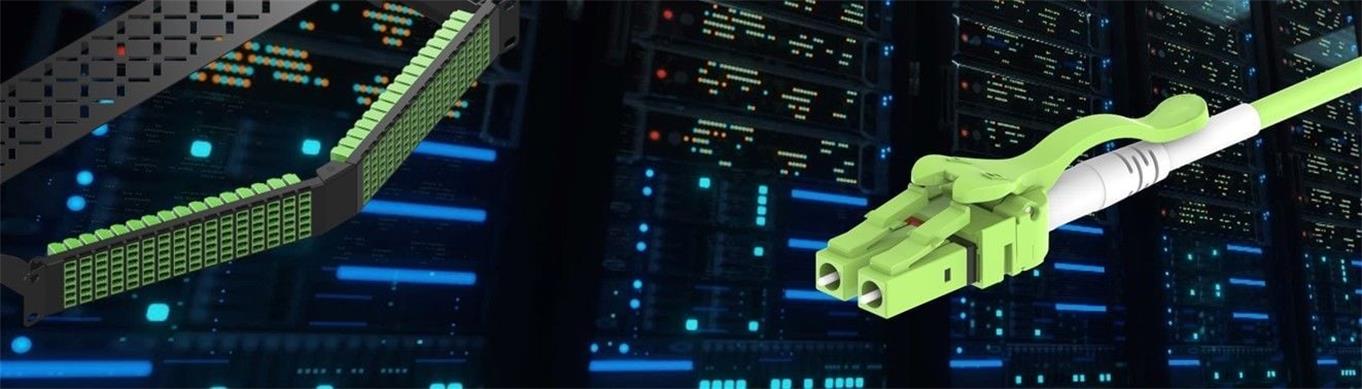
Optical Physics and Material Innovation
At the quantum level, fiber patch cables operate through total internal reflection—light pulses confined within an ultrapure silica glass core (diameters: 9μm single-mode / 50-62.5μm multimode) bounded by proprietary cladding materials. Contemporary manufacturing leverages modified chemical vapor deposition (MCVD) to achieve refractive index precision within ±0.0002%, while bend-insensitive fibers (ITU-T G.657.A1/B2 standards) utilize nanostructured trenching to reduce macro-bend losses by 85% compared to legacy models. Armored variants incorporate corrugated stainless steel or dielectric aramid yarn (e.g., DuPont™ Kevlar®) for mechanical resilience in industrial environments, where compression resistance exceeding 4,000 N/cm² is routinely required.
Fiber Patch Cables
A fiber patch cable is a short, flexible, connector-terminated optical cable engineered to transmit data as pulses of light through ultra-pure glass or plastic fibers. These cables serve as critical interconnect solutions between network devices—such as switches, routers, and servers—enabling high-speed, low-latency communication.
Core Structure & Function:
1. Light-Guiding Core: A microscopic glass strand (9μm for single-mode, 50–62.5μm for multi-mode) acts as a waveguide for light.
2. Layered Protection: Cladding reflects escaping light back into the core, while Kevlar® strength members and LSZH jackets shield against physical stress and fire.
3. Connectors: Precision ferrules (LC, SC, MTP) align fibers end-to-end with micron-level accuracy, minimizing signal loss.
Why They Dominate Modern Networks:
1. Speed & Distance: Transmit 400G+ data over 120km (single-mode) or 100G up to 150m (multi-mode).
2. EMI Immunity: Immune to electromagnetic interference—critical in industrial/medical settings.
3. Efficiency: Consume 75% less power than copper per port, reducing data center cooling loads.
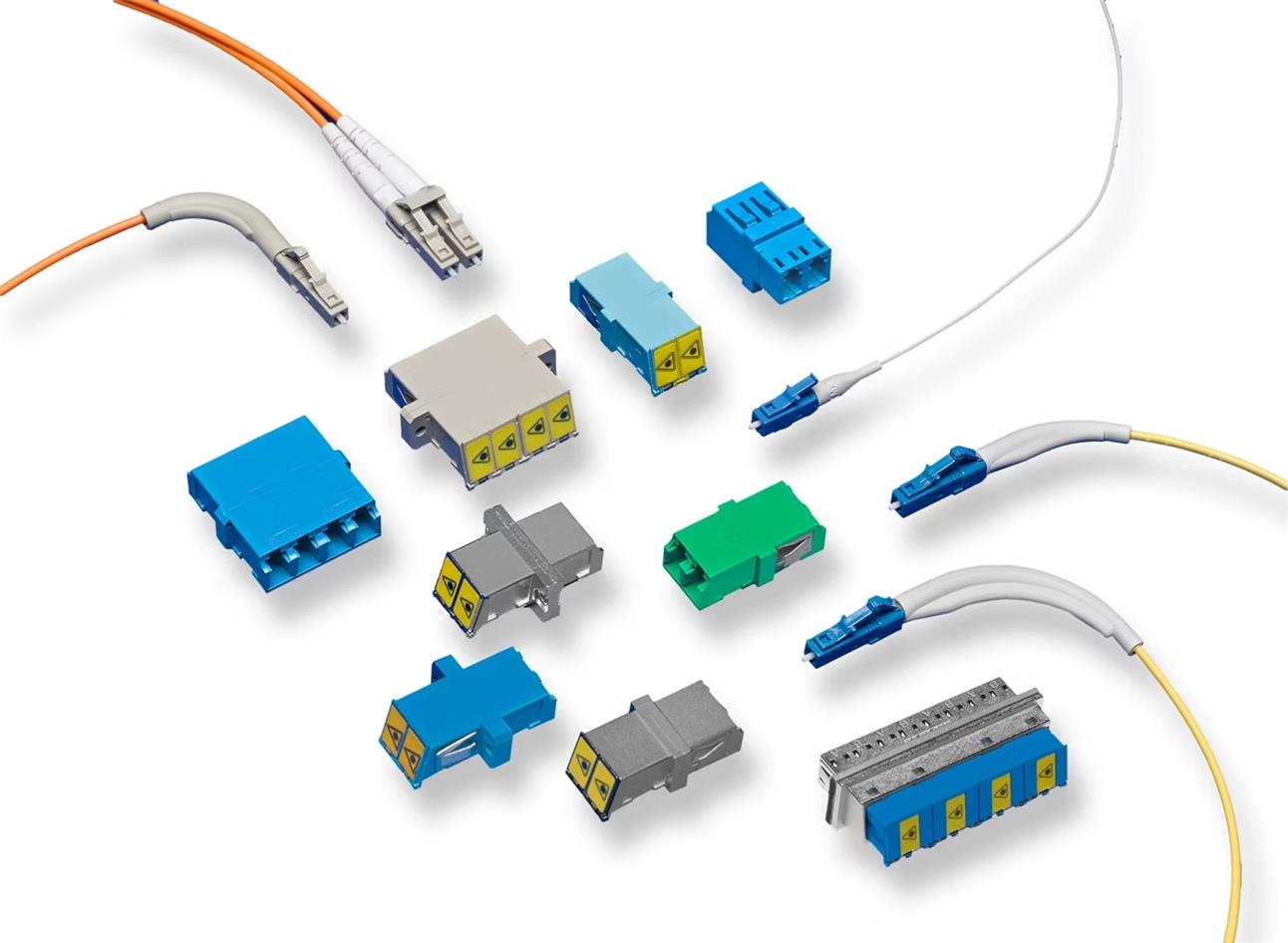
Universal Applications:
From hyperscale data centers (using MTP trunks for 400G spine links) and 5G fronthaul networks (deploying bend-insensitive fibers) to harsh industrial sites (relying on armored cables), fiber patch cables deliver future-proofed, adaptive connectivity. Their role as the invisible backbone of global digital infrastructure continues to expand with emerging technologies like quantum encryption and multi-core fibers.
In essence: Where light travels, data follows—reliably, at light-speed, and without compromise.
Connector Ecosystems and Signal Integrity
A fiber optic connector is a precision-engineered interface that mechanically aligns and secures the ends of optical fibers to enable efficient light signal transmission between network components, utilizing micron-accurate ceramic or polymer ferrules to minimize insertion loss (typically <0.3 dB) and specialized polish geometries—like the industry-standard 8° angled APC design—to suppress back-reflection below -65 dB for RF-sensitive applications. These connectors deliver critical interoperability across global infrastructure through standardized form factors (e.g., LC for high-density data centers, SC for telecom, MTP for parallel 400G optics), while engineered variants withstand industrial vibration, thermal cycling (-45°C to +85°C), and contamination through IP67-rated seals, making them the indispensable photonic handshake enabling everything from hyperscale cloud backbones to 5G fronthaul networks with uncompromised signal integrity.
| Connector Type | Ideal Application | Critical Specifications |
|---|---|---|
| LC Duplex | High-density 100G QSFP ports | ≤0.3dB insertion loss; ≥50dB return loss |
| SC-APC | CATV/GPON networks | 8° angled polish; ≥65dB return loss |
| MTP/MPO-24 | 400G-SR8 parallel optics | 12/24-fiber array; precision ferrule alignment |
Polish Types:
UPC (Blue): Standard for Ethernet (≥50dB return loss)
APC (Green): Essential for RF video (≥65dB return loss) to eliminate back-reflection.
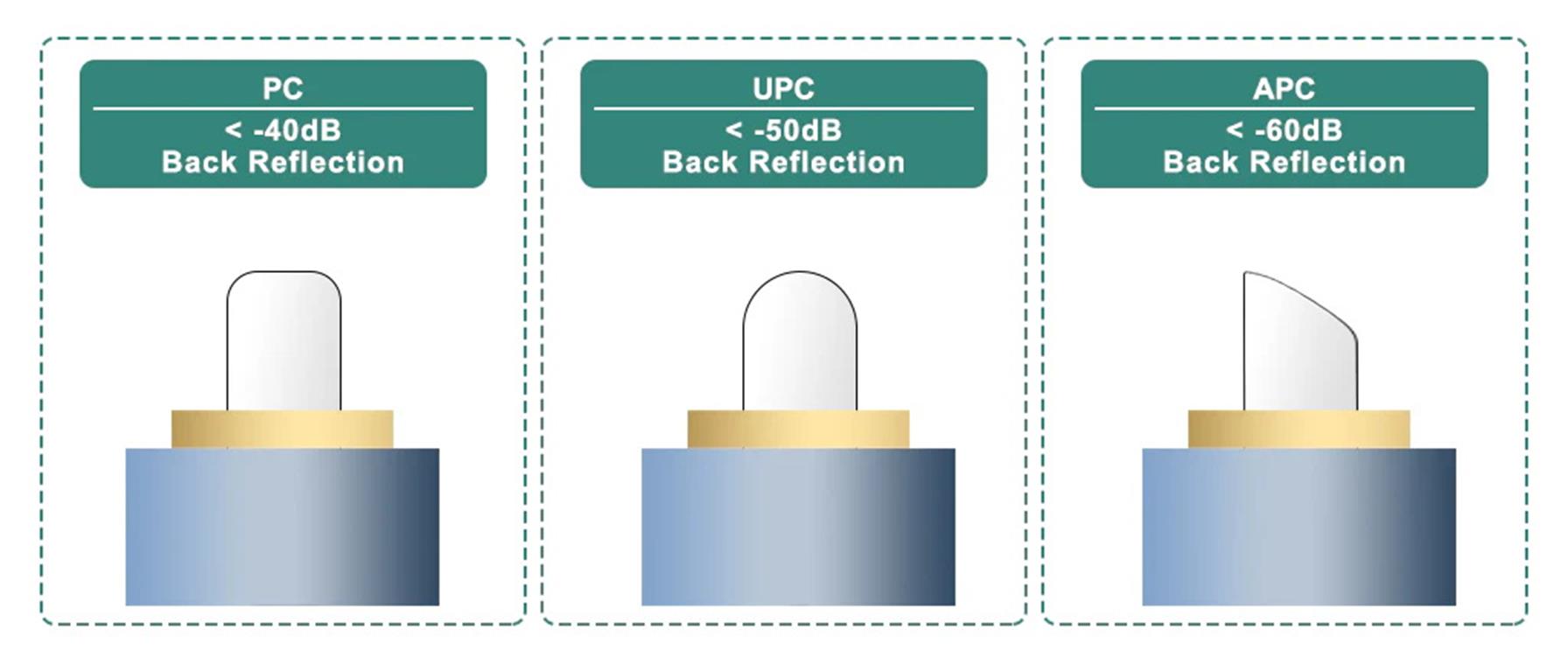
The photonic handshake between devices demands micron-scale alignment tolerance, governed by connector ferrule geometry and end-face polish topology:
1. LC (Lucent Connector): Dominates high-density environments with 1.25mm ferrules, supporting up to 144 ports per 1U panel
2. APC (Angled Physical Contact): 8° polished zirconia ferrules achieve <-65dB return loss, eliminating back-reflection in RF video and PON networks
3. MTP/MPO-24: Multi-fiber array connectors enabling 400G-SR8 parallel optics via 12-fiber rows
Critical polishing methodologies—from industry-standard UPC (Ultra Physical Contact) to superfinish EP (Extended Polish)—directly impact insertion loss budgets. Third-party validation per IEC 61300-3-35 standards confirms optimal performance when surface roughness measures <20nm RMS.

Fiber connectors enable micron-precision optical alignment critical for signal integrity, with LC duplex dominating high-density data centers (≤0.3dB insertion loss), SC-APC's 8° polish eliminating back-reflection in CATV/GPON networks (≥65dB return loss), and MTP/MPO arrays supporting parallel optics for 400G-SR8. Performance hinges on connector ferrule geometry, polish type (UPC for standard Ethernet vs. APC for RF-sensitive applications), and compliance with IEC 61300-3-35 surface roughness standards (<20nm RMS), ensuring optimal photon transmission while mitigating insertion loss and reflectance.
Deployment Best Practices and Performance Validation
Bend Management and Tensile Loading
The fundamental axiom of fiber handling—light abhors curvature—demands strict adherence to minimum bend radii:
1. Static installations: ≥15× cable diameter
2. Dynamic applications: ≥20× diameter with sustained tension ≤100N
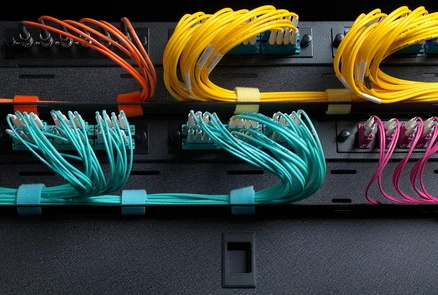
3. Bend-optimized cables (e.g., OFNP-rated Corning® ClearCurve®) permit radii down to 5mm for intra-rack routing without exceeding 0.1dB/km additional loss.
Contamination Mitigation
Industry studies reveal that 85% of fiber link failures originate from particulate contamination. Best-in-class maintenance protocols require:
1. Automated IEC-61300-3-35 compliant inspection probes
2. Non-residue cleaning fluids (isopropyl alcohol alternatives)
3. Hermetic bulkhead seals with IP67 environmental rating
Sustainability and Total Cost of Ownership Analysis
Energy Efficiency Metrics
Optical infrastructure fundamentally transforms data center economics:
| Parameter | 10G Copper | 10G Optical | Reduction |
|---|---|---|---|
| Power per port | 1.8–2.2W | 0.4–0.6W | 73% |
| Thermal load (BTU/h) | 6.8 | 1.8 | 74% |
| Rack space density | 48 ports | 144 ports | 3× improvement |
Source: Uptime Institute 2023 Global Data Center Survey
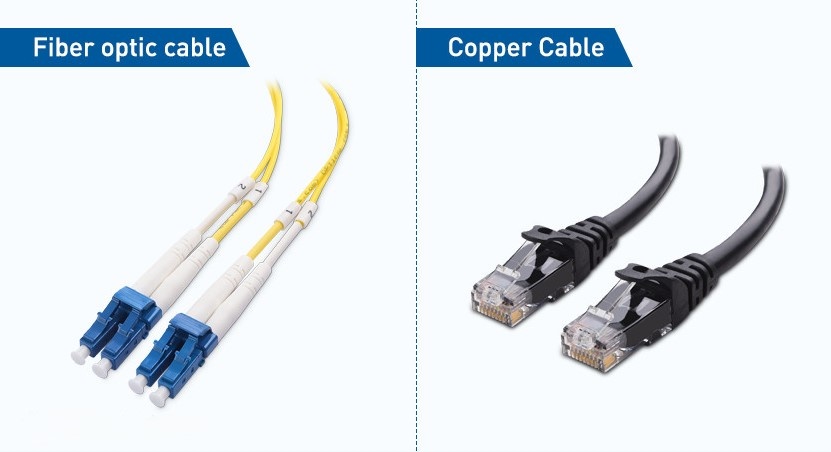
Hyperscale operators like Equinix report 31% lower PUE (Power Usage Effectiveness) in fiber-dominant facilities, while circular economy initiatives now reclaim >90% of cable jacket materials through solvent-based separation.
Emerging Frontiers and Strategic Implementation
Next-Generation Applications
1. Quantum Key Distribution (QKD): Single-photon transmission through ultra-low-loss fibers (<0.16dB/km)
2. Multi-Core Fibers: Space-division multiplexing with 19-core prototypes achieving 305Tbps throughput
3. Tactical Deployments: Radiation-hardened cables sustaining 100kGy doses for orbital data links
Implementation Framework
1. Fiber Selection: OS2 single-mode for >2km runs / OM5 wideb and multimode for <500m 100G-SWDM4
2. Polarity Management: TIA-568.0-D compliant methods (Methods A/B/C) for parallel optic channels
3. Certification: OTDR validation per ANSI/TIA-526-14-C with <0.25dB end-to-end loss
Fiber vs. Copper: Performance Benchmarking
| Parameter | Cat6A Copper | OM4 Multi-Mode Fiber | OS2 Single-Mode Fiber |
|---|---|---|---|
| Max Speed | 10 Gbps | 100 Gbps | 400 Gbps+ |
| Max Distance | 100 m | 150 m (100G) | 120 km |
| EMI/RFI Immunity | Low (requires shielding) | Absolute | Absolute |
| Power/Port (10G) | 2.0 W | 0.6 W | 0.5 W |
| Thermal Load | High (6.8 BTU/h/port) | Low (1.8 BTU/h/port) | Low (1.7 BTU/h/port) |
| Rack Density | ≤48 ports/rack | 144 ports/rack | 288 ports/rack |
| Lifetime Cost | Higher (cooling/upgrades) | Lower (energy/space) | Lowest (future-proof) |
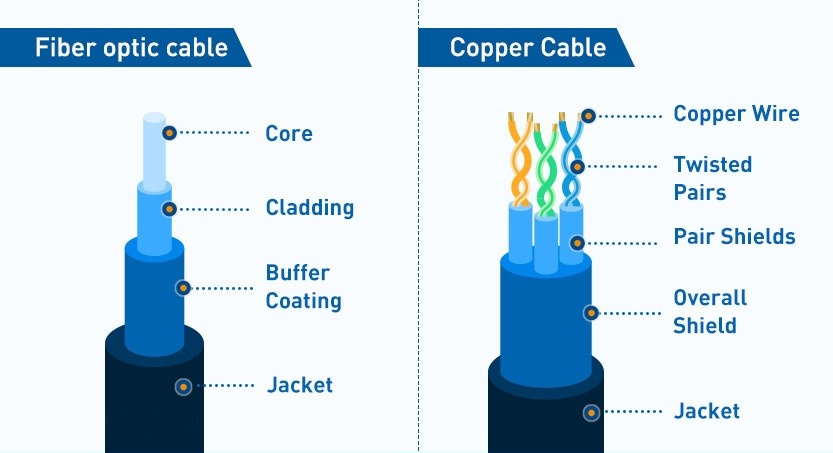
Fiber dominates copper in speed, reach, and efficiency, delivering up to 400Gbps+ over 120km (vs. copper’s 10Gbps/100m limit) while consuming 75% less power and eliminating electromagnetic interference. Though copper retains cost advantages for short-distance Power over Ethernet (PoE) applications, fiber’s superior scalability and lower cooling overhead make it the definitive choice for future-proof data centers, 5G networks, and high-bandwidth infrastructure.
Application-Specific Deployment Models
1. Data Centers
Leaf-Spine Architecture: OM4/OM5 MTP trunks for 100G spine links.
Power Efficiency: Optical ports consume 0.5W vs. copper's 2W at 10G, reducing thermal load by 74%.
2. Telecommunications
FTTx Networks: G.657 SMF with SC-APC connectors for last-mile drop cables.
5G Fronthaul: 25G SMF links between DU/CU units with ≤0.1dB/km loss tolerance.
3. Industrial & Harsh Environments
Armored Cables: Stainless steel jackets withstand 4,000 N/cm² compression and rodent exposure.
Temperature Resilience: -45°C to +85°C operational range for outdoor plants.
4. High-Density Backbones
288-Core Cables: Layer-stranding design for 28.8Tbps aggregate capacity; used in internet exchange hubs.
Looking ahead, three imperatives dominate: fiber’s energy transition (<0.5W per 100G port) slashes data center PUE by 31%, supporting global carbon neutrality; quantum-ready strands (<0.16dB/km loss) enable unhackable quantum key distribution; and sustainable innovation via LSZH jackets and solvent-based recycling (>90% material recovery) aligns with circular economies. As edge computing shrinks latency tolerances to microseconds—and global IP traffic grows 30% annually—only optical infrastructure delivers the scalability, EMI immunity, and adaptive precision required. Microsoft’s Project Natick, with zero fiber failures after five years submerged in seawater, epitomizes this medium’s unparalleled reliability.
Mastering fiber technology—from connector micron-level alignment to loss budget engineering—is now synonymous with building competitive, sustainable networks. Those harnessing its full potential will lead the sixth-generation connectivity revolution, where light pulses silently power civilization’s future.

Conclusion
As artificial intelligence workloads grow 35% annually (Dell’Oro Group, 2024) and latency thresholds descend into nanosecond territory, fiber patch cables transition from supporting actors to strategic infrastructure assets. Their unparalleled bandwidth scalability, electromagnetic immunity, and thermodynamic efficiency position optical connectivity as the non-negotiable foundation for sixth-generation networks. By mastering the principles outlined in this guide—from micro-bend physics to connector tribology—network architects can future-proof critical infrastructure while advancing sustainability imperatives.
Fibermart delivers end-to-end fiber optic solutions for telecom, enterprise, and data center markets. Its portfolio spans transceivers, cabling subsystems, and network components, emphasizing performance, sustainability, and cost efficiency. We will keep increasing investments in the optical communication technology and solution to provide remote solution diagram, technical support and on-site issue solving services for our customers. It will be achieved within one year, even along life-time.
Industry Insight: Microsoft’s Project Natick submerged data center demonstrated 0% fiber failure rates after 5 years in seawater, proving optical reliability in extreme environments.
Fiber Patch Cable FAQs
Q1: What's the difference between the blue and yellow cables?
A: The color is a quick way to tell the fiber type:
Yellow (or sometimes blue) cables are usually Single-Mode. They're for long-distance runs, like between buildings or across a city.
Orange, Aqua, or Violet cables are usually Multimode. They're for shorter distances inside a building or data center. Aqua (OM4/OM5) is for higher speeds.
Q2: I keep hearing "LC" and "SC." Which one should I use?
A: It depends on your equipment and space:
LC Connectors are small, square, and have a little tab. They're great for high-density spots like network switches where you need to fit many ports in a small space.
SC Connectors are a bit larger, square, and have a push-pull latch. They're very common and robust, often found on older equipment or in general-purpose patches.
Most of the time, you just match whatever connectors are on your equipment.
Q3: My internet is slow, and someone said it might be a bad patch cable. Is that possible?
A: Absolutely. A damaged or dirty patch cable is a very common cause of network problems. If the ends are dirty or the cable is kinked, it can cause signal loss, leading to slow speeds or dropped connections. Always check your patch cables first when troubleshooting!
Q4: How careful do I really need to be with these cables? They seem sturdy.
A: The cable itself is tough, but the ends are extremely sensitive. The most important rule is: never touch the shiny tip of the connector! The oil from your skin can block the light signal. Always keep protective caps on when the cable is not plugged in.
Q5: Why are some green and some blue?
A: This refers to the polish on the connector tip:
Blue (UPC): Standard polish. Fine for almost everything (internet, phone, video).
Green (APC): A special angled polish. Used for services that are super sensitive to signal reflections, like the fiber that comes into your house for TV (FiOS, etc.). Never force a green connector into a blue port or vice-versa—you will break both.
Q6: Can I just make my own patch cables to the length I need?
A: It's technically possible, but it's a specialized skill requiring expensive tools (cleavers, splicers, polishers). For 99% of people and businesses, it's far cheaper, faster, and more reliable to buy pre-made cables in the length you need. They are factory-terminated for perfect performance.
Q7: What does "plenum-rated" mean, and do I need it?
A: This is a fire safety rating.
Plenum-rated (OFNP): Has a special jacket that doesn't emit toxic smoke if it burns. You MUST use this in air-handling spaces, like above drop ceilings or under raised floors that are used for airflow.
Riser-rated (OFNR): Standard jacket. Can be used in vertical runs between floors (risers) but not in air plenums.
When in doubt, especially for office buildings, plenum-rated is the safer choice.
Q8: Does the length of the patch cable affect my speed or signal?
A: For most in-building uses (under 100 meters), the length has a negligible effect. The real issue is signal loss. A longer, high-quality cable will perform better than a short, damaged, or dirty one. The key specification to look at is "insertion loss," which should be low (e.g., <0.3 dB).
Q9: What's the deal with "bend-insensitive" fiber? Is it worth the extra cost?
A: If your cables are going to be routed tightly around corners or in crowded panels, yes, it's worth it. Standard fiber can have significant signal loss if bent too sharply. Bend-insensitive fiber is designed to tolerate much tighter loops and kinks without affecting performance, giving you more installation flexibility and preventing problems.
Q10: How long do these cables typically last?
A: The fiber itself doesn't degrade over time. The failure points are usually physical: the connectors get dirty, the latch on the connector breaks, or the cable gets crushed. With proper handling, a good-quality patch cable can last for many years. The main reason for replacement is physical damage or an upgrade to a higher performance standard (like moving from OM3 to OM4).
Q11: Can I use a multimode cable if my equipment has single-mode ports? (Or vice-versa?)
A: Absolutely not. The core sizes are completely different (50/62.5µm vs. 9µm). They are physically incompatible, and even if you managed to force a connection, the signal loss would be nearly 100%. Always match the fiber type of your equipment.
Q12: What's the best way to clean a fiber connector?
A: Never use compressed air! It can push dust around and create static. The best methods are:
Clicker Pen Cleaner: A specialized tool that uses a sticky tip to lift off dust. Fast and effective for light contamination.
Fiber Optic Cleaning Wipes & Solvent: For heavier grime, use a lint-free wipe moistened with pure isopropyl alcohol. Gently wipe the end-face.
Rule of Thumb: "Inspect before you connect." Use a fiber microscope to check if the end is clean.
Q13: What's the difference between a "patch cable" and a "pigtail"?
A: Patch Cable: Has connectors on both ends (e.g., LC to LC). Used to connect equipment to panels.
Pigtail: Has a connector on only one end. The bare fiber end is spliced onto a permanent cable run. Pigtails are used inside splice trays or patch panels to create a permanent connection point.
Q14: I see terms like OM3, OM4, and OM5. What's the difference?
A: These are grades of Multimode fiber, with higher numbers offering better performance for high-speed networks.
OM3 & OM4: The most common for modern data centers. OM4 has a longer reach for speeds like 40G and 100G Ethernet.
OM5: Designed to support Short-Wave Wavelength Division Multiplexing (SWDM), allowing multiple wavelengths over a single fiber. It's backwards compatible with OM3/OM4.
Q15: Are more expensive "premium" cables actually better?
A: For basic connectivity, a certified cable from a reputable supplier is fine. "Premium" cables often offer:
Tighter performance guarantees (lower insertion loss).
More durable construction (better boots, stronger latches).
Bend-insensitive fiber.
For mission-critical links in a data center, the premium cable is insurance against downtime. For a simple link, it may be overkill.





No comments have been posted yet.