


.webp)


In the rapidly evolving landscape of data transmission, the demand for high-speed, reliable, and space-efficient cabling solutions has never been greater. Two prominent options in the fiber optic cabling realm are MTP LC cable and traditional duplex LC cable. Each serves distinct purposes, but understanding their differences is crucial for making informed decisions in network design and deployment. This article delves into a detailed comparison of these two cables, exploring their design, performance, applications, and overall value in modern networking environments.
Core Design and Construction
High-Density Integration: The Engineering of MTP LC Cable
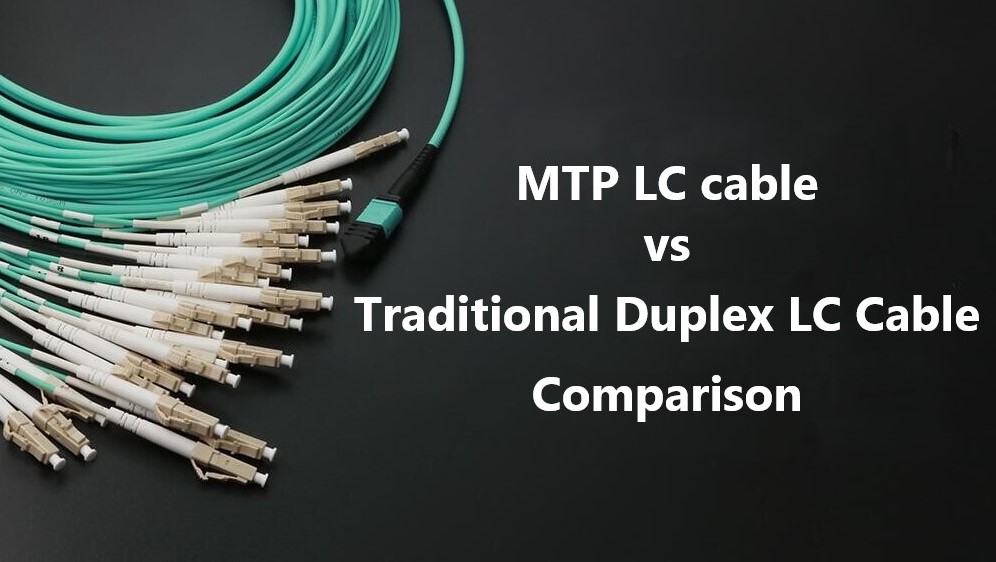
Engineered for high-density connectivity, MTP LC cable stands out with its innovative structure that addresses the limitations of traditional alternatives. At one end, it features a US Conec MTP connector, which consolidates multiple optical fibers (ranging from 8 to 144 cores) within a single ferrule. The opposite end is terminated with standard LC duplex connectors, enabling seamless integration with existing LC-compatible equipment. This design allows it to convert a single high-fiber-count MTP link into multiple individual duplex LC connections, such as MTP-12 to 6xLC or MTP-24 to 12xLC configurations.
Constructed with high-quality Corning® bend-insensitive fiber, this cable boasts a minimum bend radius of 7.5mm, facilitating easier routing in tight spaces. It is available with Plenum (OFNP) or LSZH jackets, ensuring compliance with various environmental and safety standards. Additionally, it supports custom lengths and key polarity types (A, B, or C), ensuring precise alignment of transmit and receive channels in structured cabling systems.

Conventional Pairwise Connectivity: Traditional Duplex LC Cable
Traditional duplex LC cable follows a more conventional design, consisting of two separate fibers terminated with LC connectors on both ends. Each cable supports a single duplex connection, meaning one fiber is used for transmission and the other for reception. This pairwise configuration has been a staple in networking for decades, offering simplicity and compatibility with a wide range of legacy equipment.
The construction of traditional duplex LC cable typically involves a PVC or LSZH jacket, with a larger overall diameter compared to its high-density counterpart when supporting the same number of connections. The fibers used are often standard single-mode or multimode variants, without the specialized bend-insensitive properties found in the high-density option. While this design is reliable for basic connectivity needs, it lacks the space-saving capabilities of the MTP-based solution.

Performance Metrics
Transmission Efficiency
The high-density cable excels in transmission efficiency, particularly in high-speed network environments. With insertion loss as low as 0.35dB for MTP connectors and ≤0.2dB for LC connectors, it minimizes signal degradation, ensuring consistent performance even at data rates of 100G, 400G, and beyond. The use of Corning® fiber further enhances signal integrity, reducing attenuation to ≤0.32dB/km at 1310nm and ≤0.18dB/km at 1550nm for single-mode variants.
Traditional duplex LC cable also offers decent transmission performance, but its insertion loss is typically higher compared to MTP LC cable, especially when multiple connections are required. Each additional connection point in a traditional setup introduces extra insertion loss, which can accumulate and limit the maximum distance and speed of data transmission. For 40G and 100G applications, traditional duplex LC cable may require more complex configurations, such as parallel fiber links, to achieve the same performance as the high-density alternative.
Durability and Reliability
MTP LC cable is built for durability, withstanding a wide operating temperature range of -10°C to +70°C and short-term tensile loads of up to 240N. Each unit undergoes 100% testing, accompanied by individual testing reports, and is certified to CE, RoHS, FCC, and ISO9001 standards, ensuring zero failure under a lifetime warranty. The robust construction and high-quality materials make it ideal for demanding data center environments where reliability is paramount.
Traditional duplex LC cable is also reliable for standard applications, but its durability is often limited by its design. The multiple connection points required for high-density setups increase the risk of damage or loosening, leading to potential signal disruptions. Additionally, traditional cables may not be as resistant to bending and physical stress, making them less suitable for tight routing spaces.
Application Scenarios
High-Density and High-Speed Environments
The high-density cable is the preferred choice for data centers, enterprise networks, and telecommunications infrastructure that require high-density connectivity and rapid network upgrades. Its ability to convert a single MTP link into multiple LC connections makes it ideal for Top-of-Rack (ToR) connectivity, where aggregation switches with 40G/100G/400G QSFP ports need to connect to multiple servers with 10G/25G/50G SFP ports. It also simplifies network migration and upgrades, allowing organizations to seamlessly transition from 10G and 40G to higher speeds without overhauling the entire cabling infrastructure.
Another key application of MTP LC cable is in main distribution areas (MDAs) and cross-connects, where space optimization is critical. The high-density design reduces the number of cables and patch panels required, freeing up valuable rack space and improving cable management. Whether used in large-scale data centers or enterprise campuses, it delivers the flexibility and performance needed to support modern networking demands.

Legacy and Low-Density Setups
Traditional duplex LC cable is well-suited for legacy networks and low-density connectivity needs. It is commonly used in small offices, home offices (SOHO), and small-scale enterprise environments where the number of connections is limited. For example, connecting a single server to a switch or a router to a desktop computer often relies on traditional duplex LC cable due to its simplicity and cost-effectiveness.
In addition, traditional duplex LC cable is a reliable choice for applications that do not require high-speed data transmission or frequent upgrades. It is compatible with a wide range of legacy equipment, making it easy to integrate into existing networks without significant modifications. However, in high-density environments, the use of traditional duplex LC cable can lead to cable clutter, increased installation time, and higher maintenance costs.
Cost-Effectiveness
Initial Investment
The initial cost of MTP LC cable is generally higher than that of traditional duplex LC cable. This is due to the advanced design, high-quality materials, and specialized manufacturing processes required to produce MTP connectors and bend-insensitive fiber. For example, a 12-fiber OM3 multimode MTP LC cable may cost around $45.60, while a traditional duplex LC cable of the same length and fiber type may be significantly cheaper.
However, when considering the total cost of ownership, the high-density option often proves to be more cost-effective in high-density environments. The design reduces the number of cables, patch panels, and other components needed, lowering installation and maintenance costs. Additionally, it supports future network upgrades, eliminating the need for costly cabling overhauls as data demands grow.

Long-Term Value
Traditional duplex LC cable may offer lower upfront costs, but its long-term value is limited in high-growth environments. As network traffic increases and data rates rise, organizations using traditional duplex LC cable may need to install additional cables and patch panels, leading to higher ongoing costs. The risk of signal disruptions and the need for frequent maintenance further add to the total cost of ownership.
In contrast, MTP LC cable provides long-term value by supporting scalable and future-proof networks. Its ability to handle high data rates and high-density connectivity ensures that organizations can adapt to changing business needs without significant investments in new cabling. The lifetime warranty and high reliability also reduce the risk of unplanned downtime and repair costs, making it a smart investment for modern businesses.
Summary
In summary, MTP LC cable and traditional duplex LC cable each have their strengths and weaknesses, and the choice between them depends on the specific needs of the network. The former stands out for its high-density design, superior performance, and scalability, making it the ideal solution for data centers, enterprise networks, and other high-speed, high-demand environments. Its ability to simplify cable management, optimize rack space, and support future upgrades positions it as a key enabler of modern networking.
Traditional duplex LC cable, on the other hand, remains a reliable and cost-effective option for legacy networks and low-density connectivity needs. It offers simplicity and compatibility with existing equipment, making it suitable for small-scale environments where high performance and scalability are not top priorities.
As the demand for faster data transmission and higher connectivity density continues to grow, MTP LC cable is poised to become the standard for modern networking. Its unique combination of performance, flexibility, and long-term value makes it a worthwhile investment for organizations looking to stay ahead in the digital age. Whether upgrading an existing network or building a new one, understanding the differences between these two cables is essential for making the right choice and ensuring optimal network performance.





No comments have been posted yet.