


.webp)


In today’s rapidly evolving digital connectivity landscape, our demand for the internet has long transcended mere “access”—we now expect high-speed connectivity anytime, anywhere. Whether you’re streaming shows in the living room, gaming in the bedroom, attending video conferences in the study, or controlling smart home appliances in the kitchen, a stable and smooth network experience has become a necessity for both life and work. The emergence of FTTR (Fiber to the Room) technology is set to solve the pain points of traditional networks, redefine our network experience, and become the new choice for home and enterprise networking in the gigabit era.
What is FTTR?
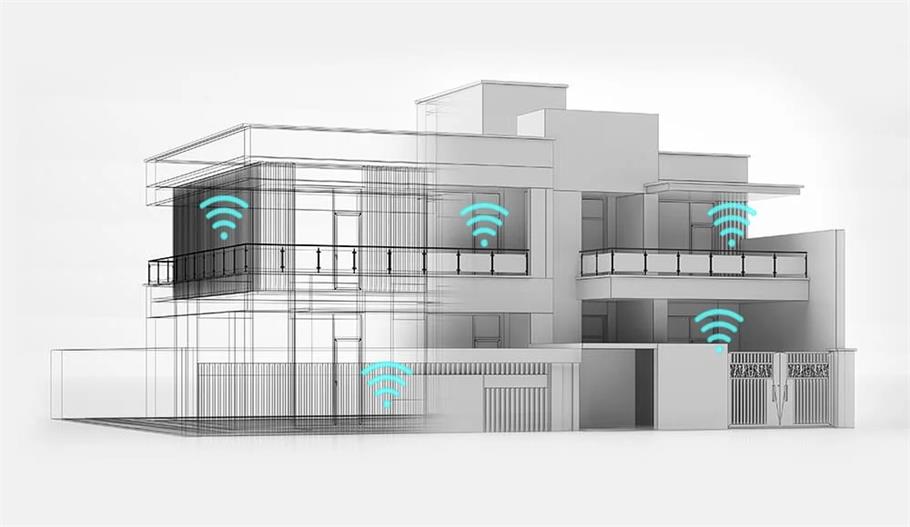
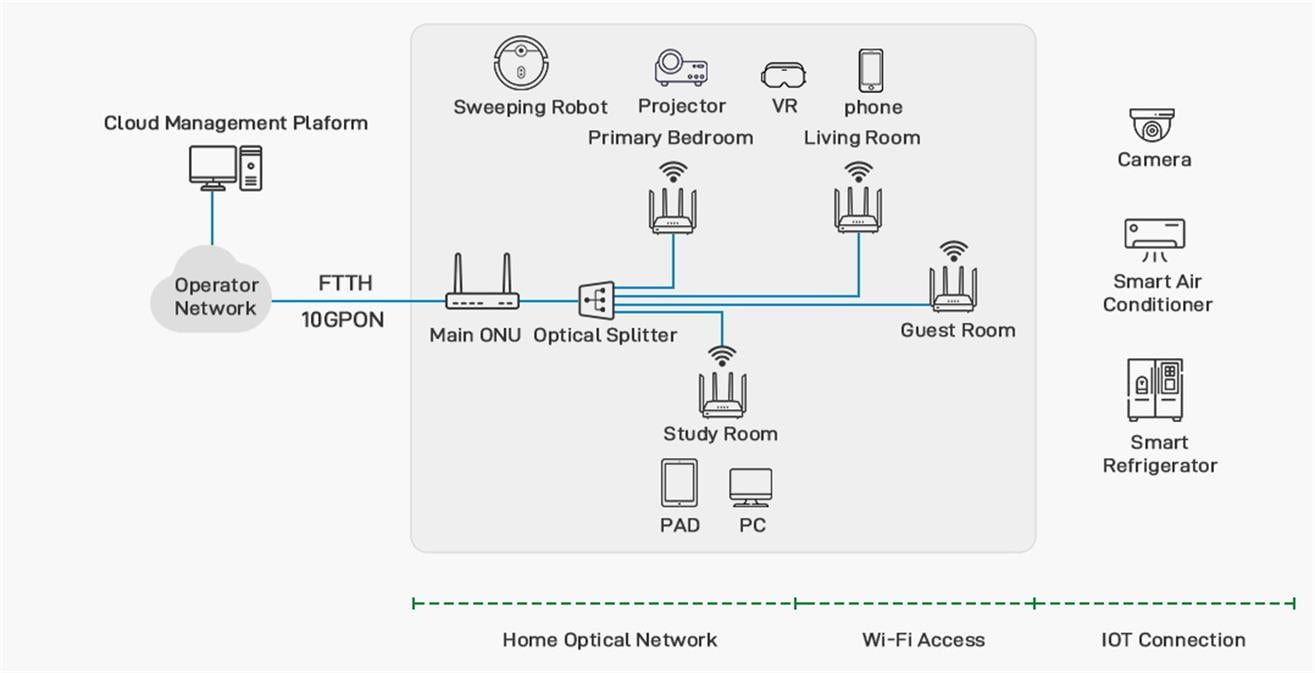
FTTR, or Fiber to the Room, is an innovative in-premises networking technology. Its core is extending optical fiber directly to every room of a user’s space. By connecting optical networking terminals to a home gateway and integrating technologies like Wi-Fi 6, it achieves seamless gigabit network coverage throughout the entire home—often referred to as “all-optical WiFi.” Simply put, traditional networks bring fiber to the “doorstep” of a home, then distribute signals via Ethernet cables or WiFi; FTTR, however, brings fiber to the “doorstep of each room,” allowing every room to directly enjoy fiber-grade high-speed transmission.
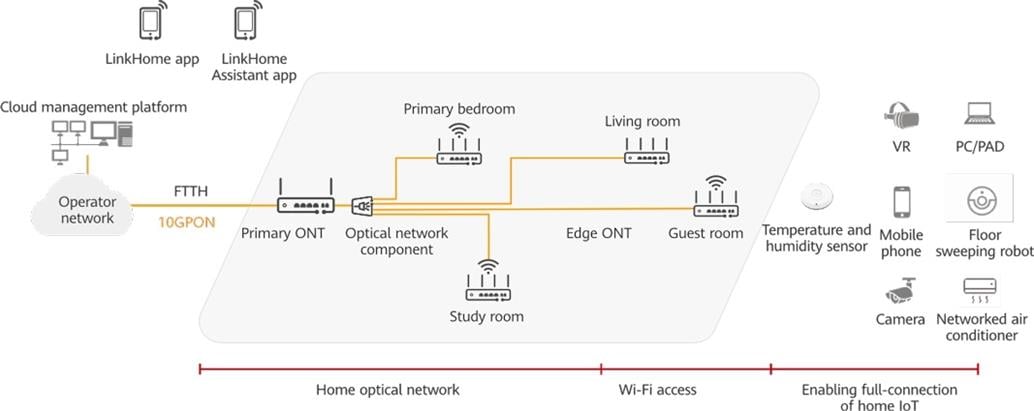
Technically speaking, FTTR represents the next evolution in home networking. It breaks the single-point limitation of traditional fiber access, extending fiber transmission to every specific area within a building (such as home rooms or enterprise offices). A complete FTTR network consists of a main optical modem, secondary optical modems, an optical network, and a network management platform. With its advantages of low latency, high stability, and high bandwidth, it meets the high-demand, multi-device networking needs of modern scenarios.
Why Do We Need FTTR? The Limitations of Traditional FTTH
Before FTTR, FTTH (Fiber to the Home) was the mainstream fiber access method. Its core workflow is: fiber optic cables connect to an ONT (Optical Network Terminal, commonly known as an optical modem) in the home, which is then physically connected to a router via an Ethernet cable to provide WiFi coverage for the entire house. However, this model often faces issues in real-world use, making it difficult to meet current network demands:
● Severe Signal Attenuation: Obstacles like walls and furniture significantly weaken WiFi signals, leading to drastically reduced speeds, lag, and even “dead zones” in rooms far from the router—where even opening a web page becomes a struggle.
● Unstable Performance: To compensate for poor coverage, many people install WiFi mesh networks or signal extenders. However, these devices degrade overall network performance, causing speed loss and inconsistent connectivity. For example, streaming may be smooth in the living room but frequently buffered in the bedroom.
● Inability to Support Multi-Device Concurrency: Modern households often have a dozen or more connected devices—smartphones, computers, TVs, smart speakers, security cameras, and more. With traditional FTTH networking, simultaneous use of multiple devices leads to bandwidth division, resulting in laggy video conferences, delayed online gaming, and slow large-file downloads.
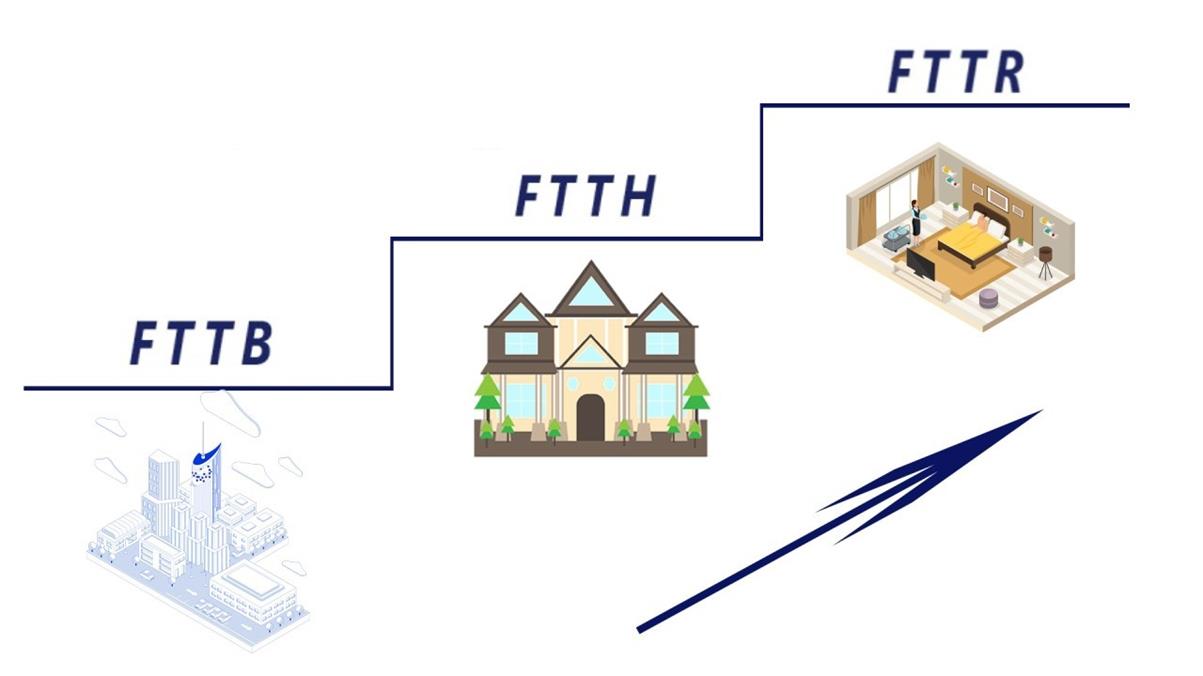
FTTR was developed to completely address these pain points, ensuring high-speed networks truly reach every corner of a space.
| Feature | FTTH (Fiber to the Home) | FTTR (Fiber to the Room) |
|---|---|---|
| Coverage | Fiber only to home entrance | Fiber extended to each room |
| Speed | 1 Gbps typical | Up to 10 Gbps uplink |
| Wi-Fi Coverage | Partial, limited by router range | Full-house Wi-Fi6 coverage |
| Signal Loss | High after wall penetration | Minimal, fiber direct to each room |
| Device Support | 8–10 devices | Up to 256 devices |
Advantages of FTTR
Compared to traditional FTTH and other networking methods, FTTR offers distinct advantages that deliver a qualitative leap for both home and enterprise use. Its key benefits fall into three categories:
Ultra-High Bandwidth for Multi-Device Concurrency
FTTR uses optical fiber as its core transmission medium, supporting full bandwidth of up to 10 Gbps—far exceeding the limits of traditional copper-based (Ethernet) networks. This means even if a dozen devices are in use simultaneously—downloading large files on a computer, streaming 4K/8K high-definition videos on a TV, playing cloud games on a smartphone, or attending online classes on a tablet—network speed remains stable without lag or bandwidth division, truly achieving “gigabit coverage throughout the home.”
Reliable and Interference-Free
Optical fiber inherently resists electromagnetic interference. Unlike traditional copper cables, it is not affected by external factors such as storms or power outages, nor is it disrupted by household appliances or walls, significantly improving transmission stability. No matter which room you’re in, signal strength remains consistent, eliminating “dead zones” and the frustration of fluctuating speeds.
Future-Proof: A Long-Term Investment
FTTR is a “future-ready” networking solution. As internet usage and data demands continue to grow—whether for future 8K videos, immersive XR (Extended Reality), smart home upgrades, enterprise cloud computing, or big data transmission—FTTR can easily accommodate these needs. There’s no need for frequent network equipment upgrades, making it a reliable, long-term investment.
FTTR Use Cases: Covering Homes and Enterprises
FTTR’s flexibility and high performance make it suitable not only for homes but also for enterprises, hotels, schools, and other scenarios, positioning it as the preferred choice for full-scenario high-speed networking.
Home Scenarios
For home users, FTTR perfectly adapts to the network needs of modern households—especially large apartments and villas. Specific applications include:
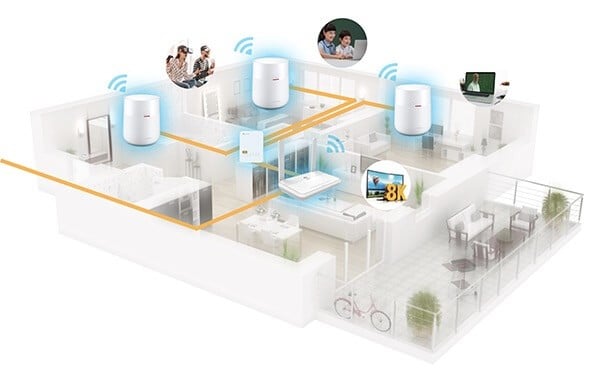
● Home Entertainment and Learning: It supports bandwidth-intensive applications such as online education, 4K/8K video streaming, cloud gaming, and immersive XR experiences. This ensures smooth online classes for children, buffer-free streaming for families, and lag-free gaming for players.
● Smart Home Support: It provides stable connectivity for various IoT devices, including smart door locks, security cameras, smart thermostats, and smart lights. This ensures efficient operation of the entire smart home system, enabling the convenience of “one-click control.”
● Multi-Device Concurrency: It easily supports simultaneous networking of a dozen or even dozens of devices in a home, solving the pain point of “lag when multiple people use the internet at the same time”—ideal for large families.
Additionally, FTTR is well-suited for broadband deployment in dense apartment buildings. Its installation is convenient, easily integrating into existing infrastructure without the need for extensive cabling, thus reducing deployment costs.
Enterprise Scenarios
As enterprises accelerate their digital transformation, their network requirements are becoming increasingly stringent. To address this, operators have launched FTTR-B (Fiber to the Room for Business), specifically designed for commercial scenarios such as enterprises, hotels, and schools:
● Hotel Scenarios: It provides stable gigabit networks for each guest room, enhancing the guest experience. It also supports live streaming, virtual meetings, and other needs for large-scale conferences and events, accommodating a large number of concurrent users and attracting corporate clients to host events.
● Office Scenarios: As the foundation of a smart office network, it supports core functions such as video conferencing, cloud computing, and IoT device connectivity, improving employee productivity. It is particularly suitable for small and medium-sized enterprises, allowing remote network management via a dedicated app to reduce operational and maintenance costs.
● Education Scenarios: It adapts to the digital teaching needs of schools and training institutions, supporting the simultaneous operation of multiple classrooms and smart devices. It provides high-speed, stable networks for teachers and students, facilitating the implementation of remote teaching and online Q&A sessions.
Global Adoption and Future Trends of FTTR
Currently, FTTR technology has gained widespread recognition from global operators and solution providers, with market adoption accelerating. By the end of Q1 2025, approximately 39 service providers across 27 markets had either launched FTTR services or were planning to do so. Countries with relatively high fiber penetration are the main drivers of FTTR commercialization—comprehensive fiber infrastructure provides a solid foundation for FTTR deployment, further promoting the development of advanced digital applications and services.
FTTR’s future potential is even more promising. Beyond its current use cases, it will play a role in more fields:
● Telemedicine: Leveraging its high-speed, low-latency advantages, FTTR can support telemedicine services, enabling doctors to diagnose and treat patients remotely. It ensures seamless transmission of medical data, making high-quality medical resources more accessible.
● Remote Learning: It breaks geographical barriers, providing students with a stable, high-speed network environment to make remote classes, online Q&A, and virtual experiments smoother—expanding access to educational resources.
● Smart Mobility and Smart Home Upgrades: As autonomous driving and full smart home adoption become more widespread, FTTR will serve as a critical network backbone, providing high-speed, stable connectivity for the coordinated operation of various smart devices.
Conclusion
FTTR is not just a simple upgrade of traditional networks—it is a revolution in “all-optical networking.” By extending fiber to every room, it completely solves the pain points of traditional networks, such as poor signal, instability, and insufficient bandwidth. With its advantages of high bandwidth, high stability, and low latency, it adapts to diverse needs across homes, enterprises, education, and hotels.
As the digital economy continues to develop, our demand for networks will keep growing. As a future-ready networking solution, FTTR not only meets current high-speed network needs but also supports future digital upgrades. It is poised to become the “new standard” for broadband connectivity in the gigabit era, creating a more convenient, efficient, and intelligent digital life and work environment for all of us.
FAQs
Q1: What’s the difference between FTTR and FTTH?
A: FTTH brings fiber to a single ONT in your home, while FTTR extends fiber directly to every room, eliminating signal loss and dead zones for more stable gigabit coverage.
Q2: Is FTTR hard to install?
A: No. It integrates easily with existing infrastructure, no extensive cabling needed—making installation simple and cost-effective, even for dense apartments.
Q3: Do I need new devices for FTTR?
A: Yes. FTTR requires dedicated equipment (main/secondary optical modems, optical terminals) instead of traditional FTTH routers.
Q4: Is FTTR only for large homes?
A: No. It works for small homes, large homes and dense apartments alike, delivering stable connectivity for multi-device use.
Q5: Does FTTR support Wi-Fi 6?
A: Yes. FTTR integrates Wi-Fi 6 with fiber to deliver seamless, low-latency gigabit Wi-Fi throughout the home.
Q6: Is FTTR more expensive than FTTH?
A: Initially, yes—due to extra optical devices and installation. But it’s future-proof, avoiding frequent upgrades and saving costs long-term.





No comments have been posted yet.