


.webp)


In high-precision optical communication systems—where signal polarization integrity directly impacts performance—traditional fiber splitters often fall short. This is where the pm fiber splitter (Polarization Maintaining Fiber Splitter) emerges as a critical solution. Unlike standard splitters that disrupt polarization states, the pm fiber splitter preserves the linear polarization of optical signals while splitting them into multiple outputs, making it indispensable for applications like aerospace, defense, fiber optic sensing, and high-speed data transmission. This guide explores the core principles, types, key specifications, applications, and selection criteria of the pm fiber splitter, highlighting why it is a cornerstone of modern polarization-sensitive optical networks.
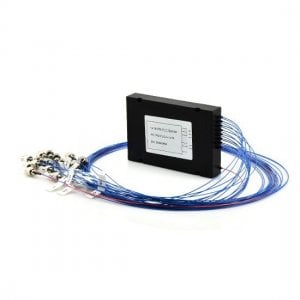
Understanding PM Fiber Splitter: What It Is and How It Works
At its core, a pm fiber splitter is a specialized optical component designed to split a single input optical signal into two or more output signals—while maintaining the original polarization state of the input. This sets it apart from conventional fiber splitters, which often scramble polarization, leading to signal degradation in systems that rely on consistent polarization (e.g., coherent communication, lidar, and fiber optic gyroscopes).
The functionality of a pm fiber splitter hinges on two key elements: polarization-maintaining (PM) fiber and precision splitting technology.
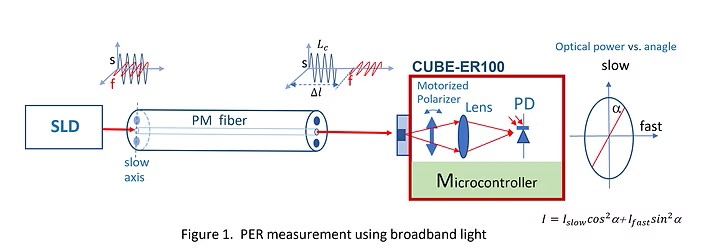
PM Fiber Foundation: Most pm fiber splitter units use PM PANDA fiber (a common type of PM fiber), which features two stress rods running parallel to the fiber core. These rods create controlled birefringence in the core, forcing light to propagate along one of two distinct axes: the “slow axis” or the “fast axis.” To ensure optimal performance, linearly polarized input light must be aligned with the slow axis of the PM fiber—this alignment guarantees the specified splitting ratio and maintains a high Polarization Extinction Ratio (PER), a critical metric for polarization integrity.
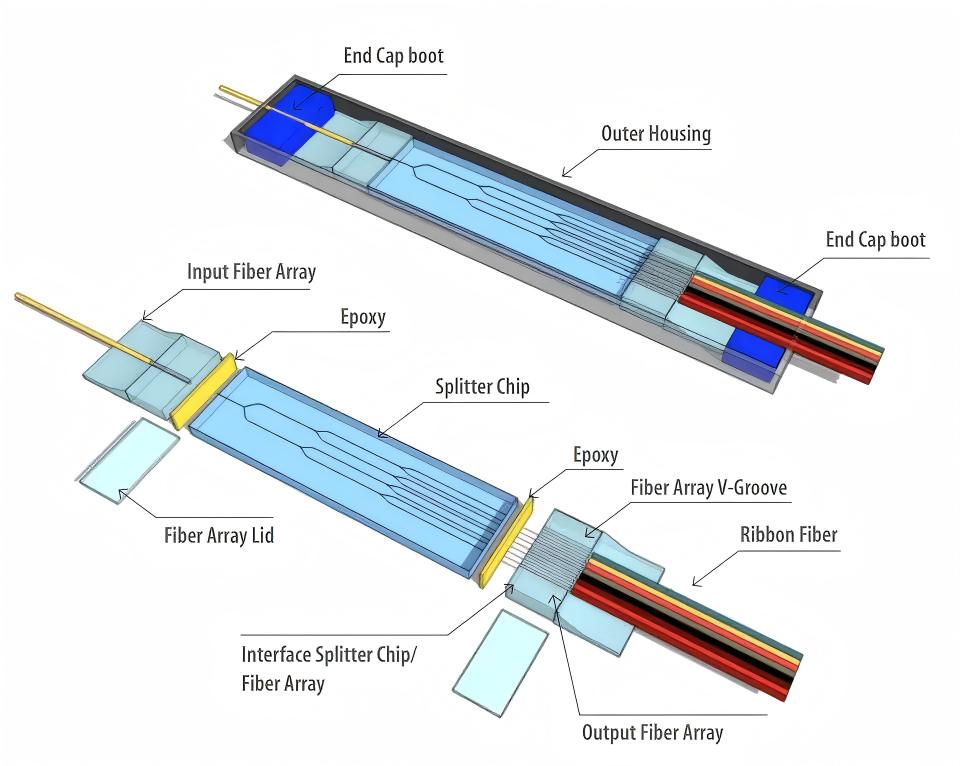
Splitting Mechanism: The pm fiber splitter uses either Planar Lightwave Circuit (PLC) or Fused Biconic Taper (FBT) technology to split signals. PLC-based splitters leverage a continuous waveguide to divide light evenly, making them ideal for high-channel-count applications (e.g., 1×32 or 2×64 splits). FBT-based splitters, by contrast, fuse two or more PM fibers together and taper them to couple light between cores, offering flexibility for custom splitting ratios. In both cases, the design ensures that polarization is preserved across all output ports—eliminating the signal loss and instability caused by polarization scrambling.
Key Types of PM Fiber Splitter: Tailored to Diverse Application Needs
Not all pm fiber splitter solutions are the same—they are engineered to address specific network requirements, from channel count to packaging and splitting technology. Understanding these types is essential for selecting the right pm fiber splitter for your use case.
1. By Splitting Technology: PLC vs. FBT PM Fiber Splitter
The two primary technologies used in pm fiber splitter design are PLC and FBT, each with unique advantages for different scenarios:
PLC PM Fiber Splitter: This type uses a planar waveguide (etched onto a silica substrate) to split signals uniformly. It excels in high-channel-count applications (supporting splits like 1×64 or 2×128) and offers low insertion loss, excellent split ratio uniformity, and high reliability. PLC pm fiber splitter units are ideal for dense optical networks—such as data centers for coherent communication or fiber optic sensing arrays—where consistent performance across multiple outputs is critical. They also operate over a broad bandwidth (±40 nm around center wavelengths like 630nm, 780nm, 980nm, 1310nm, and 1550nm), making them versatile for multi-wavelength systems.
FBT PM Fiber Splitter: FBT (Fused Biconic Taper) splitters are manufactured by fusing PM fiber cores together and tapering the fused section to control light coupling. They are well-suited for low-channel-count applications (e.g., 1×2 or 2×2 splits) and can be customized for specific splitting ratios (not just symmetrical splits). FBT pm fiber splitter units are often used in test and measurement setups, lidar systems, and small-scale sensing networks, where flexibility and cost-effectiveness for low-port counts are priorities.
2. By Distribution Type: 1×N vs. 2×N PM Fiber Splitter
pm fiber splitter units are also categorized by their input-output (I/O) configuration, which determines how many signals they can process:
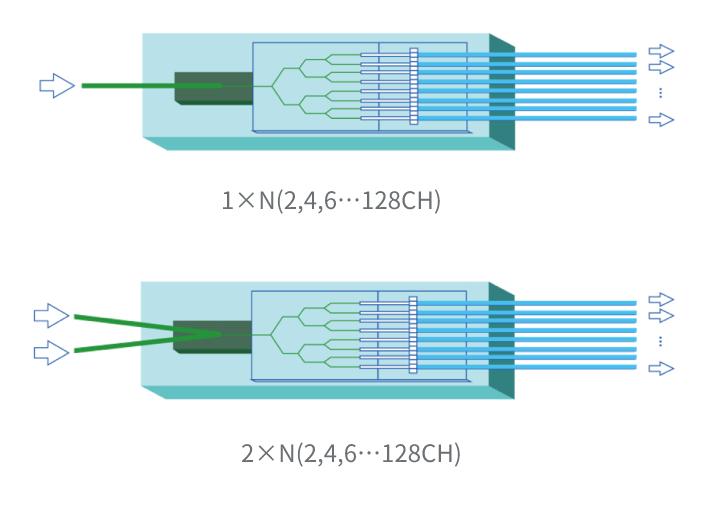
1×N PM Fiber Splitter: This configuration features one input port and N output ports (where N ranges from 2 to 128). It is used to split a single input signal into multiple outputs—common in applications like fiber optic gyroscopes (where a single laser signal is split to measure rotation) or broadcast systems (where one signal is distributed to multiple receivers).
2×N PM Fiber Splitter: With two input ports and N output ports, this type splits two independent input signals into multiple outputs. It is ideal for duplex communication systems or redundant sensing networks, where two separate signals need to be distributed while maintaining polarization integrity.
3. By Package Style: ABS Module, Steel Tube, and Rack Mount
pm fiber splitter units are packaged to suit different installation environments:
ABS Module: Lightweight and cost-effective, ABS module packaging is ideal for indoor applications like data center racks or lab setups. It provides basic protection against dust and minor impacts.
Steel Tube: Durable and rugged, steel tube packaging is designed for harsh environments—such as industrial settings or outdoor telecom enclosures—where the splitter may be exposed to vibration, temperature fluctuations, or moisture.
Rack Mount: Rack-mount packages are engineered for easy integration into standard 19-inch equipment racks, making them perfect for large-scale networks (e.g., telecom central offices or enterprise data centers) where space optimization is key.
Critical Specifications of PM Fiber Splitter: Ensuring Polarization and Performance Integrity
The performance of a pm fiber splitter is defined by key specifications that directly impact its ability to maintain polarization and deliver reliable signal splitting. These metrics are non-negotiable for polarization-sensitive applications.
1. Polarization Extinction Ratio (PER)
PER is the most critical specification for a pm fiber splitter, measuring how well it preserves the input polarization state. A high PER indicates minimal polarization cross-talk between the slow and fast axes. Top-tier pm fiber splitter units (like those from Fibermart) offer a PER of ≥18 dB (including connectors)—this ensures that the output signals retain the linear polarization of the input, preventing signal degradation in coherent systems.
2. Return Loss and Directivity
Return Loss: Measures the amount of light reflected back to the input port. A high return loss (≥50 dB for premium pm fiber splitter units) minimizes signal reflection, which can cause noise and interference in the network.
Directivity: Measures the isolation between input and unused output ports. A high directivity (≥55 dB) ensures that light from the input port does not leak into unused outputs, preventing cross-talk between channels.
3. Power Handling
Power handling refers to the maximum optical power the pm fiber splitter can withstand without damage. Fibermart’s pm fiber splitter units typically support 300 mW for connectorized or bare-fiber configurations and 500 mW when spliced—critical for high-power applications like industrial lasers or long-haul coherent transmission.
4. Operating Wavelength and Bandwidth
pm fiber splitter units are optimized for specific center wavelengths (e.g., 1310nm or 1550nm) and operate over a ±40 nm bandwidth around these centers. Choosing a splitter matched to your system’s wavelength (e.g., 980nm for pump laser splitting or 1550nm for telecom signals) ensures optimal performance.
5. Environmental Stability
Reliable pm fiber splitter units maintain performance across extreme temperatures: operating temperatures from -40°C to 85°C (-40°F to 185°F) and storage temperatures in the same range. This environmental stability is essential for outdoor, industrial, or aerospace applications where temperature fluctuations are common.
Applications of PM Fiber Splitter: Powering Polarization-Sensitive Systems
The pm fiber splitter is a linchpin in applications where polarization integrity is non-negotiable. Its ability to split signals without disrupting polarization makes it indispensable across industries.
1. Aerospace and Defense
In aerospace and defense systems—such as fiber optic gyroscopes (FOGs) for aircraft navigation or lidar for target detection—polarization stability is critical. A pm fiber splitter splits the laser signal into two paths (for FOGs) or distributes signals to multiple sensors (for lidar), ensuring that polarization-dependent measurements remain accurate. Without the pm fiber splitter, these systems would suffer from drift or measurement errors caused by polarization scrambling.
2. Fiber Optic Sensing
Fiber optic sensing networks (e.g., for structural health monitoring of bridges, pipelines, or wind turbines) rely on pm fiber splitter units to distribute sensing signals across multiple fiber optic sensors. The splitter preserves polarization, ensuring that changes in the sensor’s output (caused by strain, temperature, or vibration) are accurately detected and measured. This enables real-time monitoring of critical infrastructure.
3. Coherent Telecom and Data Centers
Coherent communication systems (used in high-speed long-haul telecom or data center interconnects) leverage polarization to double data capacity (via polarization-division multiplexing, PDM). A pm fiber splitter splits coherent signals for monitoring, testing, or distribution while maintaining polarization—ensuring that PDM systems operate at peak efficiency. It is also used in data centers to distribute clock signals or test signals across multiple servers, where polarization stability prevents timing errors.
4. Test and Measurement
In optical test labs, pm fiber splitter units are used to split a reference signal into multiple test paths, allowing simultaneous testing of multiple optical components (e.g., lasers, amplifiers, or fibers). The splitter’s high PER ensures that the reference signal’s polarization remains consistent across all test paths, guaranteeing accurate and repeatable test results.
Choosing the Right PM Fiber Splitter: Key Considerations
Selecting the optimal pm fiber splitter requires aligning its specifications with your application’s unique needs. Here are the critical factors to evaluate:
1. Define Your Application Requirements
Start by identifying your core needs: What is the required split ratio (e.g., 1×8 or 2×4)? What wavelength range will you use (e.g., 1310nm for telecom or 980nm for pump lasers)? Is the application indoor (lab/data center) or outdoor/industrial (requiring rugged packaging)? Answering these questions will narrow down your pm fiber splitter options.
2. Prioritize Critical Specifications
Focus on specifications that directly impact your system:
For polarization-sensitive applications (e.g., FOGs), prioritize a pm fiber splitter with PER ≥18 dB.
For high-power systems (e.g., industrial lasers), choose a splitter with power handling ≥500 mW (spliced configuration).
For multi-wavelength systems, select a splitter with a broad bandwidth (±40 nm) matching your operating wavelengths.

As optical systems become more advanced—relying on polarization for higher capacity, accuracy, and sensitivity—the pm fiber splitter remains an irreplaceable component. Its ability to split signals while preserving polarization integrity enables breakthroughs in aerospace navigation, fiber optic sensing, coherent telecom, and test and measurement.
By understanding the pm fiber splitter’s types, specifications, and applications, you can select a solution that optimizes your system’s performance, reliability, and scalability. Whether you need a PLC pm fiber splitter for high-channel-count data centers or an FBT pm fiber splitter for lab testing, investing in a high-quality unit from a reputable supplier ensures that your polarization-sensitive systems operate at peak efficiency—today and in the future.






No comments have been posted yet.