


.webp)


The polarization state of a laser essentially describes the vibration direction of the electric field vector. In optical and optical communication systems, the two most common polarization classification systems are:
● s/p polarization (senkrecht/parallel): Used to describe the behavior of light at interfaces
● o/e Rays (ordinary/extraordinary): Used to describe the propagation of light in anisotropic materials
These two systems are often mixed in engineering applications, but from a physical perspective, they correspond to two completely different constraint mechanisms and belong to different levels of description systems.
Engineering-Level Understanding: Differences Between the S Polarization and P Polarization
s-Polarization and p-Polarization (Interface Coordinate System)
Definition Criterion: Incident plane: A plane jointly determined by the propagation direction of light and the normal of the interface.
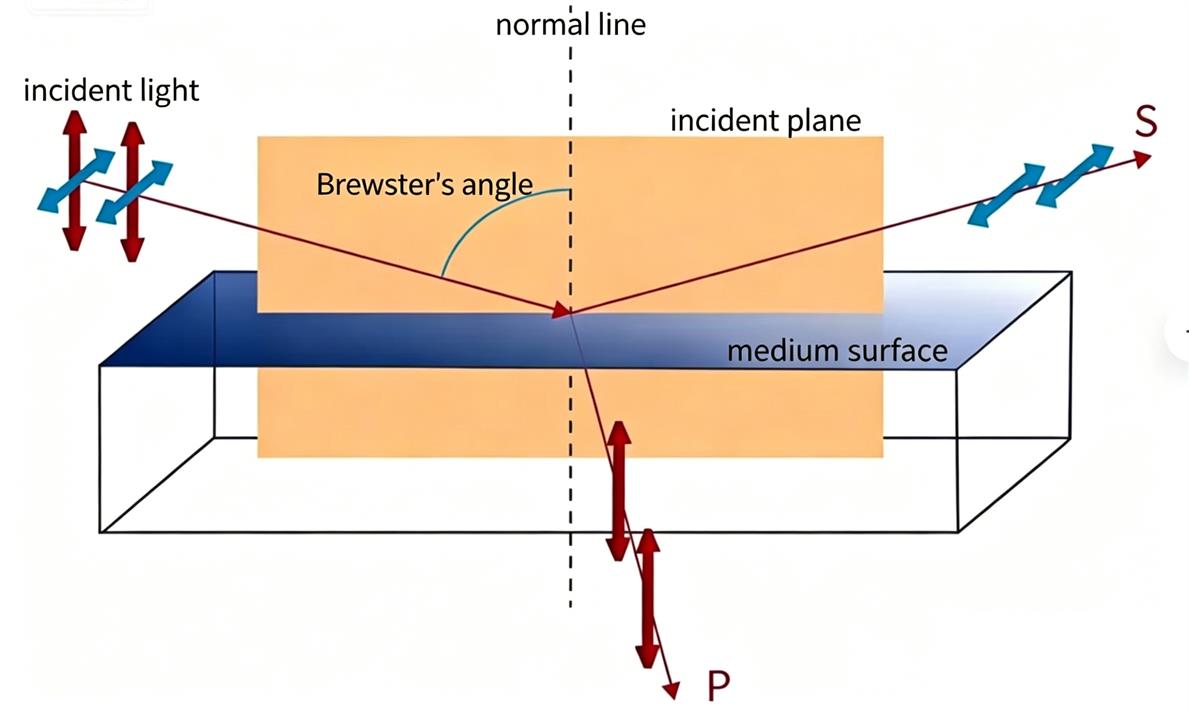
When the incident angle meets a specific condition (i.e., Brewster's angle, which is approximately 56° for glass), the reflected light becomes completely s-polarized, and the refracted light consists of p-polarized light and partial s-polarized light. This phenomenon is used in the design of laser resonators to reduce reflection loss.
① s-Polarization (senkrecht polarization, vertical polarization)
Electric field direction: Perpendicular to the incident plane
Equivalent understanding: The electric field is parallel to the interface
Memory aid: senkrecht (German for "perpendicular") → perpendicular to the incident plane
② p-Polarization (parallel polarization)
Electric field direction: Lies within the incident plane
Memory aid: parallel → within the incident plane
Core Characteristics:
● Only defined in interface-related problems (reflection, refraction, gratings, coating, etc.)
● Completely determined by the geometric relationship between the incident direction and the interface
Note: s/p polarization is not an intrinsic property of light, but a polarization decomposition method defined relative to the incident interface.
Engineering Significance:
● Differences in Fresnel reflection/transmission
● Brewster's angle (zero reflection for p-polarization)
● Optical coating design (AR/HR)
● Polarization Dependent Loss (PDL) - Coupling efficiency analysis (end-face/grating)
o-Ray and e-Ray (Crystal Coordinate System)
Definition Criterion: Crystal optical axis and its dielectric anisotropy.
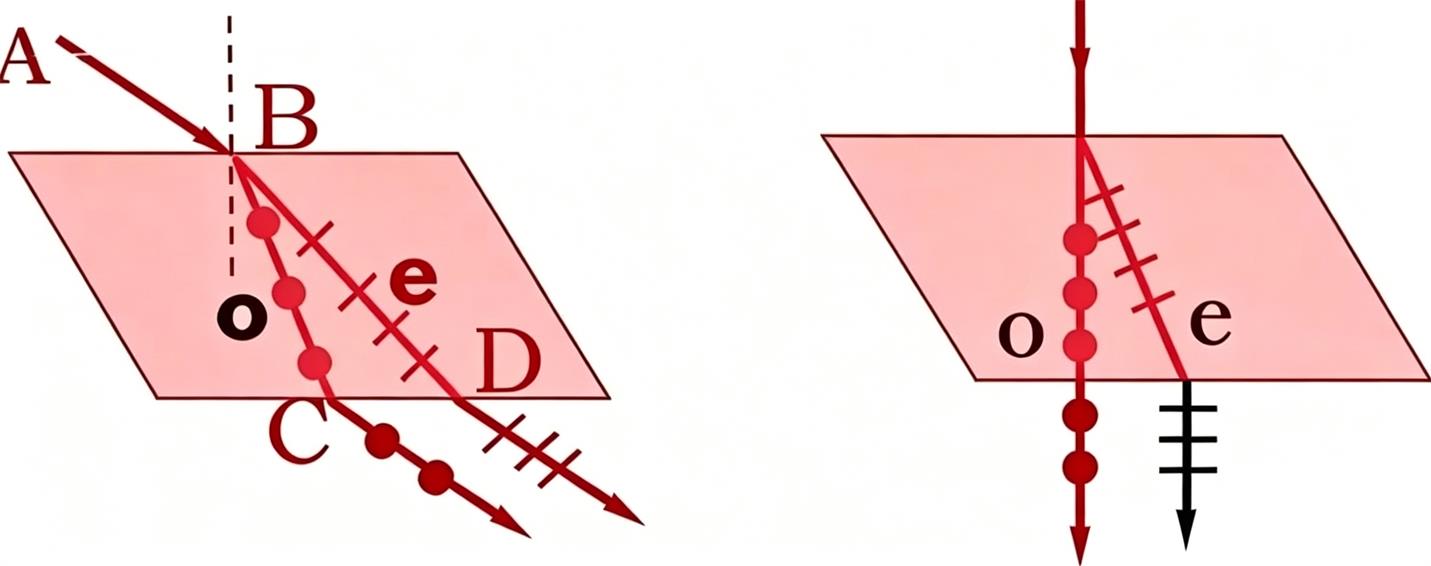
① o-Ray (ordinary ray)
Refractive index: Independent of the propagation direction (constant)
Propagation characteristics:
● Satisfies the conventional law of refraction
● The direction of the wave vector is consistent with the direction of energy propagation
② e-Ray (extraordinary ray)
Refractive index: Varies with the propagation direction
Propagation characteristics:
● Determined by anisotropy
● The direction of energy propagation (Poynting vector) is generally not completely consistent with the direction of the wave vector
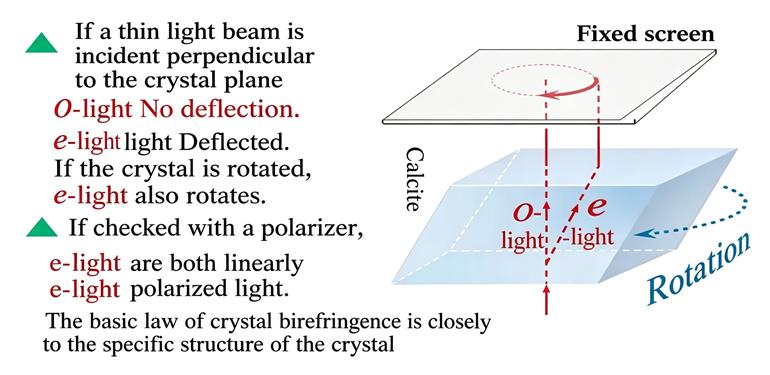
Core Characteristics:
● Only exist in anisotropic media (such as quartz, lithium niobate, YVO₄, etc.)
● Essential source: Dielectric constant is a tensor → the material responds differently to electric fields in different directions → birefringence occurs
Key Conclusion: o-Rays and e-Rays correspond to mutually orthogonal eigenpolarization states. When propagating along the optical axis: No birefringent separation occurs.

Unity of Physical Nature: Perspective from Maxwell's Equations
The two types of polarization can be unified into one sentence:
The polarization state is the eigenstate of Maxwell's equations under specific constraint conditions.

Two types of constraints correspond to two types of polarization:
|
Type
|
Source of Constraint
|
Nature
|
|---|---|---|
|
s/p Polarization
|
Electromagnetic boundary conditions (interface)
|
Boundary eigenstates
|
|
o/e Rays
|
Dielectric tensor (material)
|
Material eigenmodes
|
Nature of s/p Polarization
■ At the interface, the electromagnetic field must satisfy:
● Continuity of the tangential component of the electric field
● Continuity of the tangential component of the magnetic field
■ Under this constraint, the electromagnetic field is naturally decomposed into two decoupled modes:
● TE mode (corresponding to s-polarization)
● TM mode (corresponding to p-polarization)
s/p polarization is the result of eigen-decomposition determined by boundary conditions.
Nature of o/e Rays
■ In anisotropic media:
● The dielectric constant is a tensor
● The electric field must satisfy: D = ε · E
■ From this, a set of allowed propagating eigenpolarization states is obtained:
● o-Ray
● e-Ray
o/e Rays are the eigenpropagation modes determined by the material's dielectric tensor.
Unified Core Conclusion:
● s/p polarization: Determined by external boundary conditions;
● o/e Rays: Determined by internal material properties.
Why the s/p Polarization and o/e Rays Cannot Be Mixed
|
Comparison Dimension
|
s/p Polarization
|
o/e Rays
|
|---|---|---|
|
Intrinsic Property
|
No
|
Yes
|
|
Dependent Object
|
Incident plane (interface)
|
Optical axis (material)
|
|
Variation with Environment
|
Variable
|
Invariable
|
|
Physical Nature
|
Coordinate decomposition
|
Eigenpropagation mode
|
Summary in one sentence: s/p polarization is a "description method" of polarization, while o/e Rays are the "intrinsic existence form" of polarization.
Practical Significance in Coupling Scenarios Such as Optical Communication/Silicon Photonics/CPO
Interface Problems → Use s/p Polarization
● Silicon photonics grating coupling
● Chip end-face coupling
● Optical coating and reflection control
● FAU optical coupling
Focus: Coupling efficiency + Polarization Dependent Loss (PDL) + Reflection loss
Material/Device Problems → Use o/e Rays
● Lithium niobate modulators
● Polarizing Beam Splitters (PBS)
● Waveplates and polarization controllers
● Polarization-maintaining fibers
System-Level Problems (e.g., CPO / Optical Engine)
In practical systems, the following usually exist simultaneously:
● Interface effects (s/p polarization)
● Material anisotropy (o/e Rays)
● Waveguide mode evolution
The final polarization behavior is jointly determined by "boundary conditions + material properties".
Final Summary
Within the framework of electromagnetic theory: The polarization state is the eigenstate of Maxwell's equations under specific constraints.
● Interface constraints → s/p polarization
● Material constraints → o/e Rays
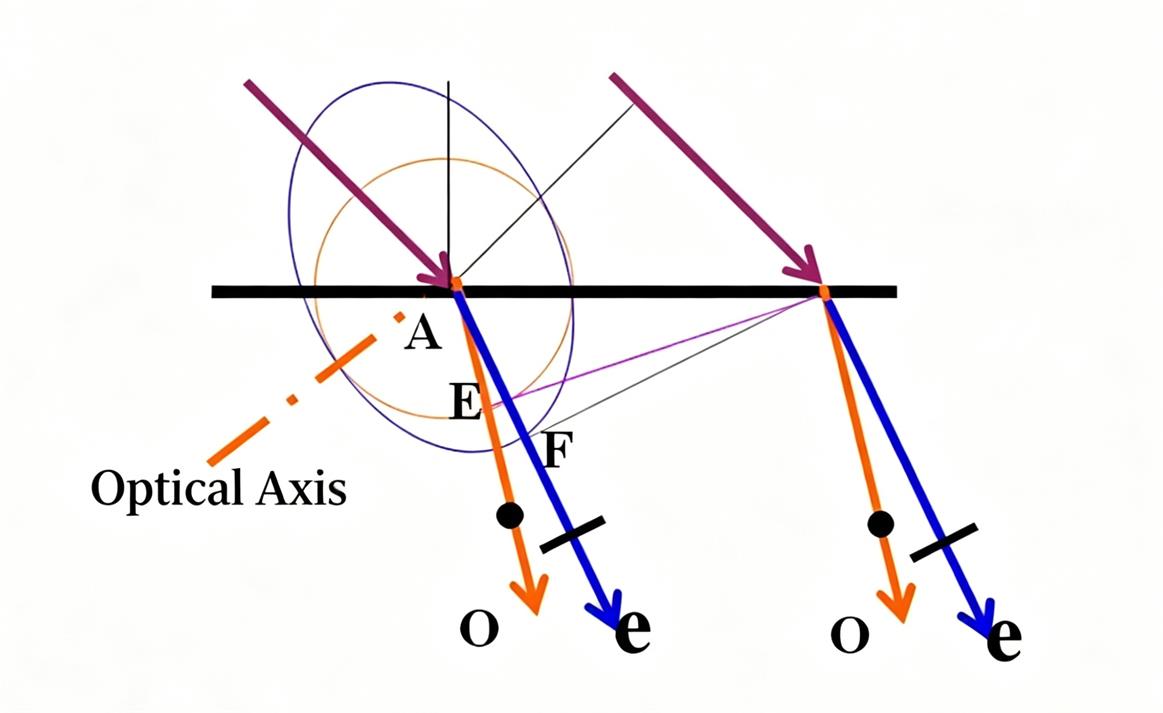
The two correspond to two different physical mechanisms: external boundaries and internal materials, belonging to different levels of description systems and cannot be directly mixed.
In one sentence: All polarization problems essentially boil down to one question: Under given constraints, in what directions can the electric field stably exist?
Posted on 6 May, 2026, by Francisco, Fibermart, All Copy Right Reserved.





No comments have been posted yet.