


.webp)


Driven by the rapid advancement of 5G/6G telecommunications, cloud computing, and artificial intelligence, global data traffic continues to grow exponentially. This trend imposes stringent requirements on the bandwidth, reliability, and operational flexibility of modern optical communication networks. As a core optical-layer switching component, optical switches directly route optical signals without electro-optical conversion, serving as a fundamental building block for All-Optical Networks (AON).
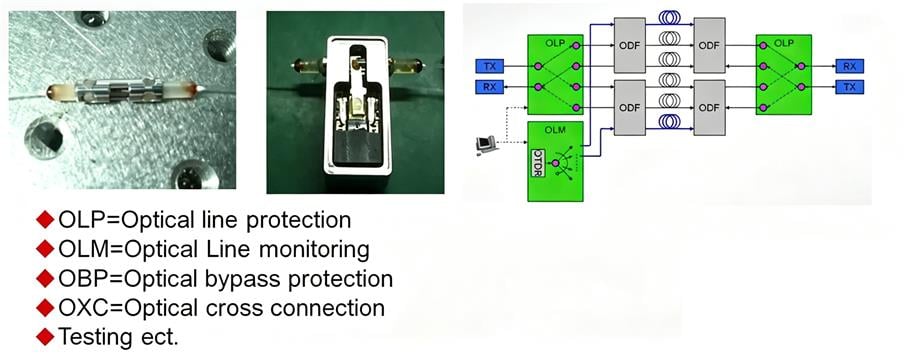
Among diverse optical switch technologies, the Mechanical Optical Switch (MOS) stands out as the most mature and commercially adopted solution. Compared with MEMS, liquid crystal, and thermo-optic switches, MOS delivers superior optical performance, cost-efficiency, and technological stability. It remains the preferred option for applications demanding low insertion loss and high isolation. Although MEMS optical switches have made significant progress in large-scale switching matrices, MOS still dominates the market for small-to-medium port configurations (≤16×16). This guide provides engineers with a systematic breakdown of MOS working principles, critical performance parameters, mainstream classifications, and field application practices.
Structure Parts of Mechanical Optical Switches
A mechanical optical switch is a passive optical component that reroutes optical signals by physically moving internal optical elements. Precisely controlled mechanical motion displaces mirrors, prisms, or optical fibers, enabling signal switching between different output ports.
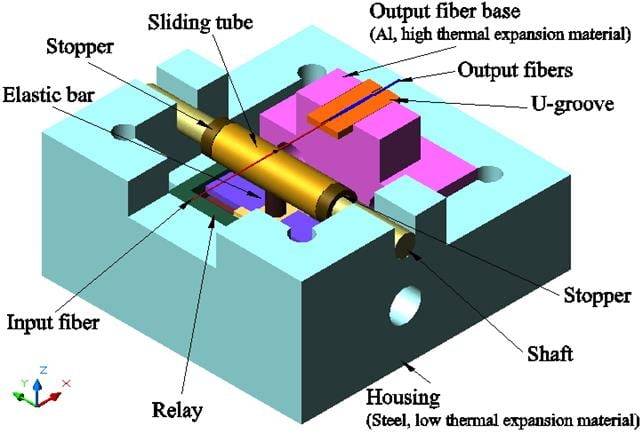
A standard MOS consists of four essential modules, all of which jointly determine its optical performance and environmental durability:
Collimator
The collimator is the primary optical element of a MOS. It converts divergent light emitted from optical fibers into collimated parallel beams, and couples incoming parallel light back into fiber cores. Composed of a GRIN lens and single-mode/multi-mode fiber with high-precision alignment, premium collimators minimize insertion loss and return loss, acting as a decisive factor for overall optical performance.
Relay Actuator
The relay converts electrical control signals into mechanical motion. MOS actuators fall into two categories: electromagnetic relays and stepping motors. Electromagnetic relays feature millisecond-level switching speed and a compact, cost-effective structure, ideal for general industrial scenarios. Stepping motors provide exceptional positioning accuracy, repeatability, and service life, suitable for high-precision and high-reliability operating conditions.
Functional Assembly
This assembly includes optical switching elements (mirrors, prisms, fiber clamps), transmission mechanisms, positioning structures, and limit components. These parts work in tandem to ensure accurate, stable displacement of optical elements for error-free signal routing.
Packaging Housing
The metal housing (typically aluminum alloy or stainless steel) provides mechanical protection and environmental isolation. Sealed packaging prevents contamination from dust and moisture. High-end MOS models are filled with inert nitrogen gas internally to enhance long-term operational stability and service life in harsh working environments.
Fundamental Working Principles of Mechanical Optical Switch
All mechanical optical switches reroute optical signals through physical beam deflection. Based on distinct optical switching mechanisms, MOS products are classified into three mainstream structural designs:
Fiber Displacement Type
This design switches optical paths by directly displacing input or output fibers. The driving mechanism aligns movable fibers with target ports to complete signal transmission. Featuring a simple structure and low manufacturing cost, fiber-displacement MOS has a relatively slow switching speed and is susceptible to mechanical vibration. It is primarily deployed in low-speed switching scenarios with non-stringent response requirements.
Optical Element Displacement Type
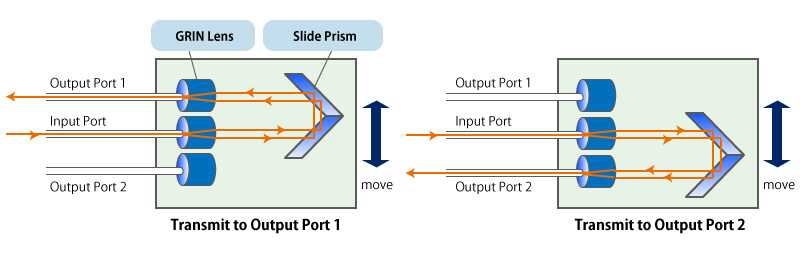
As the most widely adopted MOS architecture, this design fixes all input and output fibers while adjusting intermediate optical elements (mirrors or prisms) to change beam propagation directions. Taking a 1×2 MOS as an example: the input light transmits directly to the first output port when the mirror is raised; when the mirror drops, the light is reflected to the second port. This solution delivers fast switching, high positioning precision, and excellent optical performance, becoming the mainstream technical route for commercial MOS products.
Beam Deflection Type
Beam deflection MOS uses rotating prisms or mirrors to steer incident beams toward different output ports. It is highly applicable for multi-port configurations (1×N or N×N), achieving high port density within a compact footprint. For instance, a rotating pentagonal prism can sequentially direct input light to circumferentially arranged output ports, realizing 1×N multi-channel switching.
Key Performance Parameters & Industry Certification Standards of MOS
Performance parameters define MOS operating characteristics and determine its applicability in optical system integration. Engineers shall evaluate the following optical, mechanical, and environmental indicators during product selection and deployment:
Optical Parameters
● Insertion Loss (IL): The optical power loss incurred when signals pass through the switch, measured in dB. Lower loss is preferred, with a typical range of 0.3~1.0 dB. Losses mainly stem from collimator coupling, optical element absorption/reflection, and alignment deviations.
● Return Loss (RL): The absolute ratio of reflected optical power to incident power at fiber ports, measured in dB. Higher return loss indicates weaker signal reflection, with a standard specification of ≥50 dB, which protects lasers and adjacent optical components from reflected interference.
● Isolation: The optical power attenuation of undesired channels in the off state, measured in dB. A minimum isolation of 55 dB effectively suppresses crosstalk between independent signal channels.
● Crosstalk: Residual signal power transmitted to non-target ports, measured in dB. Industrial-grade MOS requires crosstalk ≤-55 dB to guarantee signal independence.
● Wavelength Dependent Loss (WDL): Insertion loss variation across the operating wavelength band, with a typical threshold ≤0.2 dB for consistent broadband performance.
● Polarization Dependent Loss (PDL): Insertion loss fluctuation caused by varying polarization states of incident light, controlled below 0.1 dB for high-precision optical systems.
Mechanical & Environmental Parameters
● Switching Time: The time required for the switch to complete a stable state transition, ranging from 5 to 20 ms. Although slower than MEMS switches, this response speed meets the requirements of most optical network protection and testing applications.
● Repeatability: Insertion loss deviation during repeated switching cycles, typically controlled within ±0.05 dB to ensure long-term operational stability.
● Service Lifetime: High-quality MOS supports over 10⁷ switching cycles, adapting to long-term uninterrupted industrial operation.
● Operating Temperature Range: Industrial-grade MOS operates stably from -40℃ to +85℃, tolerating extreme outdoor and industrial environmental conditions.
Industry Certification Standards
Commercial MOS products must comply with international standardized testing and certification specifications to ensure compatibility and reliability in global optical communication systems:
● Telcordia GR-1221-CORE: General reliability requirements for passive optical components
● Telcordia GR-1209-CORE: Mechanical and environmental test methods for passive optical components
● IEC 61300: Basic test and measurement procedures for optical fiber interconnection devices and passive components
● RoHS: Restriction of hazardous substances in electrical and electronic equipment
Mechanical Optical Switch (MOS) Type and Classifications
Based on port configuration and functional characteristics, mechanical optical switches are categorized into three series for differentiated industrial applications:
1×N Series MOS
As the most common product line, 1×N switches support one-way multi-channel signal selection:
● 1×2 MOS: The fundamental and highest-volume optical switch, widely deployed in 1+1 and 1:1 optical line protection systems. Annual global shipments exceed 10 million units, accounting for over 60% of the total MOS market share.
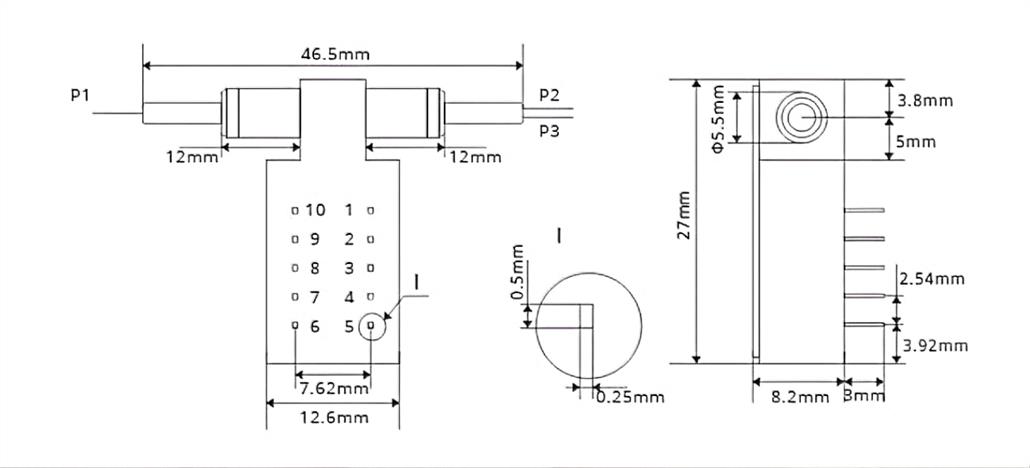
● 1×4 MOS: Applied in multi-channel optical testing and line monitoring systems. It enables a single OTDR device to monitor four optical fiber lines automatically.

● 1×8/1×16 MOS: Designed for high-channel-count scenarios, support cascading expansion. Most 1×16 models adopt stepping motor drives for high-precision switching, commonly used in fiber sensing networks to monitor hundreds of sensing nodes in a time-sharing manner.
2×2 Series MOS
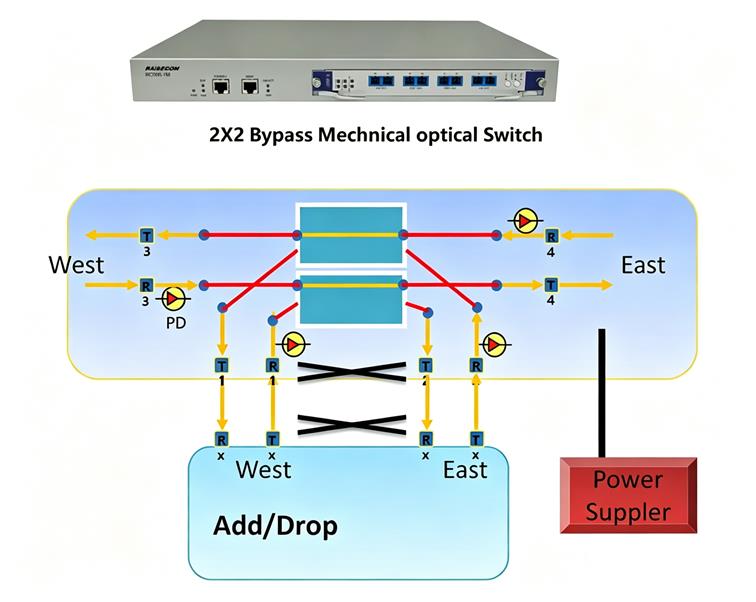
● 2×2 Bypass MOS: Primarily used for optical amplifier bypass protection. When an EDFA or Raman amplifier malfunctions, the bypass switch automatically isolates the faulty device from the optical link to avoid full-link interruption. This standard configuration improves system availability from 99.9% to 99.999%.
● 2×2 Full-Function MOS: Supports four switching states: straight-through, cross connection, full disconnection, and full pass-through. Its flexible switching logic facilitates flexible signal add/drop in optical add-drop multiplexing systems.
M×N Series MOS
● 2×4 MOS: Integrated with two independent 1×2 switches, optimized for bidirectional optical line protection systems.
● 4×4 MOS: Composed of two 2×2 switches, serving as the basic unit for small-scale optical cross-connection matrix construction to realize complex optical path allocation.
FiberMart Mechanical Optical Switch (MOS) Solutions
Fiber optical switch is one of the main factors to affect the optical performance of the network. It is the key device to realize optical networking network. Currently, Fiber-Mart produces four series of optical switches, including opto-mechanical fiber optical switch, MEMS optical switch, solid-state optical switch, PM Optical Switch.
FiberMart Mechanical Optical Switch type as 1xN, 2x2, MxN as well as customized switching types for single mode fibers, multi-mode fibers, non-latching and latching are available. And 1xN rackmount and benchtop optical switches are ideal for high-volume manufacturing production testing.
FiberMart Bestsellers:
● 1x2 Optical Switch Opto-Mechanical Mini BiDi Non-latching 5V:The 1x2 Opto-Mechanical Bi-directional Fiber Optical Switch redirects 1 input signal to 2 output fibers using opto-mechanical configuration and electrical control. Integrated position sensors and thin film filter technology ensure high reliability, stability, and low cost by simplifying the platform and reducing moving part sensitivity. Also known as 1x2 fiber latching switch, 1x2 latching switch, 1x2 opto-mechanical switch.
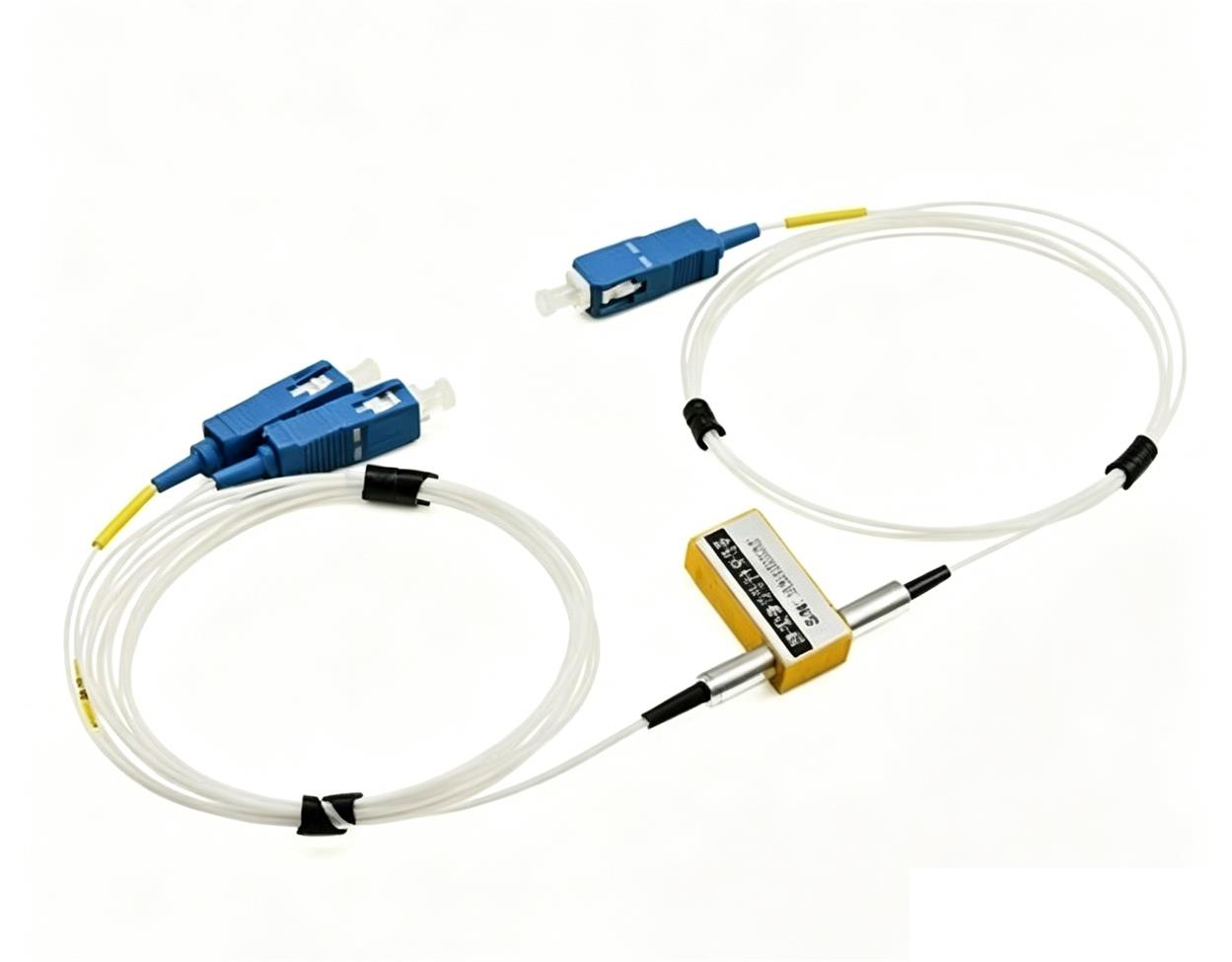
● Dual 1x2 Optical Switch Opto-Mechanical Bidi D1x2 Mini: The D1x2 Opto-Mechanical Bi-directional Fiber Optic Switch redirects 2 optical signals into 4 fibers using opto-mechanics, activated by an electrical signal. It features integrated position sensors and thin film filter technology for robust, reliable, and low-cost light path alteration with high stability.
● 1x32 PM Optical Switch PM1550nm 5V 900um 1m:The Polarization Maintaining Optical Switch (PM Fiber Optical Switches) is a passive component possessing two or more ports that selectively transmits, redirects or blocks optical signals from a given input port to a given output port in an optical fiber transmission line. Fibermart’s polarization maintaining (PM) fiber switches are fabricated from PM panda fibers and high-quality connectors that are compatible with industry standards. They are able to maintain a well-defined state of polarization (SOP) of the light.
Typical Applications of Mechanical Optical Switch
Benefiting from low insertion loss, high isolation, and outstanding reliability, MOS is extensively deployed in optical communication infrastructure, testing equipment, and optical networking systems. The mainstream application scenarios are summarized as follows:
Optical Bypass Protection (OBP)
OBP is one of the core MOS applications. When key link devices (optical amplifiers, OADM nodes) fail, MOS automatically bypasses the faulty unit to maintain continuous optical signal transmission. It has become a standard configuration for backbone and metropolitan optical networks to enhance system operational stability.
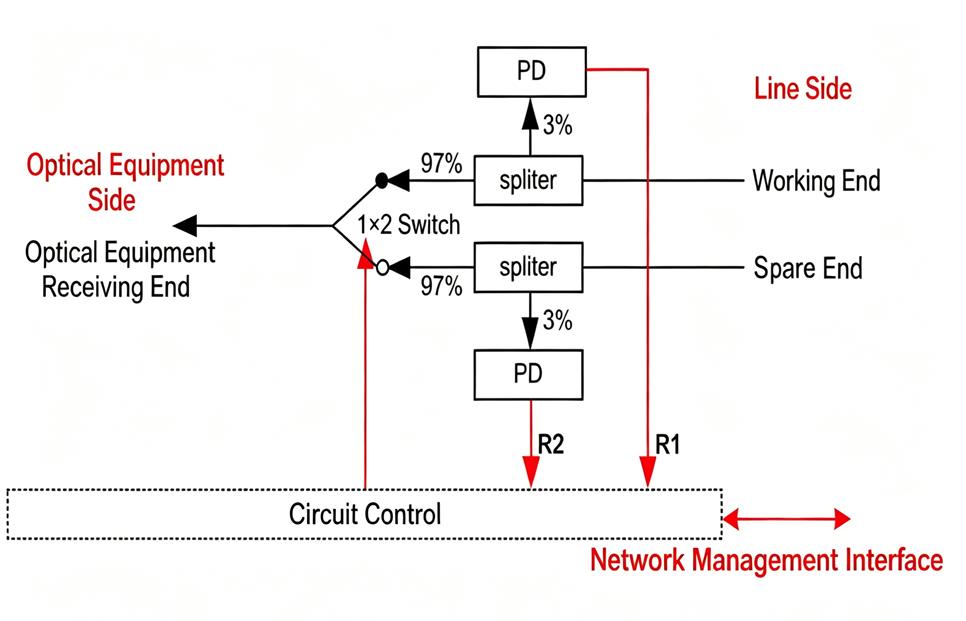
Optical Line Protection (OLP)
OLP systems utilize MOS to realize automatic switching between primary and backup fiber links. In the event of fiber fracture or signal degradation on the primary line, the system completes link switching within milliseconds to achieve non-interruptible communication services. This solution is widely adopted by telecom operators for backbone, metropolitan, and access network deployment.
Optical Line Monitoring (OLM)
MOS connects multiple fiber lines to an OTDR device to implement automated line monitoring. The system quickly locates fault points and triggers alarm notifications in case of line abnormalities, significantly reducing manual maintenance costs and improving fiber network operation efficiency.
Optical Communication Test Systems
In component production and system verification, MOS constructs automated multi-channel test platforms. It enables a single testing instrument to evaluate multiple devices and parameters sequentially, effectively improving testing throughput and lowering production and R&D costs.
Optical Cross-Connection (OXC)
OXC is the core hardware of all-optical networks for dynamic signal routing across fibers and wavelengths. For small-to-medium scale OXC systems, MOS matrices are the optimal solution with low loss, high isolation, and cost advantages, fully meeting the deployment demands of metropolitan and regional networks.
Optical Add-Drop Multiplexer (OADM)
Reconfigurable Optical Add-Drop Multiplexers (ROADM) rely on MOS to dynamically configure wavelength channels. The switch realizes selective uploading and downloading of specific wavelength signals without interfering with other channels, enhancing network flexibility and scalability.

Summary
As a mature and reliable optical-layer switching technology, mechanical optical switches have long served as a critical component of modern optical communication networks. Despite the competitive pressure from MEMS and emerging optical switch technologies, MOS maintains an irreplaceable market position in small-to-medium port applications by virtue of superior optical performance, mature manufacturing processes, and favorable cost control.
Moving forward, MOS will evolve toward higher integration, lower insertion loss, faster switching response, and longer service life. Hybrid switching architectures combining MOS and MEMS will become a key development trend, balancing high performance and economic cost to adapt to diversified networking requirements.
For optical communication engineers, a thorough understanding of MOS working mechanisms, performance parameters, and application boundaries is essential for designing and maintaining high-performance optical transmission systems. This guide aims to provide practical technical references for global engineering teams to support standardized and optimized MOS deployment in optical network infrastructure.
Frequently Asked Questions (FAQs)
Q1: What defines a mechanical optical switch (MOS), and what is its working principle?
MOS is a passive optical component that realizes optical signal path switching through physical displacement of internal optical parts such as mirrors and optical fibers. It completes beam routing without electro-optical conversion, mainly relying on mechanical motion to change the propagation direction of optical beams.
Q2: What are the advantages of MOS compared with MEMS and other optical switches?
MOS features lower insertion loss, higher isolation and superior signal transmission performance. It has mature manufacturing technology, stable quality and lower comprehensive cost. It is the optimal choice for small and medium port configurations (≤16×16), while it is less competitive in large-scale switching matrix scenarios.
Q3: Which key performance parameters matter most for MOS selection?
Engineers should prioritize optical indicators including insertion loss, return loss and isolation, as well as mechanical and environmental parameters such as switching time, repeatability, service life and operating temperature. These parameters directly determine the stability and compatibility of MOS in optical systems.
Q4: What are the mainstream MOS port types and their applicable scenarios?
There are three mainstream types. 1×N switches are for multi-channel signal selection and line monitoring; 2×2 switches are mostly used for equipment bypass protection and optical signal scheduling; M×N switches serve as the basic unit for building small-scale optical cross-connection matrices.
Q5: What are the typical industrial applications of MOS?
MOS is widely used in optical communication infrastructure. The main scenarios include optical line protection, equipment bypass protection, automatic fiber line monitoring, optical communication testing systems, as well as wavelength signal scheduling of R-OADM and small-scale optical cross-connection systems.
Q6: What optical wavelengths can mechanical optical switches support?
Commercial MOS covers standardized and classified optical wavelength bands to meet diverse application demands, with three mainstream spectral ranges: 460~780 nm for visible light scenarios, 850~1310 nm for short-distance multimode and intermediate transmission links, and 1260~1660 nm for mainstream long-haul telecom wavebands.
Posted on 11 May, 2026, by Francisco, Fibermart, All Copy Right Reserved.





No comments have been posted yet.