


.webp)


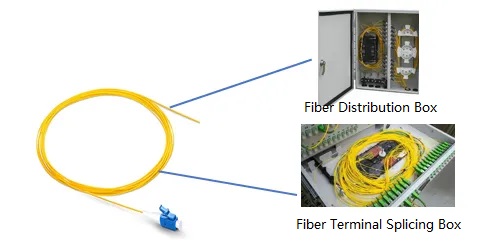
Fiber pigtail is a fiber optic cable with a connector on one end and the other end exposed. Fiber pigtails are usually used for field termination, which requires the use of a fusion splicer. Compared with the quick termination and polishing connection installed on site, pre-terminated fiber pigtails with connectors not only save time, but also provide higher performance and reliability .
What is Fiber Pigtail?
A fiber pigtail is a short, usually tight-buffered, fiber optic cable with a factory-installed connector on one end and unterminated fiber on the other end. The connector side can therefore be connected to the equipment while the other end is either fusion spliced in the case of fusion splicing or mechanically spliced in the case of mechanical splicing. Fiber pigtails are used to connect fiber optic cables by either fusion splicing or mechanical splicing. High-quality pigtails combined with appropriate fusion splicing techniques provide the best performance for fiber optic cable termination. Fiber pigtails are commonly found in fiber management equipment such as ODFs (optical distribution frames), fiber optic terminal boxes, and patch panels.
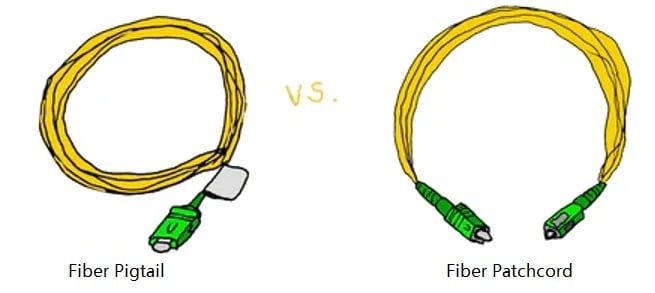
What is the difference between fiber pigtails and fiber patch cords?
Only one end of the fiber pigtail is inserted into the fiber connector, and the other end is empty. Fiber patch cords are connected to fiber connectors at both ends. Patch cord fibers are usually jacketed; however, fiber pigtails are usually not jacketed because they are fused and protected in the fiber splice closure. In addition, the patch cord fiber can be split into two sections to form two pigtails. Some installers prefer to do this to avoid the trouble of testing the pigtails on site - they can simply test the performance of the fiber patch cord and then cut it into two sections to form two fiber pigtails.
Types of Fiber Optic Pigtails
1. According to the fiber types
Fiber pigtails are divided into multimode fiber and single-mode fiber. Multimode pigtails are made of 62.5/125μm or 50/125μm bulk multimode fiber and terminated with a multimode connector. In more detail, they can be divided into OM1, OM2, OM3, OM4 and OM5 pigtails. Single-mode pigtails are made of 9/125μm OS1 or OS2 bulk single-mode fiber cables and terminated with single-mode connectors.
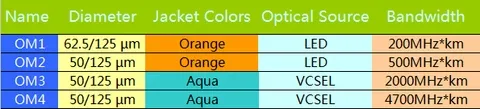
List of multimode fiber types
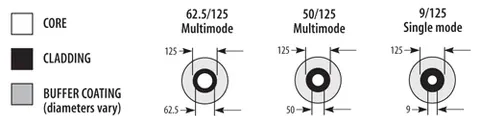
Fiber Core Cladding Buffer Size List
Generally speaking, 99% of single-mode applications use pigtails, but many multi-mode applications also use pigtails.
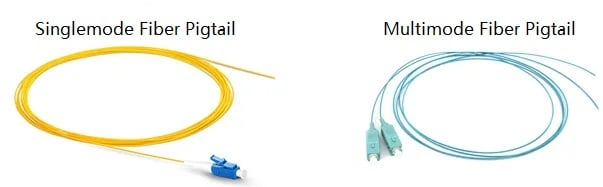
2. According to the type of fiber connectors
There are many types of fiber pigtail connectors, such as LC pigtail, SC connector pigtail, ST pigtail, FC pigtail, MT-RJ pigtail, E2000 pigtail, etc. The pigtail interface can be divided into three types: FC, SC, and LC. The two ends are: FC-FC, SC-SC, LC-LC, FC-SC, FC-LC, and SC-LC, a total of six types of fiber optic patch cords.
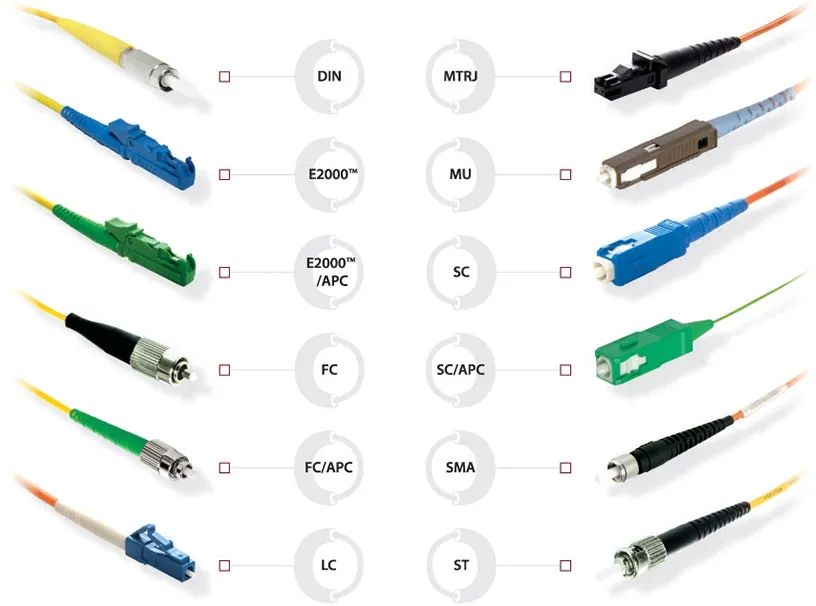
3. According to the connector endface polishing type
it can be divided into PC, UPC, and APC fiber pigtails.
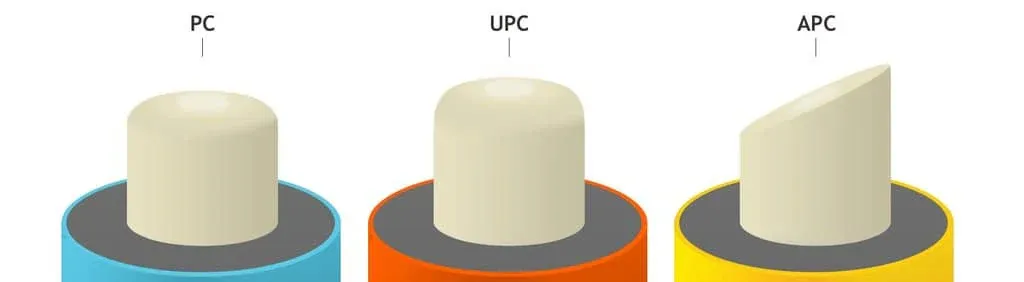
PC Fiber Pigtails
PC is the abbreviation of "physical contact" connector. PC fiber pigtails are made with physical contact polished connectors. Most multimode pigtails use PC polished connectors and are widely used in telecommunications and data systems.
UPC Fiber Optic Pigtails
UPC stands for "Ultra Physical Contact." Unlike PC fiber pigtails, these pigtails are made with UPC connectors, which improve physical contact, resulting in fewer air gaps and further reduced optical loss (ORL). It is the most common type of polish found in singlemode and multimode pigtails.
APC Fiber Optic Pigtails
APC stands for "Angled Physical Contact". It is designed to further reduce back reflections. The ferrule end faces of these connectors are polished at an 8 degree angle. APC fiber pigtails are commonly used in CATV, FTTx and other WDM systems.
4. According to the application scenario type classification
According to the different application environments, the fiber optic pigtails are divided into ordinary indoor pigtails, armored pigtails, and waterproof pigtails. The most common type of conventional indoor pigtail is the conventional indoor pigtail, which has no additional protection and is a bare fiber. It has the lowest cost, a smaller bending radius, and is easy to route. As the name implies, these pigtails are only suitable for indoor use and are not suitable for harsh environments. Armored pigtails The armored pigtails are equipped with a stainless steel tube in the shell to prevent damage caused by rats, construction activities, and the weight of other cables. The waterproof fiber optic pigtail uses a sturdy fiber optic connector and is equipped with a stainless steel reinforced waterproof device and an armored outdoor PE sheath. Therefore, it protects the optical cable from twisting, squeezing, or rat bite damage. Waterproof fiber optic pigtails are suitable for harsh outdoor environments, such as communication towers, military applications, etc.
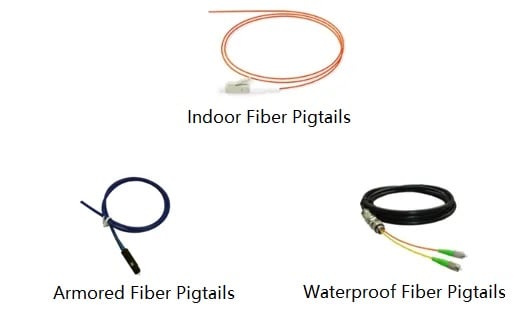
5. Classified by the number of optical fibers
The most common fiber pigtail has one optical fiber, for example, a simplex LC connector pigtail consists of one bare optical fiber and a terminated LC connector.
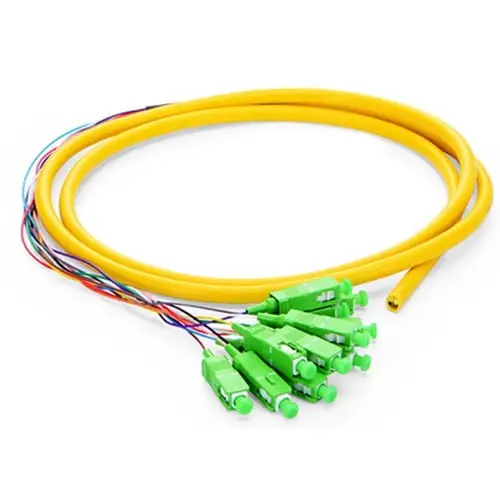
However, in some cases, the fiber counts are available as 2, 4, 6, 8, 12, 24, 48 and 72. The 12 Fiber Pigtail is the most popular in Fiber Optic networks. Each fiber pigtail should be color coded according to the industry standard TIA-EIA-598-A.
6. By fiber construction According to the fiber optic cable structure
we can classify them into multi-fiber bundle pigtails, multi-fiber Robin pigtails, 0.9mm pigtails and 2.0/3.0mm pigtails.
Fiber Pigtail Color Code
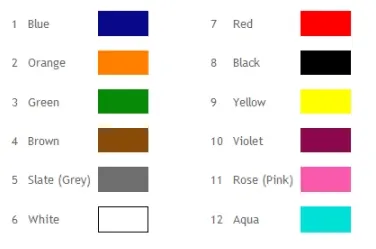
The fiber optic industry standard TIA-EIA-598-A defines color coding to identify individual fibers within a single fiber optic cable tube. Fiber optic pigtails follow the industry standard TIA-EIA_598-A color coding scheme to identify themselves. Here are the colors and positions they represent.
Benefits of Using Fiber Pigtails
There are many benefits to using fiber pigtails, including:
Easy to Install: The pigtails are easy to install and can be used to quickly and easily connect devices.
Versatility: Pigtails are available in a variety of connector types and lengths for a wide range of applications.
Durability: The pigtail is made of high-quality materials to withstand harsh environments.
Cost-effectiveness: Fiber pigtails are a cost-effective way to connect devices and extend network coverage.
Final Words
If you are looking for high-quality fiber optic pigtails, Fibermart is your best choice. We offer comprehensive fiber optic pigtail customization services, including fiber types, connectors, lengths, and packaging options to meet your specific needs. Whether it's 9/125 single-mode fiber, 62.5/125 multi-mode fiber, or 100G OM3, OM4, OM5 types, Fibermart can provide high-quality solutions. Additionally, we offer simplex, duplex, and multi-fiber pigtails in various specifications, fully compliant with Telcordia, EIA/TIA, and IEC standards.
At Fibermart, you can easily find the fiber optic pigtail products you need, such as SC pigtails, LC pigtails, 12 Fibers Pigtail and more. Our fiber pigtails are not only diverse but also reliable, providing excellent performance and stability for your communication network. Visit our website now to purchase your desired fiber optic pigtail products and experience our professional service and high-quality products. Fibermart, making your communication network more efficient and reliable!
Related Hot topics:
- What is Fiber Splitter? FBT Coupler vs PLC Splitter
- Fiber Optic Connector Types
- What is Optical Circulator? How it works?
- What is Optical Switch? Types of Optical Switches
- What is Polarization Maintaining Fiber?
- What is Optical Amplifier? Types of Optical Amplifiers
- What is CWDM and DWDM?
- OADM (Optical Add-Drop Multiplexer) Tutorial





No comments have been posted yet.